

Andere Kunden interessierten sich auch für
 Nonlinear Elliptic and Parabolic Problems115,99 €
 Analysis III77,99 €
 Introduction to Calculus and Analysis II/243,99 €
 Modern Methods in the Calculus of Variations38,99 €
 Analysis I53,99 €
 Partial Differential Equations and Boundary Value Problems76,99 €
 Mathematical Analysis II66,99 €
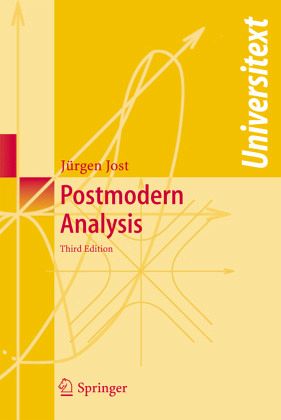
This is an introduction to advanced analysis at the beginning graduate level that blends a modern presentation with concrete examples and applications, in particular in the areas of calculus of variations and partial differential equations. The book does not strive for abstraction for its own sake, but tries rather to impart a working knowledge of the key methods of contemporary analysis, in particular those that are also relevant for application in physics. It provides a streamlined and quick introduction to the fundamental concepts of Banach space and Lebesgue integration theory and the basic notions of the calculus of variations, including Sobolev space theory. The third edition contains new material on further important tool in analysis, namely cover theorems. Useful references for such results and further properties of various classes of weakly differential functions are added. And finally, misprints and minor inconsistencies have been corrected.
What is the title of this book intended to signify, what connotations is the adjective "Postmodern" meant to carry? A potential reader will surely pose this question. To answer it, I should describe what distinguishes the - proach to analysis presented here from what has by its protagonists been called "Modern Analysis". "Modern Analysis" as represented in the works of the Bourbaki group or in the textbooks by Jean Dieudonn´ e is characterized by its systematic and axiomatic treatment and by its drive towards a high level of abstraction. Given the tendency of many prior treatises on analysis to degenerate into a collection of rather unconnected tricks to solve special problems, this de?nitely represented a healthy achievement. In any case, for the development of a consistent and powerful mathematical theory, it seems to be necessary to concentrate solely on the internal problems and structures and to neglect the relations to other ?elds of scienti?c, even of mathematical study for a certain while. Almost complete isolation may be required to reach the level of intellectual elegance and perfection that only a good mathem- ical theory can acquire. However, once this level has been reached, it can be useful to open one's eyes again to the inspiration coming from concrete external problems.
What is the title of this book intended to signify, what connotations is the adjective "Postmodern" meant to carry? A potential reader will surely pose this question. To answer it, I should describe what distinguishes the - proach to analysis presented here from what has by its protagonists been called "Modern Analysis". "Modern Analysis" as represented in the works of the Bourbaki group or in the textbooks by Jean Dieudonn´ e is characterized by its systematic and axiomatic treatment and by its drive towards a high level of abstraction. Given the tendency of many prior treatises on analysis to degenerate into a collection of rather unconnected tricks to solve special problems, this de?nitely represented a healthy achievement. In any case, for the development of a consistent and powerful mathematical theory, it seems to be necessary to concentrate solely on the internal problems and structures and to neglect the relations to other ?elds of scienti?c, even of mathematical study for a certain while. Almost complete isolation may be required to reach the level of intellectual elegance and perfection that only a good mathem- ical theory can acquire. However, once this level has been reached, it can be useful to open one's eyes again to the inspiration coming from concrete external problems.