
Andere Kunden interessierten sich auch für
 Democracy in the Political Present30,99 €
 Henri Lefebvre and the Theory of the Production of Space20,99 €
 Crisis as Form33,99 €
 The Limit of the Useful26,99 €
 Foucault with Marx26,99 €
 Louis Althusser21,99 €
 Everything and Less28,99 €






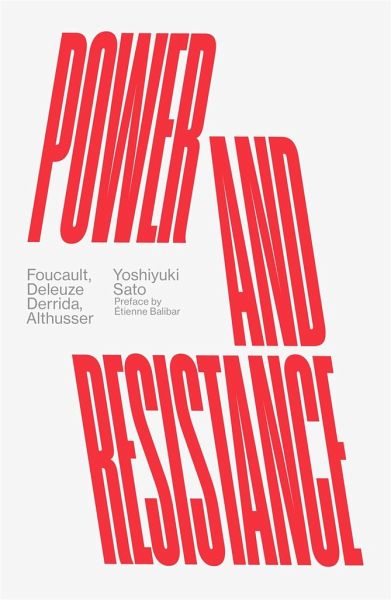
Conceptually dense and philosophically masterful, Yoshiyuki Sato's Power and Resistance ranges widely across the work of Foucault, Deleuze, Derrida, and Althusser (with Lacan as the 'silent partner' of the text), in pursuit of how the structuralist (non)dialectic of power and resistance comes to be underpinned by this aporetic subject that must be both the product of the social structure, yet also that which furnishes the force of resistance to its reproduction, demonstrating precisely that the "thought of the subject" is nothing other than a theory of how the 'outside' relates to the interiority of the structure. Refusing the now-widespread reception of post-68 French thought as having 'done away with' the category of the subject, Sato shows ably and with real mastery of the literature, why we must instead consider these thinkers to be precisely 'theoreticians of the subject'. In our current conceptual conjuncture, this important book has reemerged in English after its French and Japanese editions to provide the thought of a transformation beyond that dialectic of subjection and resistance which merely reinforces the social closure, giving proof positive for the politicality and living force of this set of figures so crucial to twentieth century thought. Gavin Walker