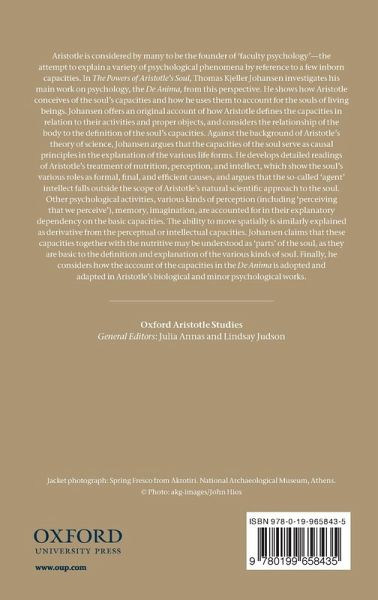
Aristotle is considered by many to be the founder of 'faculty psychology'--the attempt to explain a variety of psychological phenomena by reference to a few inborn capacities. In The Powers of Aristotle's Soul, Thomas Kjeller Johansen investigates his main work on psychology, the De Anima, from this perspective. He shows how Aristotle conceives of the soul's capacities and how he uses them to account for the souls of living beings. Johansen offers an original account of how Aristotle defines the capacities in relation to their activities and proper objects, and considers the relationship of…mehr
Aristotle is considered by many to be the founder of 'faculty psychology'--the attempt to explain a variety of psychological phenomena by reference to a few inborn capacities. In The Powers of Aristotle's Soul, Thomas Kjeller Johansen investigates his main work on psychology, the De Anima, from this perspective. He shows how Aristotle conceives of the soul's capacities and how he uses them to account for the souls of living beings. Johansen offers an original account of how Aristotle defines the capacities in relation to their activities and proper objects, and considers the relationship of the body to the definition of the soul's capacities. Against the background of Aristotle's theory of science, Johansen argues that the capacities of the soul serve as causal principles in the explanation of the various life forms. He develops detailed readings of Aristotle's treatment of nutrition, perception, and intellect, which show the soul's various roles as formal, final and efficient causes, and argues that the so-called 'agent' intellect falls outside the scope of Aristotle's natural scientific approach to the soul. Other psychological activities, various kinds of perception (including 'perceiving that we perceive'), memory, imagination, are accounted for in their explanatory dependency on the basic capacities. The ability to move spatially is similarly explained as derivative from the perceptual or intellectual capacities. Johansen claims that these capacities together with the nutritive may be understood as 'parts' of the soul, as they are basic to the definition and explanation of the various kinds of soul. Finally, he considers how the account of the capacities in the De Anima is adopted and adapted in Aristotle's biological and minor psychological works.
Thomas Kjeller Johansen studied Philosophy and Classics at Cambridge, before taking up lectureships at Bristol, Edinburgh and Oxford. He has held a British Academy Research Readership, a membership at the Institute for Advanced Study, Princeton, and a fellowship the Center for Hellenic Studies, Washington DC. He is the author of Plato's Natural Philosophy (CUP, 2004), Aristotle on the Sense-Organs (CUP, 1998), and the translator of Plato, Timaeus and Critias (Penguin Classics, 2008).
Inhaltsangabe
Acknowledgements Abbreviations Introduction 1: Circumscribing the soul 2: Towards a scientific definition of the soul 3: Parts and unity in the definition of the soul 4: The definition of dunamis 5: The priority of the objects over the capacities of the soul 6: The importance of nutrition 7: The soul as an efficient cause 8: The matter of the soul's activities 9: The perceptual capacity extended 10: Phantasia 11: The intellect and the limits of naturalism 12: The locomotive capacity 13: The descent from definition: The capacities of the soul applied 14: The capacities in the Parts and lives of animals
Acknowledgements Abbreviations Introduction 1: Circumscribing the soul 2: Towards a scientific definition of the soul 3: Parts and unity in the definition of the soul 4: The definition of dunamis 5: The priority of the objects over the capacities of the soul 6: The importance of nutrition 7: The soul as an efficient cause 8: The matter of the soul's activities 9: The perceptual capacity extended 10: Phantasia 11: The intellect and the limits of naturalism 12: The locomotive capacity 13: The descent from definition: The capacities of the soul applied 14: The capacities in the Parts and lives of animals
Es gelten unsere Allgemeinen Geschäftsbedingungen: www.buecher.de/agb
Impressum
www.buecher.de ist ein Internetauftritt der buecher.de internetstores GmbH
Geschäftsführung: Monica Sawhney | Roland Kölbl | Günter Hilger
Sitz der Gesellschaft: Batheyer Straße 115 - 117, 58099 Hagen
Postanschrift: Bürgermeister-Wegele-Str. 12, 86167 Augsburg
Amtsgericht Hagen HRB 13257
Steuernummer: 321/5800/1497
USt-IdNr: DE450055826