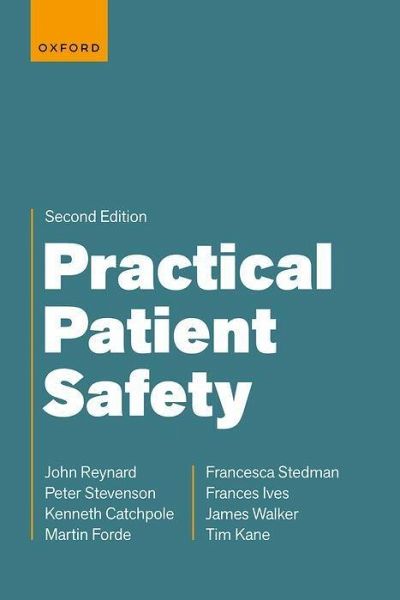
Despite sustained efforts to improve patient safety, preventable harm remains a persistent challenge in healthcare. Panagioti's 2019 meta-analytic indicate a 6% prevalence of avoidable patient harm, with 12% of these events resulting in severe outcomes or mortality. Progress in general has been limited, and a paradigm shift is needed. This second edition of Practical Patient Safety shows frontline doctors, nurses, and other healthcare professionals how techniques developed and used by staff in High Reliability Organisations, such as the railway and aviation industries. It builds on the…mehr
Despite sustained efforts to improve patient safety, preventable harm remains a persistent challenge in healthcare. Panagioti's 2019 meta-analytic indicate a 6% prevalence of avoidable patient harm, with 12% of these events resulting in severe outcomes or mortality. Progress in general has been limited, and a paradigm shift is needed. This second edition of Practical Patient Safety shows frontline doctors, nurses, and other healthcare professionals how techniques developed and used by staff in High Reliability Organisations, such as the railway and aviation industries. It builds on the foundational aim of its predecessor, which is to equip individual healthcare professionals with practical, evidence-based techniques for error prevention in routine clinical settings. Drawing on insights from high-reliability industries such as aviation and rail, the book explores how small, intentional changes in communication, crisis management, and workplace civility can disrupt error chains and enhance safety. With a focus on actionable strategies as structured readback, precise language use, and simulation-based preparation, this title provides a basic advice for the individual health care worker on error prevention in their day-to-day practice.
John Reynard is a consultant urological surgeon and Honorary Senior Lecturer in the Nuffield Department of Surgical Sciences at the University of Oxford. He is an honorary consultant urologist to The National Spinal Injuries Centre at Stoke Mandeville Hospital. He holds a Masters degree in Medical Law and Ethics. He has been actively engaged for many years in training doctors and medical students in techniques that can be used to prevent and mitigate the effects of error in healthcare. He is a co-author of 'Practical Patient Safety', published by Oxford University Press, which demonstrates how principles of safety derived from high reliability organisations such as the aviation and petrochemical industries can be applied in surgical and medical practice, in particular through training for health care professionals. Peter Stevenson has been an Airline Pilot and Human Factors Instructor for over 30 years, starting one of the first Human Factors courses in the UK. He flies Airbus A330 airliners on intercontinental routes for a major UK airline. Since 1999 he has designed and presented Human Factors / Patient Safety courses in 5 NHS Trusts. For the last 14 years he has lectured 4th year medical students at the University of Oxford. He has chaired a committee to recommend measures to respond to a fatal adverse event which occurred during surgery on a child. He had also advised other NHS Trusts after adverse events. He joint-authored a book entitled 'Practical Patient Safety' published by Oxford University Press. Kenneth Catchpole is a Human Factors Engineer who has spent the last 23 years studying and improving safety in acute care. Locally, he applies human factors expertise in accident analysis and quality improvement across the clinical enterprise, while also leading research that includes sterile processing, retained foreign objects, diagnostic excellence, anesthesia medication delivery, robotic surgery, congenital heart surgery and neonatal resuscitation. Through over 160 peer-reviewed publications, public speaking, and the media, he has engaged thousands of people in the improvement of healthcare from a human-centered perspective, while working to embed human factors practice in everyday care. Martin Forde attended Langley Grammar School in Berkshire, obtaining 11 'O' levels and 3 'A' levels. He was offered a place at Brasenose College Oxford, graduating in 1982 with a 2:1 degree in Jurisprudence. He completed Bar exams in 1983, pupillage in 1984 practising at 1 Crown Office Row. He now pecialises in all aspects of Health Law including the regulation of the Health profession and Clinical Negligence. Francesca Stedman is a consultant paediatric surgeon at Southampton Children's Hospital. She specialises in colorectal pathology, as well as non-technical skills and education. She enjoys her frequent surgical on-calls, as every day is different, and she is well known for her midnight laparotomies. Francesca runs the simulation-based surgical skills training within the department, is the Wessex School of Surgery lead for Human Factors, and is committed to the department's well-being, mainly by providing baked goods for meetings. In her free time, Francesca enjoys cycling, running and baking, as well as camping with her young family. Fran Ives is a Chartered Human Factors Specialist and Fellow of the Chartered Institute of Ergonomics and Human Factors. She began her career in the automotive and nuclear industries before moving into healthcare in 2004, where she has led national programmes to embed Human Factors into patient safety and implementation science. Fran has supported the development of chartered Human Factors professionals in healthcare and has held leadership roles within the Chartered Institute of Ergonomics and Human Factors. Her academic interests focus on translating Human Factors principles into practical, system level improvements across complex healthcare environments to support safer, more effective care delivery. James Walker is Professor Emeritus of Obstetrics and Gynaecology at the University of Leeds, specialising in high-risk obstetrics and maternity safety. He has significantly contributed to improving patient care through his work with families, the development of best practice guidelines, and the analysis of adverse outcomes. He has served as an advisor to the National Patient Safety Agency and the Care Quality Commission and was a member of the Morecambe Bay Inquiry. As founding Clinical Director of the maternity investigation program at the Healthcare Safety Investigation Branch, he played a key role in shaping investigations into clinical practice. Tim Kane qualified from St Bartholomew's Hospital. He undertook registrar training in the Wessex region and specialist fellowship at the Royal Adelaide Hospital. He has been a consultant since 2009 with a trauma and arthroplasty practice in a busy district general hospital. His interest in patient safety and how it can be influenced stems from experience in governance. This has been focused with learning from experts within High Reliability Organisations and mentoring from Peter and John. He strives to apply human factors principles in everyday clinical practice. He has mentored trainee doctors undertaking safety projects which have been presented at the IHI/BMJ quality improvement and patient safety conference. He is a member of the Chartered Institute of Ergonomics and Human Factors and has recently joined the faculty for the Non-Technical Skills for Surgeons (NOTSS) course.
Inhaltsangabe
* 1.: Clinical error: The scale of the problem, what is safety and, approaches to error analysis * 2.: Safety management * 3.: The healthcare safety investigation branch - what we did and what we learnt * 4.: Learning from accidents: storytelling * 5.: Human systems integration in robotic assisted surgery * 6.: Non-technical skills * 7.: Safety critical communication * 8.: Clinical crisis management and preparedness * 9.: Professional culture * 10.: Human factors training and simulation * 11.: A clinician's personal patient safety toolbox * 12.: A clinical lead's departmental safety management plan * 13.: The criminalisation of unintentional error * 14.: Ergonomic principles in the human-machine interface
* 1.: Clinical error: The scale of the problem, what is safety and, approaches to error analysis * 2.: Safety management * 3.: The healthcare safety investigation branch - what we did and what we learnt * 4.: Learning from accidents: storytelling * 5.: Human systems integration in robotic assisted surgery * 6.: Non-technical skills * 7.: Safety critical communication * 8.: Clinical crisis management and preparedness * 9.: Professional culture * 10.: Human factors training and simulation * 11.: A clinician's personal patient safety toolbox * 12.: A clinical lead's departmental safety management plan * 13.: The criminalisation of unintentional error * 14.: Ergonomic principles in the human-machine interface
Es gelten unsere Allgemeinen Geschäftsbedingungen: www.buecher.de/agb
Impressum
www.buecher.de ist ein Internetauftritt der buecher.de internetstores GmbH
Geschäftsführung: Monica Sawhney | Roland Kölbl | Günter Hilger
Sitz der Gesellschaft: Batheyer Straße 115 - 117, 58099 Hagen
Postanschrift: Bürgermeister-Wegele-Str. 12, 86167 Augsburg
Amtsgericht Hagen HRB 13257
Steuernummer: 321/5800/1497
USt-IdNr: DE450055826