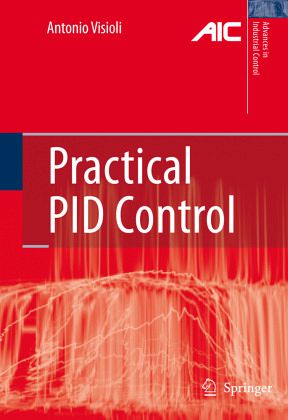
Proportional-integral-derivative (PID) controllers are the most adopted controllers in industrial settings. The availability of microprocessors and software tools and increasing demand for higher product quality at reduced cost have stimulated research to devise new methodologies to improve their performance and ease of use. "Practical PID Control" focuses on those functionalities that can provide significant improvements in PID performance in combination with parameter tuning. In particular, the choice of filter to make the controller proper, the use of a feedforward action and the…mehr
Proportional-integral-derivative (PID) controllers are the most adopted controllers in industrial settings. The availability of microprocessors and software tools and increasing demand for higher product quality at reduced cost have stimulated research to devise new methodologies to improve their performance and ease of use.
"Practical PID Control" focuses on those functionalities that can provide significant improvements in PID performance in combination with parameter tuning. In particular, the choice of filter to make the controller proper, the use of a feedforward action and the selection of an anti-windup strategy are addressed. The choices of identification algorithm and model reduction technique are analysed in the context of model-based PID control. Widely adopted PID-based control architectures (ratio and cascade control) and performance assessment are also covered. Simulation and experimental results are provided better to illustrate the different methodologies and to discuss their pros and cons.
Artikelnr. des Verlages: 11592044, 978-1-84628-585-1
Seitenzahl: 332
Erscheinungstermin: 11. Oktober 2006
Englisch
Abmessung: 241mm x 160mm x 23mm
Gewicht: 682g
ISBN-13: 9781846285851
ISBN-10: 1846285852
Artikelnr.: 20880510
Herstellerkennzeichnung
Springer-Verlag KG
Sachsenplatz 4-6
1201 Wien, AT
ProductSafety@springernature.com
Autorenporträt
Antonio Visioli received the Laurea degree in electronic engineering from the University of Parma, Parma, Italy, and the Ph.D. degree in applied mechanics from the University of Brescia, Brescia, Italy, in 1995 and 1999 respectively. His Ph.D. dissertation was on control strategies for industrial robot manipulators. From 1997 to 2005 he has been assistant professor and from 2005 he is associate professor of Automatic Control at the Department of Electronics for Automation, University of Brescia, Italy. His research interests include industrial robot control and trajectory planning, input-output-inversion-based control and process control. In particular, industrial (PID) controllers have always been one of the main subjects of his research, as shown by a large number of publications in refereed journals and conference proceedings. Overall, he is the author or co-author of more than 100 papers in international journals and refereed conference proceedings and he is the author of the book Practical PID Control published by Springer. He cooperates with different companies (e.g. Whirlpool Europe and Yokogawa Italia) and universities. Dr. Visioli is a senior member of IEEE, member of IFAC and member of the national board of Anipla (Italian Association for the Automation). Qing-Chang Zhong joined the Department of Electrical Engineering and Electronics, University of Liverpool as a Senior Lecturer in August 2005. He received his first Ph.D. degree in Control Theory and Engineering from Shanghai Jiao Tong University, China in 1999 and his second Ph.D. degree in Control and Power Engineering from Imperial College London in 2004, winning the Best Doctoral Thesis Prize. He started his career in control engineering in 1990 after receiving his first degree. He joined the School of Electronics, University of Glamorgan as a Senior Lecturer in early 2004 and was promoted to Reader in May 2005. He is a Senior Member of IEEE, a Member of IET andUKACC. He (jointly with his co-authors, when appropriate) has made significant contributions to control theory and time-delay systems and published a monograph, Robust Control of Time-delay Systems, with Springer in 2006. The majority of his research results in control were published in the top two international journals in systems and control: IEEE Transactions on Automatic Control and Automatica. His other research interests cover automotive electronics, power electronics and renewable energy. He is leading an EPSRC-funded Network for New Academics in Control Engineering with more than 60 members, which aims to shape the future of collaborative research in control and related areas. He serves on the Technical Committee 2.2 (Linear Control Systems) of the International Federation of Automatic Control and has been on the Int. Program Committees of several international conferences. He has been invited to visit various institutions all over the world and hosted visitors from different countries. His research is funded by EPSRC and industrial partners.
Inhaltsangabe
Basics of PID Control.- Derivative Filter Design.- Anti-windup Strategies.- Set-point Weighting.- Use of a Feedforward Action.- Plug&Control.- Identification and Model Reduction Techniques.- Performance Assessment.- Control Structures.
Basics of PID Control.- Derivative Filter Design.- Anti-windup Strategies.- Set-point Weighting.- Use of a Feedforward Action.- Plug&Control.- Identification and Model Reduction Techniques.- Performance Assessment.- Control Structures.
Rezensionen
From the reviews: "Visioli's book covers the newest techniques of PID controllers in many areas. There are clearly explained and vividly demonstrated. It is evident that Visioli himself has contributed significantly to many of the topics covered. The book has also an excellent list of references to recent literature... ...Visioli should be congratulated for his effors and novel ways of treating PID control." IEEE Transactions on Automatic Control, 53 (2008), 2217-2218, (Reviewer: Heikki N. Koivo) The text of Practical PID Control provides a nice review of proportional-integral-derivative (PID) design and implementation... This book will provide the user with a good reference to identify and implement an optimized PID design, including one reference to use of fuzzy logic in variable set point weighting design. The text provides several mechanisms for achieving good results from your application using PID control, which in some cases may be the only method available to the user. When there are other options, however, a modified PID can also provide an effective means of achieving good performance without excessive engineering time. This text, while focusing on the former, provides several references to latter 'fusion' approaches for achieving good control. What the text may lack in depth is made up for in coverage of the topic of practical PID control. The text as written would be a helpful reference to the undergraduate practitioner with a classical controls background or a graduate-level controls engineer with implementation experience. International Journal of Robust and Nonlinear Control 19 (2009) 1076 - 1078 (Reviewer: Craig Rieger)…mehr
Es gelten unsere Allgemeinen Geschäftsbedingungen: www.buecher.de/agb
Impressum
www.buecher.de ist ein Internetauftritt der buecher.de internetstores GmbH
Geschäftsführung: Monica Sawhney | Roland Kölbl | Günter Hilger
Sitz der Gesellschaft: Batheyer Straße 115 - 117, 58099 Hagen
Postanschrift: Bürgermeister-Wegele-Str. 12, 86167 Augsburg
Amtsgericht Hagen HRB 13257
Steuernummer: 321/5800/1497
USt-IdNr: DE450055826