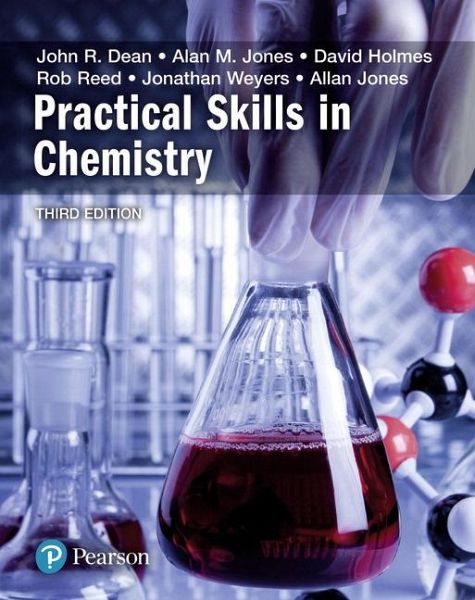
Practical skills form the cornerstone of chemistry. However, the diversity of skills required in the laboratory means that a student’s experience may be limited. While some techniques do require specific skills, many of them are transferable generic skills that are required throughout the subject area. Limited time constraints of the modern curriculum often preclude or minimise laboratory time. Practical Skills in Chemistry 3rd edition provides a general guidance for use in and out of practical sessions, covering a range of techniques from the basic to the more advanced. This ‘one-stop’ text…mehr
Practical skills form the cornerstone of chemistry. However, the diversity of skills required in the laboratory means that a student’s experience may be limited. While some techniques do require specific skills, many of them are transferable generic skills that are required throughout the subject area. Limited time constraints of the modern curriculum often preclude or minimise laboratory time. Practical Skills in Chemistry 3rd edition provides a general guidance for use in and out of practical sessions, covering a range of techniques from the basic to the more advanced. This ‘one-stop’ text will guide you through the wide range of practical, analytical and data handling skills that you will need during your studies. It will also give you a solid grounding in wider transferable skills such as teamwork, using information technology, communicating information and study skills. This edition has been enhanced and updated throughout to provide a complete and easy-to-read guide to the developing skills required from your first day through to graduation, further strengthening its reputation as the practical resource for students of chemistry and related discipline areas.Hinweis: Dieser Artikel kann nur an eine deutsche Lieferadresse ausgeliefert werden.
John R Dean is Professor in Analytical and Environmental Sciences at the University of Northumbria at Newcastle Alan M Jones was Head of Chemical Sciences at the University of Northumbria at Newcastle, David Holmes is Associate Dean of the Keith B. Taylor Global Scholars Programme, St George’s University School of Medicine (Grenada), based at the University of Northumbria at Newcastle Rob Reed is Adjunct Professor (Education & Science) at Central Queensland University, Australia Jonathan Weyers is Honorary Senior Lecturer at the University of Dundee Allan Jones is Chancellor’s Award Fellow in Ecology, Environmental Science and Zoology at the University of Dundee.
Inhaltsangabe
Contents
List of boxes viii Preface to the second edition xi Guided tour xii For the student xiv Acknowledgements xv List of abbreviations xvi
Study and examination skills 1. The importance of transferable skills 2. Managing your time 3. Working with others 4. Taking notes from lectures and texts 5. Learning and revising 6. Curriculum options, assessments and exams 7. Preparing your curriculum vitae
Information technology and library resources 8. Finding and citing published information 9. Evaluating information 10. Using online resources 11. Internet resources for chemistry 12. Using spreadsheets 13. Word processors, databases and other packages
Communicating information 14. Organising a poster display 15. Giving a spoken presentation 16. General aspects of scientific writing 17. Writing essays 18. Reporting practical and project work 19. Writing literature surveys and reviews
Fundamental laboratory techniques 20. Your approach to practical work 21. Health and safety 22. Working with liquids 23. Basic laboratory procedures I 24. Basic laboratory procedures II 25. Principles of solution chemistry 26. pH and buffer solutions
The investigative approach 27. Making and recording measurements 28. SI units and their use 29. Scientific method and design of experiments 30. Project work
Instrumental techniques 46. Fundamental principles of quantitative chemical analysis 47. Calibration and quantitative analysis 48. Basic spectroscopy 49. Atomic spectroscopy 50. X-ray fluorescence spectroscopy 51. Chromatography – basic principles 52. Gas and liquid chromatography 53. Electrophoresis 54. Electroanalytical techniques 55. Radioactive isotopes and their uses 56. Infrared spectroscopy 57. Nuclear magnetic resonance spectroscopy 58. Mass spectrometry 59. Thermal analysis
Analysis and presentation of data 60. Using graphs 61. Presenting data in tables 62. Hints for solving numerical problems 63. Descriptive statistics 64. Choosing and using statistical tests 65. Drawing chemical structures 66. Chemometrics 67. Computational chemistry
List of boxes viii Preface to the second edition xi Guided tour xii For the student xiv Acknowledgements xv List of abbreviations xvi
Study and examination skills 1. The importance of transferable skills 2. Managing your time 3. Working with others 4. Taking notes from lectures and texts 5. Learning and revising 6. Curriculum options, assessments and exams 7. Preparing your curriculum vitae
Information technology and library resources 8. Finding and citing published information 9. Evaluating information 10. Using online resources 11. Internet resources for chemistry 12. Using spreadsheets 13. Word processors, databases and other packages
Communicating information 14. Organising a poster display 15. Giving a spoken presentation 16. General aspects of scientific writing 17. Writing essays 18. Reporting practical and project work 19. Writing literature surveys and reviews
Fundamental laboratory techniques 20. Your approach to practical work 21. Health and safety 22. Working with liquids 23. Basic laboratory procedures I 24. Basic laboratory procedures II 25. Principles of solution chemistry 26. pH and buffer solutions
The investigative approach 27. Making and recording measurements 28. SI units and their use 29. Scientific method and design of experiments 30. Project work
Instrumental techniques 46. Fundamental principles of quantitative chemical analysis 47. Calibration and quantitative analysis 48. Basic spectroscopy 49. Atomic spectroscopy 50. X-ray fluorescence spectroscopy 51. Chromatography – basic principles 52. Gas and liquid chromatography 53. Electrophoresis 54. Electroanalytical techniques 55. Radioactive isotopes and their uses 56. Infrared spectroscopy 57. Nuclear magnetic resonance spectroscopy 58. Mass spectrometry 59. Thermal analysis
Analysis and presentation of data 60. Using graphs 61. Presenting data in tables 62. Hints for solving numerical problems 63. Descriptive statistics 64. Choosing and using statistical tests 65. Drawing chemical structures 66. Chemometrics 67. Computational chemistry
Answers to study exercises Index
Es gelten unsere Allgemeinen Geschäftsbedingungen: www.buecher.de/agb
Impressum
www.buecher.de ist ein Internetauftritt der buecher.de internetstores GmbH
Geschäftsführung: Monica Sawhney | Roland Kölbl | Günter Hilger
Sitz der Gesellschaft: Batheyer Straße 115 - 117, 58099 Hagen
Postanschrift: Bürgermeister-Wegele-Str. 12, 86167 Augsburg
Amtsgericht Hagen HRB 13257
Steuernummer: 321/5800/1497
USt-IdNr: DE450055826