
Nicht lieferbar
Andere Kunden interessierten sich auch für
 Future Shock: A Case for the B-2 Bomber52,99 €
 Preventing Violence and Crime in America's Schools54,99 €
 Addressing the Global Fresh Water Crisis Before the Wave Crashes: A Proactive Approach to National Security52,99 €
 Asymmetric Threats to U.S. National Security to the Year 201052,99 €
 Preempting the Storm: Mitigating America's National Security Vulnerability to Disruptive Magnetic Events52,99 €
 Patching the Wetware: Addressing the Human Factor in Information Security52,99 €
 A Study of Central Asia to Identify Future Threats to Regional Stability52,99 €






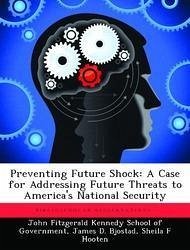
The U.S. has emerged as the sole superpower in the world for the foreseeable future. Despite this, there remain numerous threats to U.S. vital national interests, including developing threats that have the potential to become significant threats in the future. We propose a National Security process that looks separately at future threats, as well as existing ones. In addition, we propose a reconsideration of the National Security Council's evaluation process and its coordination of national security and foreign policy among the various departments and agencies. To illustrate the problem of focusing primarily on more current threats, we present two very different but significant threats to the future of the national interest of the U.S.: the HIV/AIDS pandemic in Sub-Saharan Africa and the approximately forty thousand tactical nuclear weapons of the former Soviet Union (FSU) and the fissile material both within them and in stockpiles throughout Russia. Both issues have far-reaching international implications in the next 10-20 years that could be reduced to a much lesser level of threat, if not fully eliminated, by a concerted and appropriately funded effort now. The HIV/AIDS pandemic in Sub-Saharan Africa is a U.S. national security threat with far reaching international implications that, if left unconstrained will develop into a depopulation crisis of the African continent of as much as a 50-80% over the next twenty year. The net effect would be reflected in the numbers of key professionals and skilled workers critical for the mining and production of minerals that are unavailable from any other part of the world, as well as 20% of all crude oil imported by the U.S. The cost of eliminating and controlling HIV/AIDS in Sub-Saharan Africa over the ten years is currently estimated to be $50 billion, comparable to the Marshall Plan in 1952 that pumped the equivalent of $88 billion into Europe. A second threat we explore is the theft or diversion of former Soviet tactic This work has been selected by scholars as being culturally important, and is part of the knowledge base of civilization as we know it. This work was reproduced from the original artifact, and remains as true to the original work as possible. Therefore, you will see the original copyright references, library stamps (as most of these works have been housed in our most important libraries around the world), and other notations in the work. This work is in the public domain in the United States of America, and possibly other nations. Within the United States, you may freely copy and distribute this work, as no entity (individual or corporate) has a copyright on the body of the work. As a reproduction of a historical artifact, this work may contain missing or blurred pages, poor pictures, errant marks, etc. Scholars believe, and we concur, that this work is important enough to be preserved, reproduced, and made generally available to the public. We appreciate your support of the preservation process, and thank you for being an important part of keeping this knowledge alive and relevant.