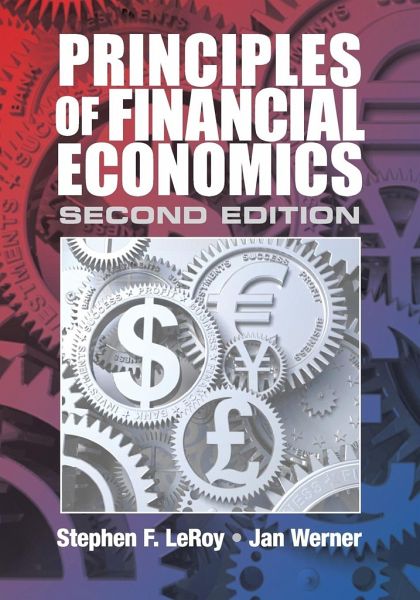
This second edition provides a rigorous yet accessible graduate-level introduction to financial economics. Since students often find the link between financial economics and equilibrium theory hard to grasp, less attention is given to purely financial topics, such as valuation of derivatives, and more emphasis is placed on making the connection with equilibrium theory explicit and clear. This book also provides a detailed study of two-date models because almost all of the key ideas in financial economics can be developed in the two-date setting. Substantial discussions and examples are…mehr
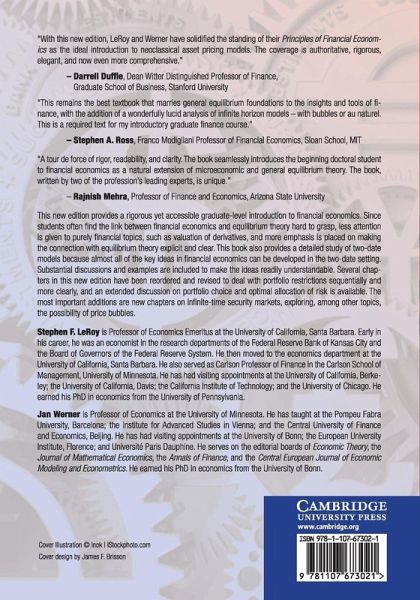
This second edition provides a rigorous yet accessible graduate-level introduction to financial economics. Since students often find the link between financial economics and equilibrium theory hard to grasp, less attention is given to purely financial topics, such as valuation of derivatives, and more emphasis is placed on making the connection with equilibrium theory explicit and clear. This book also provides a detailed study of two-date models because almost all of the key ideas in financial economics can be developed in the two-date setting. Substantial discussions and examples are included to make the ideas readily understandable. Several chapters in this new edition have been reordered and revised to deal with portfolio restrictions sequentially and more clearly, and an extended discussion on portfolio choice and optimal allocation of risk is available. The most important additions are new chapters on infinite-time security markets, exploring, among other topics, the possibility of price bubbles.
Stephen F. LeRoy is Professor of Economics Emeritus at the University of California, Santa Barbara. Early in his career, he was an economist in the research departments of the Federal Reserve Bank of Kansas City and the Board of Governors of the Federal Reserve System. He then moved to the economics department at the University of California, Santa Barbara. He also served as Carlson Professor of Finance in the Carlson School of Management, University of Minnesota. He has had visiting appointments at the University of California, Berkeley, the University of California, Davis, the California Institute of Technology, and the University of Chicago. He earned his PhD in economics from the University of Pennsylvania.
Inhaltsangabe
Preface Part I. Equilibrium and Arbitrage: 1. Equilibrium in security markets 2. Linear pricing 3. Arbitrage and positive pricing Part II. Valuation: 4. Valuation 5. State prices and risk-neutral probabilities Part III. Portfolio Restrictions: 6. Portfolio restrictions 7. Valuation under portfolio restrictions Part IV. Risk: 8. Expected utility 9. Risk aversion 10. Risk Part V. Optimal Portfolios: 11. Optimal portfolios with one risky security 12. Comparative statics of optimal portfolios 13. Optimal portfolios with several risky securities Part VI. Equilibrium Prices and Allocations: 14. Consumption-based security pricing 15. Complete markets and Pareto-optimal allocations of risk 16. Optimality in incomplete markets Part VII. Mean-Variance Analysis: 17. The expectations and pricing kernels 18. The mean-variance frontier payoffs 19. Capital asset pricing model 20. Factor pricing Part VIII. Multidate Security Markets: 21. Equilibrium in multidate security markets 22. Multidate arbitrage and positivity 23. Dynamically complete markets 24. Valuation Part IX. Martingale Property of Security Prices: 25. Event prices, risk-neutral probabilities, and the pricing kernel 26. Martingale property of gains 27. Conditional consumption-based security pricing 28. Conditional beta pricing and the CAPM Part X. Infinite-Time Security Markets: 29. Equilibrium in infinite-time security markets 30. Arbitrage, valuation, and price bubbles 31. Arrow-Debreu equilibrium in infinite time.
Es gelten unsere Allgemeinen Geschäftsbedingungen: www.buecher.de/agb
Impressum
www.buecher.de ist ein Internetauftritt der buecher.de internetstores GmbH
Geschäftsführung: Monica Sawhney | Roland Kölbl | Günter Hilger
Sitz der Gesellschaft: Batheyer Straße 115 - 117, 58099 Hagen
Postanschrift: Bürgermeister-Wegele-Str. 12, 86167 Augsburg
Amtsgericht Hagen HRB 13257
Steuernummer: 321/5800/1497
USt-IdNr: DE450055826