
Andere Kunden interessierten sich auch für
 The Constitutional Court of the Republic of the Congo: a political institution41,99 €
 Constitutional bodies in French-speaking Black Africa29,99 €
 Non-compliance action and its integral reparation in Ecuador41,99 €
 Merger regime in French and Congolese law36,99 €
 MEDICAL SECRET AND HIV/AIDS: Partner information27,99 €
 Rights Before Courts113,99 €
 Judicial Activism76,99 €



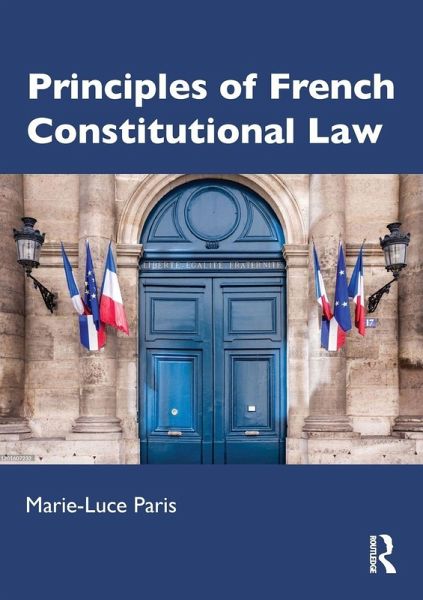
Principles of French Constitutional Law offers a concise and accessible account of the key principles and rules of constitutional law in the French legal system, presenting a muchneeded up-to-date overview of this rapidly changing subject.
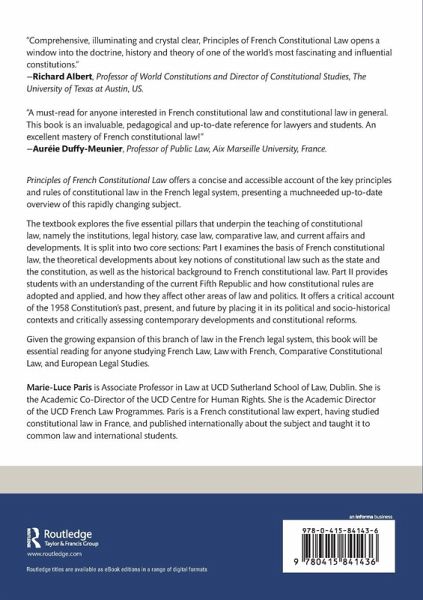
The textbook explores the five essential pillars that underpin the teaching of constitutional law, namely the institutions, legal history, case law, comparative law, and current affairs and developments. It is split into two core sections: Part I examines the basis of French constitutional law, the theoretical developments about key notions of constitutional law such as the state and the constitution, as well as the historical background to French constitutional law. Part II provides students with an understanding of the current Fifth Republic and how constitutional rules are adopted and applied, and how they affect other areas of law and politics. It offers a critical account of the 1958 Constitution's past, present, and future by placing it in its political and socio-historical contexts and critically assessing contemporary developments and constitutional reforms.
Given the growing expansion of this branch of law in the French legal system, this book will be essential reading for anyone studying French Law, Law with French, Comparative Constitutional Law, and European Legal Studies.
The textbook explores the five essential pillars that underpin the teaching of constitutional law, namely the institutions, legal history, case law, comparative law, and current affairs and developments. It is split into two core sections: Part I examines the basis of French constitutional law, the theoretical developments about key notions of constitutional law such as the state and the constitution, as well as the historical background to French constitutional law. Part II provides students with an understanding of the current Fifth Republic and how constitutional rules are adopted and applied, and how they affect other areas of law and politics. It offers a critical account of the 1958 Constitution's past, present, and future by placing it in its political and socio-historical contexts and critically assessing contemporary developments and constitutional reforms.
Given the growing expansion of this branch of law in the French legal system, this book will be essential reading for anyone studying French Law, Law with French, Comparative Constitutional Law, and European Legal Studies.
"Comprehensive, illuminating and crystal clear, Principles of French Constitutional Law opens a window into the doctrine, history and theory of one of the world's most fascinating and influential constitutions."
-Richard Albert, Professor of World Constitutions and Director of Constitutional Studies, The University of Texas at Austin, US.
"A must-read for anyone interested in French constitutional law and constitutional law in general. This book is an invaluable, pedagogical and up-to-date reference for lawyers and students. An excellent mastery of French constitutional law!"
-Aurélie Duffy-Meunier, Professor of Public Law, Aix Marseille University, France.
-Richard Albert, Professor of World Constitutions and Director of Constitutional Studies, The University of Texas at Austin, US.
"A must-read for anyone interested in French constitutional law and constitutional law in general. This book is an invaluable, pedagogical and up-to-date reference for lawyers and students. An excellent mastery of French constitutional law!"
-Aurélie Duffy-Meunier, Professor of Public Law, Aix Marseille University, France.