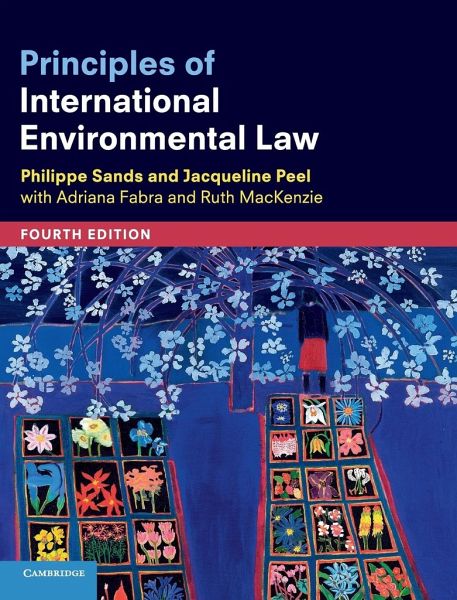
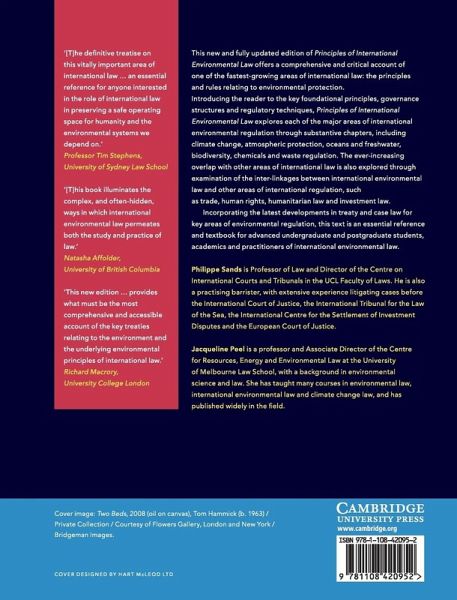
A comprehensive account of one of the fastest growing areas of international law: principles and rules relating to environmental protection. Incorporating the latest developments in treaty and case law for key areas of environmental regulation, this text is an essential reference and textbook for students, academics and practitioners.
A comprehensive account of one of the fastest growing areas of international law: principles and rules relating to environmental protection. Incorporating the latest developments in treaty and case law for key areas of environmental regulation, this text is an essential reference and textbook for students, academics and practitioners.
Philippe Sands is Professor of Law and Director of the Centre on International Courts and Tribunals in the University College London Faculty of Laws. He is also a practising barrister, with extensive experience litigating cases before the International Court of Justice, the International Tribunal for the Law of the Sea, the International Centre for the Settlement of Investment Disputes and the European Court of Justice.
Inhaltsangabe
Part I. The Legal and Institutional Framework: 1. The environment and international society: issues, concepts and definitions 2. History 3. Governance: states, international organisations and non-state actors 4. International law-making and regulation 5. Compliance: implementation, enforcement, dispute settlement Part II. Principles and Rules Establishing Standards: 6. General principles and rules 7. Atmospheric protection 8. Climate change 9. Freshwater resources 10. Biological diversity 11. Oceans, seas and marine living resources 12. Hazardous substances and activities, and waste 13. The Polar regions: Antarctica and the Arctic Part III. Techniques for Implementing International Principles and Rules: 14. Environmental impact assessment 15. Environmental information and technology transfer 16. Liability for environmental damage Part IV. Linkage of International Environmental Law and Other Areas of International Law: 17. Human rights and international humanitarian law 18. International economic law: trade, investment and intellectual property 19. Future developments.
Part I. The Legal and Institutional Framework: 1. The environment and international society: issues, concepts and definitions; 2. History; 3. Governance: states, international organisations and non-state actors; 4. International law-making and regulation; 5. Compliance: implementation, enforcement, dispute settlement; Part II. Principles and Rules Establishing Standards: 6. General principles and rules; 7. Atmospheric protection; 8. Climate change; 9. Freshwater resources; 10. Biological diversity; 11. Oceans, seas and marine living resources; 12. Hazardous substances and activities, and waste; 13. The Polar regions: Antarctica and the Arctic; Part III. Techniques for Implementing International Principles and Rules: 14. Environmental impact assessment; 15. Environmental information and technology transfer; 16. Liability for environmental damage; Part IV. Linkage of International Environmental Law and Other Areas of International Law: 17. Human rights and international humanitarian law; 18. International economic law: trade, investment and intellectual property; 19. Future developments.
Part I. The Legal and Institutional Framework: 1. The environment and international society: issues, concepts and definitions 2. History 3. Governance: states, international organisations and non-state actors 4. International law-making and regulation 5. Compliance: implementation, enforcement, dispute settlement Part II. Principles and Rules Establishing Standards: 6. General principles and rules 7. Atmospheric protection 8. Climate change 9. Freshwater resources 10. Biological diversity 11. Oceans, seas and marine living resources 12. Hazardous substances and activities, and waste 13. The Polar regions: Antarctica and the Arctic Part III. Techniques for Implementing International Principles and Rules: 14. Environmental impact assessment 15. Environmental information and technology transfer 16. Liability for environmental damage Part IV. Linkage of International Environmental Law and Other Areas of International Law: 17. Human rights and international humanitarian law 18. International economic law: trade, investment and intellectual property 19. Future developments.
Part I. The Legal and Institutional Framework: 1. The environment and international society: issues, concepts and definitions; 2. History; 3. Governance: states, international organisations and non-state actors; 4. International law-making and regulation; 5. Compliance: implementation, enforcement, dispute settlement; Part II. Principles and Rules Establishing Standards: 6. General principles and rules; 7. Atmospheric protection; 8. Climate change; 9. Freshwater resources; 10. Biological diversity; 11. Oceans, seas and marine living resources; 12. Hazardous substances and activities, and waste; 13. The Polar regions: Antarctica and the Arctic; Part III. Techniques for Implementing International Principles and Rules: 14. Environmental impact assessment; 15. Environmental information and technology transfer; 16. Liability for environmental damage; Part IV. Linkage of International Environmental Law and Other Areas of International Law: 17. Human rights and international humanitarian law; 18. International economic law: trade, investment and intellectual property; 19. Future developments.
Rezensionen
'Principles of International Environmental Law remains the definitive treatise on this vitally important area of international law. The international community faces unprecedented environmental challenges and this work provides a comprehensive assessment of the capacity of environmental norms and institutions to address these threats. The work is an essential reference for anyone interested in the role of international law in preserving a safe operating space for humanity and the environmental systems we depend on in the Anthropocene.' Tim Stephens, University of Sydney Law School
Es gelten unsere Allgemeinen Geschäftsbedingungen: www.buecher.de/agb
Impressum
www.buecher.de ist ein Internetauftritt der buecher.de internetstores GmbH
Geschäftsführung: Monica Sawhney | Roland Kölbl | Günter Hilger
Sitz der Gesellschaft: Batheyer Straße 115 - 117, 58099 Hagen
Postanschrift: Bürgermeister-Wegele-Str. 12, 86167 Augsburg
Amtsgericht Hagen HRB 13257
Steuernummer: 321/5800/1497
USt-IdNr: DE450055826