
Andere Kunden interessierten sich auch für
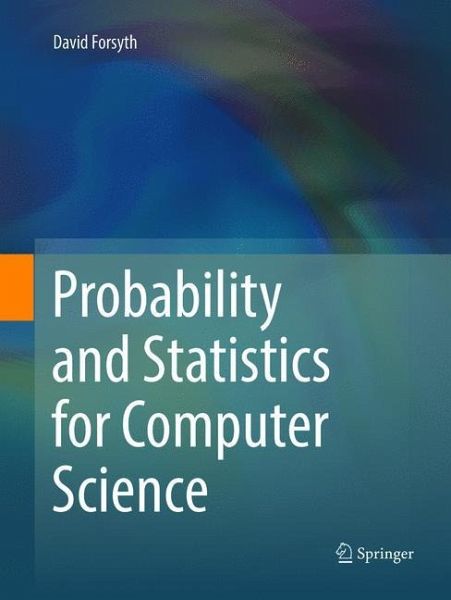
 Probability and Statistics for Computer Science47,99 €
 Analytical and Computational Methods in Probability Theory38,99 €
 Engineering Statistics42,99 €
 Engineering Statistics42,99 €
 Probability Theory I42,99 €
 Applied Probability53,99 €
 Applied Probability57,99 €
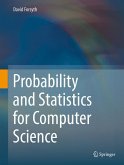
This textbook is aimed at computer science undergraduates late in sophomore or early in junior year, supplying a comprehensive background in qualitative and quantitative data analysis, probability, random variables, and statistical methods, including machine learning.
With careful treatment of topics that fill the curricular needs for the course, Probability and Statistics for Computer Science features:
- A treatment of random variables and expectations dealing primarily with the discrete case.
- A practical treatment of simulation, showing how many interesting probabilities and expectations can be extracted, with particular emphasis on Markov chains.
- A clear but crisp account of simple point inference strategies (maximum likelihood; Bayesian inference) in simple contexts. This is extended to cover some confidence intervals, samples and populations for random sampling with replacement, and the simplest hypothesis testing.
-Achapter dealing with classification, explaining why it's useful; how to train SVM classifiers with stochastic gradient descent; and how to use implementations of more advanced methods such as random forests and nearest neighbors.
- A chapter dealing with regression, explaining how to set up, use and understand linear regression and nearest neighbors regression in practical problems.
- A chapter dealing with principal components analysis, developing intuition carefully, and including numerous practical examples. There is a brief description of multivariate scaling via principal coordinate analysis.
- A chapter dealing with clustering via agglomerative methods and k-means, showing how to build vector quantized features for complex signals.
Illustrated throughout, each main chapter includes many worked examples and other pedagogical elements such as
boxed Procedures, Definitions, Useful Facts, and Remember This (short tips). Problems and Programming Exercises are at the end of each chapter, with a summary of what the reader should know.
Instructor resources include a full set of model solutions for all problems, and an Instructor's Manual with accompanying presentation slides.
With careful treatment of topics that fill the curricular needs for the course, Probability and Statistics for Computer Science features:
- A treatment of random variables and expectations dealing primarily with the discrete case.
- A practical treatment of simulation, showing how many interesting probabilities and expectations can be extracted, with particular emphasis on Markov chains.
- A clear but crisp account of simple point inference strategies (maximum likelihood; Bayesian inference) in simple contexts. This is extended to cover some confidence intervals, samples and populations for random sampling with replacement, and the simplest hypothesis testing.
-Achapter dealing with classification, explaining why it's useful; how to train SVM classifiers with stochastic gradient descent; and how to use implementations of more advanced methods such as random forests and nearest neighbors.
- A chapter dealing with regression, explaining how to set up, use and understand linear regression and nearest neighbors regression in practical problems.
- A chapter dealing with principal components analysis, developing intuition carefully, and including numerous practical examples. There is a brief description of multivariate scaling via principal coordinate analysis.
- A chapter dealing with clustering via agglomerative methods and k-means, showing how to build vector quantized features for complex signals.
Illustrated throughout, each main chapter includes many worked examples and other pedagogical elements such as
boxed Procedures, Definitions, Useful Facts, and Remember This (short tips). Problems and Programming Exercises are at the end of each chapter, with a summary of what the reader should know.
Instructor resources include a full set of model solutions for all problems, and an Instructor's Manual with accompanying presentation slides.