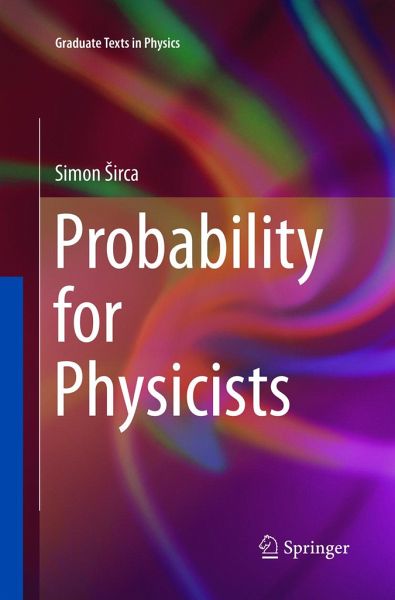
This book is designed as a practical and intuitive introduction to probability, statistics and random quantities for physicists. The book aims at getting to the main points by a clear, hands-on exposition supported by well-illustrated and worked-out examples. A strong focus on applications in physics and other natural sciences is maintained throughout. In addition to basic concepts of random variables, distributions, expected values and statistics, the book discusses the notions of entropy, Markov processes, and fundamentals of random number generation and Monte-Carlo methods.
This book is designed as a practical and intuitive introduction to probability, statistics and random quantities for physicists. The book aims at getting to the main points by a clear, hands-on exposition supported by well-illustrated and worked-out examples. A strong focus on applications in physics and other natural sciences is maintained throughout. In addition to basic concepts of random variables, distributions, expected values and statistics, the book discusses the notions of entropy, Markov processes, and fundamentals of random number generation and Monte-Carlo methods.
Simon irca was born on February 27, 1969, in Ljubljana, Slovenia. He is Professor of Physics at the Faculty of Mathematics and Physics, University of Ljubljana, where he has been teaching courses on Probability for Physicists, Computational Physics and Model Analysis. He is head of the research group Structure of Hadronic Systems active in the Hall A Collaboration at Thomas Jefferson National Accelerator Facility (USA) and the A1/MAGIX Collaborations at MAMI/MESA in Mainz (Germany). His main research field is the study of hadronic structure and dynamics by scattering of electrons on light nuclei, exploiting polarized beams, polarized targets, and recoil polarimetry. He is also involved in theoretical work on quark models of hadrons, with focus on electroweak processes. Martin Horvat was born on April 25, 1977, in Maribor, Slovenia. He is Assistant Professor at the Faculty of Mathematics and Physics, University of Ljubljana, where he has led the Physical Laboratory Course and taught Basic Applied Mathematics and Physics. The bulk of his research is devoted to classical and quantum non-linear dynamics, to transport properties in extended systems, to the quantum-classical correspondence, to theoretical and applied aspects of quantum mechanics on the classical phase space, as well as to statistical mechanics and its origin in dynamics. He is also involved in the development of methods for solving the time-dependent Schrödinger equation in atomic physics, in research of autonomic relativistic global navigation satellite systems (RGNSS) for the European Space Agency (ESA), in modeling of astrophysical bodies, mainly eclipsing binary stars and synthesis of their observable, for prominent astrophysical packages PHOEBE and in statistical analysis and modeling of uncertainty in normal-mode decomposition of weather forecasts from the European Centre for Medium-Range Weather Forecasts system (ECMWF).
Inhaltsangabe
Basic Terminology.- Probability Distributions.- Special Continuous Probability Distributions.- Expected Values.- Special Discrete Probability Distributions.- Convolution.- Samples.- Estimation of Parameters and Statistical Tests.- Regression.- Entropy.- Markov Processes.- Generation of Pseudorandom Numbers.- Monte Carlo Method.- Stochastic Population Modeling.
Basic Terminology.- Probability Distributions.- Special Continuous Probability Distributions.- Expected Values.- Special Discrete Probability Distributions.- Convolution.- Samples.- Estimation of Parameters and Statistical Tests.- Regression.- Entropy.- Markov Processes.- Generation of Pseudorandom Numbers.- Monte Carlo Method.- Stochastic Population Modeling.
Rezensionen
"Sirca ... provides a thorough background; sections cover fundamentals of probability analysis, statistical distributions, and applications of the theories using computer-based algorithms. ... The work includes useful graphs, four appendixes covering random number generation, and tables of normal distributions. There are extensive references and a valuable index. Summing Up: Recommended. Graduate students; researchers/faculty; professionals." (N. Sadanand, Choice, Vol. 54 (4), December, 2016)
Es gelten unsere Allgemeinen Geschäftsbedingungen: www.buecher.de/agb
Impressum
www.buecher.de ist ein Internetauftritt der buecher.de internetstores GmbH
Geschäftsführung: Monica Sawhney | Roland Kölbl | Günter Hilger
Sitz der Gesellschaft: Batheyer Straße 115 - 117, 58099 Hagen
Postanschrift: Bürgermeister-Wegele-Str. 12, 86167 Augsburg
Amtsgericht Hagen HRB 13257
Steuernummer: 321/5800/1497
USt-IdNr: DE450055826