Making a game can be an intensive process, and if not planned accurately can easily run over budget. The use of procedural generation in game design can help with the intricate and multifarious aspects of game development; thus facilitating cost reduction. This form of development enables games to create their play areas, objects and stories based on a set of rules, rather than relying on the developer to handcraft each element individually. Readers will learn to create randomized maps, weave accidental plotlines, and manage complex systems that are prone to unpredictable behavior. Tanya…mehr
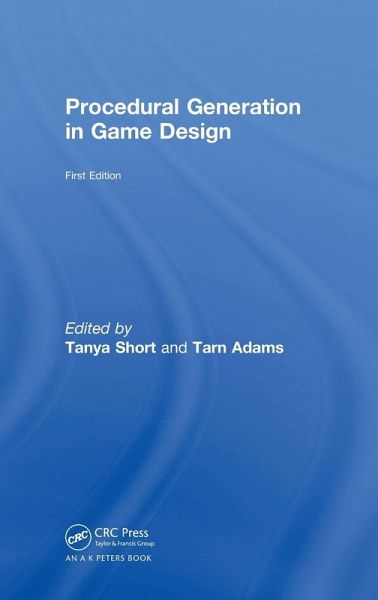
Making a game can be an intensive process, and if not planned accurately can easily run over budget. The use of procedural generation in game design can help with the intricate and multifarious aspects of game development; thus facilitating cost reduction. This form of development enables games to create their play areas, objects and stories based on a set of rules, rather than relying on the developer to handcraft each element individually. Readers will learn to create randomized maps, weave accidental plotlines, and manage complex systems that are prone to unpredictable behavior. Tanya Short's and Tarn Adams' Procedural Generation in Game Design offers a wide collection of chapters from various experts that cover the implementation and enactment of procedural generation in games. Designers from a variety of studios provide concrete examples from their games to illustrate the many facets of this emerging sub-discipline.
Key Features:
Introduces the differences between static/traditional game design and procedural game design
Demonstrates how to solve or avoid common problems with procedural game design in a variety of concrete ways
Includes industry leaders' experiences and lessons from award-winning games
World's finest guide for how to begin thinking about procedural design
Tanya X. Short is the director of Kitfox Games, the indie game studio behind Moon Hunters and Shattered Planet. Previously, she worked as a designer at Funcom Games on The Secret World and Age of Conan: Hyborian Adventures. In her spare time, she acts as the co-director of Pixelles, a non-profit helping more women make games. Tarn Adams is best known as the developer of Dwarf Fortress since 2002 with his older brother Zach. He learned programming in his childhood, and designed computer games as a hobby until he quit his first year of a mathematics post doctorate at Texas A&M to focus on game development in 2006.
Inhaltsangabe
Preface Section I Procedural Generation Chapter 1 When and Why to Use Procedural Generation Darren Grey Chapter 2 Managing Output: Boredom versus Chaos Kenny Backus Chapter 3 Aesthetics in Procedural Generation Liam Welton Chapter 4 Designing for Modularity Jason Grinblat Chapter 5 Ethical Procedural Generation Dr. Michael Cook Section II Procedural Content Chapter 6 Level Design I: Case Study Chris Chung Chapter 7 Level Design II: Handcrafted Integration Jim Shepard Chapter 8 Level Design III: Architecture and Destruction Evan Hahn Chapter 9 Cyclic Generation Dr. Joris Dormans Chapter 10 Worlds Dr. Mark R. Johnson Chapter 11 Puzzles Danny Day Chapter 12 Procedural Logic Ben Kane Chapter 13 Artificial Intelligence Mark R. Johnson Chapter 14 Procedural Enemy Waves Wyatt Cheng Chapter 15 Generative Artwork Loren Schmidt Chapter 16 Generative Art Toys Kate Compton Chapter 17 Audio and Composition Bronson Zgeb Section III Procedural Narrative Chapter 18 Story and Plot Generation Ben Kybartas Chapter 19 Emergent Narratives and Story Volumes Jason Grinblat Chapter 20 Poetry Generation Harry Tuffs Chapter 21 Characters and Personalities Emily Short Section IV The Procedural Future Chapter 22 Understanding the Generated Gillian Smith Chapter 23 Content Tools Case Study Kepa Auwae Chapter 24 Automated Game Tuning Aaron Isaksen Chapter 25 Generating Rules Dr. Michael Cook Chapter 26 Algorithms and Approaches Brian Bucklew Chapter 27 Meaning Dr. Mark R. Johnson INDEX
Preface Section I Procedural Generation Chapter 1 When and Why to Use Procedural Generation Darren Grey Chapter 2 Managing Output: Boredom versus Chaos Kenny Backus Chapter 3 Aesthetics in Procedural Generation Liam Welton Chapter 4 Designing for Modularity Jason Grinblat Chapter 5 Ethical Procedural Generation Dr. Michael Cook Section II Procedural Content Chapter 6 Level Design I: Case Study Chris Chung Chapter 7 Level Design II: Handcrafted Integration Jim Shepard Chapter 8 Level Design III: Architecture and Destruction Evan Hahn Chapter 9 Cyclic Generation Dr. Joris Dormans Chapter 10 Worlds Dr. Mark R. Johnson Chapter 11 Puzzles Danny Day Chapter 12 Procedural Logic Ben Kane Chapter 13 Artificial Intelligence Mark R. Johnson Chapter 14 Procedural Enemy Waves Wyatt Cheng Chapter 15 Generative Artwork Loren Schmidt Chapter 16 Generative Art Toys Kate Compton Chapter 17 Audio and Composition Bronson Zgeb Section III Procedural Narrative Chapter 18 Story and Plot Generation Ben Kybartas Chapter 19 Emergent Narratives and Story Volumes Jason Grinblat Chapter 20 Poetry Generation Harry Tuffs Chapter 21 Characters and Personalities Emily Short Section IV The Procedural Future Chapter 22 Understanding the Generated Gillian Smith Chapter 23 Content Tools Case Study Kepa Auwae Chapter 24 Automated Game Tuning Aaron Isaksen Chapter 25 Generating Rules Dr. Michael Cook Chapter 26 Algorithms and Approaches Brian Bucklew Chapter 27 Meaning Dr. Mark R. Johnson INDEX
Rezensionen
Short, director of KitFox Games, and Adams, the independent co-creator of the popular game Dwarf Fortress, have edited a substantial collection of essays providing concepts and practical application of procedurally generated content and algorithms for game design purposes. Procedural generational the method of creating data via algorithm rather than by handâEUR"is a principle developers can harness to allow the game to generate its own content (settings, objects, and stories) using a series of rules. This method can result in considerable savings over the more traditional game design. Unlike Procedural Content Generation in Games (Shaker, Togelius, Nelson, 2016), the material here is authored by independent developers (with one exception from Blizzard Entertainment), so the information is more accessible and actionable. The book should enable game developers evaluating procedural generation for their games to make an informed decision whether or not to use it. Those with a background in computer science or who are already using procedural generation may learn something new from the contributorsâEUR(TM) experiences and methodologies.
--A. Chen, Cogswell College
Summing Up: Recommended. Upper-division undergraduates through faculty and professionals.
Es gelten unsere Allgemeinen Geschäftsbedingungen: www.buecher.de/agb
Impressum
www.buecher.de ist ein Internetauftritt der buecher.de internetstores GmbH
Geschäftsführung: Monica Sawhney | Roland Kölbl | Günter Hilger
Sitz der Gesellschaft: Batheyer Straße 115 - 117, 58099 Hagen
Postanschrift: Bürgermeister-Wegele-Str. 12, 86167 Augsburg
Amtsgericht Hagen HRB 13257
Steuernummer: 321/5800/1497
USt-IdNr: DE450055826