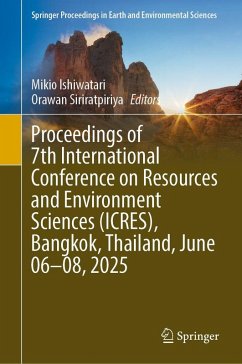
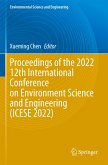
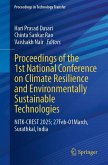
This book presents the selected papers from 2025 7th International Conference on Resources and Environment Sciences, held in the city of Bangkok, Thailand, from June 06 08, 2025. The conference brought together people from both academia and industry to address environmental challenges in our rapidly changing world. The book contains the newest research and innovative approaches to managing environmental resources and covers the latest contributions from scholars, researchers, and practitioners worldwide. The topics include environmental pollution monitoring and the health risk assessment,…mehr
This book presents the selected papers from 2025 7th International Conference on Resources and Environment Sciences, held in the city of Bangkok, Thailand, from June 06 08, 2025. The conference brought together people from both academia and industry to address environmental challenges in our rapidly changing world. The book contains the newest research and innovative approaches to managing environmental resources and covers the latest contributions from scholars, researchers, and practitioners worldwide. The topics include environmental pollution monitoring and the health risk assessment, wastewater treatment and water resource management, environmental biology and resource management, green technology, emission reduction, and sustainable development. The book serves as a good reference for researchers, practitioners, and policymakers which offers practical insights and useful solutions to environmental issues for the benefit of current and future generations.
Produktdetails
Produktdetails
Springer Proceedings in Earth and Environmental Sciences
Dr. Mikio Ishiwatari is a professor at the School of Business Administration, Meiji University, Japan. He served as Senior Advisor on Disaster Management and Water Resources Management at Japan International Cooperation Agency, and Visiting Professor, Graduate School of Frontier Sciences, the University of Tokyo. He has been engaged in the projects and research works of disaster risk reduction (DRR), climate change adaptation, and water. He led formulation of the Japanese assistance policies of climate change adaptation and community-based disaster management. He worked at the World Bank as Senior Disaster Risk Management Specialist and produced the “Learning from Megadisaster: Lessons from the Great East Japan Earthquake.” He worked at various positions at the Ministry of Land, Infrastructure, and Transport, Japan for 17 years. He formulated and supervised national projects of flood risk management and highways in Iwami District as Director of Hamada River and Road Office and was responsible for research and technology development as Senior Deputy Director for River Technology and Information. Orawan Siriratpiriya graduated from Chulalongkorn University with a degree B.Ed. in Chemistry and Biology and M.Sc.in Environmental Science from Kasetsart University. Soon after graduating she started working at the Institute of Environmental Research, Chulalongkorn University. She received fellowship for 1 year research from Norwegian Agency for International Development (NORAD) and furthered her study for D.Sc.in soil management- Waste Disposal/Utilization at Department of Soil Fertility and Management, The Agricultural University of Norway, NORWAY. She has been selected not only from United Nations Environment Programme (UNEP) in 1990 for International Leadership in Sustainable Environmental Management with a fellowship at Center for Environmental Management, Tufts University, Massachusetts, USA under “Intensive, International Post-Graduate Programme in Environmental Management” specialized in Risk Assessment and Analysis, but also from APRU (Association of Pacific Rim Univ.) as Fellow in 2004 on Globalization and the Environment: Multidisciplinary Perspective at University of California Santa Barbara, Santa Barbara, USA., and Osaka University, Osaka, Japan. Her working experiences around 30 years as principal investigator, project director/integrator/manager/coordinator, lecturer and thesis adviser in the area of Waste Disposal and Utilization, Zero Waste, Heavy Metals in Soil and Plant, Soil Management, Wastewater Management, Nutrient Cycle, Climate Change (GHGs, carbon sequestration), Environmental Education, Environmental Impact Assessment (EIA), Environmental Sustainable Development. She was Expert in Environmental Impact Assessment (License) of Juristic Person ‘Chulalongkorn University’ (1991-2017), Southeast Asia Programme Officer, The International START (HDP/IGBP/WCRP) Secretariat, Washington DC, USA (1994-1995), [START = Global Change System for Analysis, Research, and Training], Thai National Expert for EIA/SEA (Environmental Impact Assessment/Strategic Environmental Assessment) guidelines development in the Mekong River Basin (2002-2003), including Committee for The Thai Environment Dictionary, Royal Institute Edition (2003-2022), Board member as Environmental Expert for National Fertilizer Board, Thailand (2009-2014), Resource Person in Expert Meeting and International Conference organized by SWAPI (Solid Waste Management Experts in Asia and Pacific Islands) and Ministry of Environment, Japan (2005-present), Member of Drafting Committee “State of the 3Rs in Asia and the Pacific”, United Nations Centre for Regional Development (UNCRD) and Institute for Global Environmental Strategies (IGES) (2017), At present, she still active as Chair Conference, Keynote Speaker, Session Chair in the International Conference, Peer Review, Editor, Editorial Board in Journal of Material Cycles and Waste Management, Springer. Her related publication such as Municipal Solid Waste Management in Thailand: Challenges and Strategic Solution in “Municipal Solid Waste Management in Asia and the Pacific Islands” Agamuthu Pariatamby and Masaru Tanaka (eds.), Springer-Verlag Singapore 2014. ISBN: 978-981-4451-72-7. She has been published approximately 150 publications.
Inhaltsangabe
Environmental Quality Monitoring and Pollution Control.- The Corn Hill Hazard: a Polical Ecology of Land-Use Change and Vulnerability in South Sulawesi, Indonesia.- Effluent Effects on Soil Carbon Storage of Mangrove Forest at The King’s Royally Initiated Lame Phak Bia Environmental Research and Developmental Project, Thailand.- Sustainable Utilization of Chicken Eggshell Waste for Adsorptive Removal of Congo Red Dye from Wastewater.- Impact of Animal Farming on Household Groundwater Physicochemical Quality: A Case Study in Naushehro Feroze, Sindh, Pakistan.- Effect of Intermittent Aeration on The Reduction of Organic and Nutrient Content in Domestic Wastewater from The Office Building using Fixed-bed Anaerobic-Aerobic Reactor.- Assessment of Zn–Cu Based Modified Septic Tank–Microbial Fuel Cell (MST-MFC) for Domestic Office Wastewater: Treatment Performance and Energy Potential.- Resource Recycling and Sustainable Development.- Environmental Impact Assessment of End-of-Life Lithium-ion Battery Recycling.- A System for Improving the Separation of Fine Fraction of Construction and Demolition Waste Based on Artificial Intelligence and Modern Technology.- Environmental and Marketing Analysis of the Pandan (Pandanus simplex merr.) Industry in Luisiana, Laguna as a Model to Revitalize Traditional Weaving Craft in the Philippines.- The Relationship Between Artificial Intelligence Technology and Green Supply Chain.- Ecosystem Management and Environmental Impact of Human Behavior.- Enhancing Water Quality and Nile Tilapia Growth through Speece Cone Nanobubble Aeration in Philippine RAS.- An analysis of Active Region AR 3664 Associated with An Enormous X-Class Solar Flare in May 2024.- Behind the Leftovers: A Scoping Review on Household Food Waste Determinants in Asia.
Environmental Quality Monitoring and Pollution Control.- The Corn Hill Hazard: a Polical Ecology of Land-Use Change and Vulnerability in South Sulawesi, Indonesia.- Effluent Effects on Soil Carbon Storage of Mangrove Forest at The King’s Royally Initiated Lame Phak Bia Environmental Research and Developmental Project, Thailand.- Sustainable Utilization of Chicken Eggshell Waste for Adsorptive Removal of Congo Red Dye from Wastewater.- Impact of Animal Farming on Household Groundwater Physicochemical Quality: A Case Study in Naushehro Feroze, Sindh, Pakistan.- Effect of Intermittent Aeration on The Reduction of Organic and Nutrient Content in Domestic Wastewater from The Office Building using Fixed-bed Anaerobic-Aerobic Reactor.- Assessment of Zn–Cu Based Modified Septic Tank–Microbial Fuel Cell (MST-MFC) for Domestic Office Wastewater: Treatment Performance and Energy Potential.- Resource Recycling and Sustainable Development.- Environmental Impact Assessment of End-of-Life Lithium-ion Battery Recycling.- A System for Improving the Separation of Fine Fraction of Construction and Demolition Waste Based on Artificial Intelligence and Modern Technology.- Environmental and Marketing Analysis of the Pandan (Pandanus simplex merr.) Industry in Luisiana, Laguna as a Model to Revitalize Traditional Weaving Craft in the Philippines.- The Relationship Between Artificial Intelligence Technology and Green Supply Chain.- Ecosystem Management and Environmental Impact of Human Behavior.- Enhancing Water Quality and Nile Tilapia Growth through Speece Cone Nanobubble Aeration in Philippine RAS.- An analysis of Active Region AR 3664 Associated with An Enormous X-Class Solar Flare in May 2024.- Behind the Leftovers: A Scoping Review on Household Food Waste Determinants in Asia.
Es gelten unsere Allgemeinen Geschäftsbedingungen: www.buecher.de/agb
Impressum
www.buecher.de ist ein Internetauftritt der buecher.de internetstores GmbH
Geschäftsführung: Monica Sawhney | Roland Kölbl | Günter Hilger
Sitz der Gesellschaft: Batheyer Straße 115 - 117, 58099 Hagen
Postanschrift: Bürgermeister-Wegele-Str. 12, 86167 Augsburg
Amtsgericht Hagen HRB 13257
Steuernummer: 321/5800/1497
USt-IdNr: DE450055826