
Proceedings of the 18th International Conference on Environmental Degradation of Materials in Nuclear Power Systems - Water Reactors
Volume 1
Herausgegeben:Jackson, John H; Paraventi, Denise; Wright, Michael
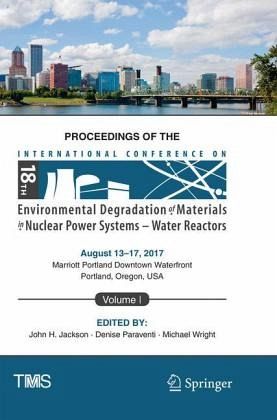
Proceedings of the 18th International Conference on Environmental Degradation of Materials in Nuclear Power Systems - Water Reactors
Volume 1
Herausgegeben:Jackson, John H; Paraventi, Denise; Wright, Michael
- Broschiertes Buch
- Merkliste
- Auf die Merkliste
- Bewerten Bewerten
- Teilen
- Produkt teilen
- Produkterinnerung
- Produkterinnerung
This two-volume set represents a collection of papers presented at the 18th International Conference on Environmental Degradation of Materials in Nuclear Power Systems - Water Reactors. The purpose of this conference series is to foster an exchange of ideas about problems and their remedies in water-cooled nuclear power plants of today and the future. Contributions cover problems facing nickel-based alloys, stainless steels, pressure vessel and piping steels, zirconium alloys, and other alloys in water environments of relevance. Components covered include pressure boundary components, reactor…mehr
Andere Kunden interessierten sich auch für
 Proceedings of the 18th International Conference on Environmental Degradation of Materials in Nuclear Power Systems - Water Reactors313,99 €
") Proceedings of the 6th International Conference on Recrystallization and Grain Growth (ReX&GG 2016)151,99 €
Proceedings of the 6th International Conference on Recrystallization and Grain Growth (ReX&GG 2016)151,99 € Proceedings of the 3rd Pan American Materials Congress152,99 €
") Proceedings of the 11th International Conference on Porous Metals and Metallic Foams (MetFoam 2019)115,99 €
Proceedings of the 11th International Conference on Porous Metals and Metallic Foams (MetFoam 2019)115,99 € Proceedings of the 9th International Symposium on Superalloy 718 & Derivatives: Energy, Aerospace, and Industrial Applications154,99 €
 1st International Conference on 3D Materials Science, 201276,99 €
 Proceedings of the 9th International Symposium on Superalloy 718 & Derivatives: Energy, Aerospace, and Industrial Applications154,99 €
-
-
-

This two-volume set represents a collection of papers presented at the 18th International Conference on Environmental Degradation of Materials in Nuclear Power Systems - Water Reactors. The purpose of this conference series is to foster an exchange of ideas about problems and their remedies in water-cooled nuclear power plants of today and the future. Contributions cover problems facing nickel-based alloys, stainless steels, pressure vessel and piping steels, zirconium alloys, and other alloys in water environments of relevance. Components covered include pressure boundary components, reactor vessels and internals, steam generators, fuel cladding, irradiated components, fuel storage containers, and balance of plant components and systems.
Produktdetails
- Produktdetails
- The Minerals, Metals & Materials Series
- Verlag: Springer / Springer International Publishing / Springer, Berlin
- Artikelnr. des Verlages: 978-3-319-88398-4
- Softcover reprint of the original 1st ed. 2018
- Seitenzahl: 1287
- Erscheinungstermin: 1. Januar 1900
- Englisch
- Abmessung: 235mm x 155mm
- ISBN-13: 9783319883984
- ISBN-10: 3319883984
- Artikelnr.: 54781543
- Herstellerkennzeichnung
- Libri GmbH
- Europaallee 1
- 36244 Bad Hersfeld
- gpsr@libri.de
- The Minerals, Metals & Materials Series
- Verlag: Springer / Springer International Publishing / Springer, Berlin
- Artikelnr. des Verlages: 978-3-319-88398-4
- Softcover reprint of the original 1st ed. 2018
- Seitenzahl: 1287
- Erscheinungstermin: 1. Januar 1900
- Englisch
- Abmessung: 235mm x 155mm
- ISBN-13: 9783319883984
- ISBN-10: 3319883984
- Artikelnr.: 54781543
- Herstellerkennzeichnung
- Libri GmbH
- Europaallee 1
- 36244 Bad Hersfeld
- gpsr@libri.de
The Minerals, Metals & Materials Society (TMS) is a member-driven international professional society dedicated to fostering the exchange of learning and ideas across the entire range of materials science and engineering, from minerals processing and primary metals production, to basic research and the advanced applications of materials. Included among its nearly 13,000 professional and student members are metallurgical and materials engineers, scientists, researchers, educators, and administrators from more than 70 countries on six continents.
Part 1. PWR Nickel SCC
SCC.
Scoring Process for Evaluating Laboratory PWSCC Crack Growth Rate Data of Thick
wall Alloy 690 Wrought Material and Alloy 52, 152, and Variant Weld Material.
Applicability of Alloy 690/52/152 Crack Growth Testing Conditions to Plant Components.
SCC of Alloy 152/52 Welds Defects, Repairs and Dilution Zones in PWR Water.
NRC Perspectives on Primary Water Stress Corrosion Cracking of High
chromium, Nickel
based Alloys.
Stress Corrosion Cracking of 52/152 Weldments near Dissimilar Metal Weld Interfaces.
Composite Material Stress Corrosion Crack Arrest Testing in Hydrogen Deaerated Water.
Investigation of Hydrogen Behavior in Relation to the PWSCC Mechanism in Alloy TT690.
Part 2. PWR Nickel SCC
Initiation.
Crack Initiation of Alloy 600 in PWR Water.
SCC Initiation Behavior of Alloy 182 in PWR Primary Water.
Multiple Cracks Interactions in Stress Corrosion Cracking: In
situ Observation by Digital Image Correlation and Phase Field Modelling.
Stress Corrosion Cracking Initiation of Alloy 82 in Hydrogenated Steam.
Application of Ultra
high Pressure Cavitation Peening on Reactor Vessel Head Penetration, BMN and Primary Nozzles.
The Effect of Surface Condition on Primary Water Stress Corrosion Cracking Initiation of Alloy 600.
Microstructural Effects on SCC Initiation in Simulated PWR Primary Water for Cold
worked Alloy 600.
Part 3. PWR Nickel SCC
Aging Effects.
A Kinetic Study of Order
disorder Transition in Ni
Cr Based Alloys.
The Role of Stoichiometry on Ordering Phase Transformations in Ni
Cr Alloys for Nuclear Applications.
The Effect of Hardening via Long Range Order on the SCC and LTCP Susceptibility of a Nickel
30Chromium Binary Alloy.
PWSCC Initiation of Alloy 600: Effect of Long
term Thermal Aging and Triaxial Stress.
Stress Corrosion Cracking Behavior of Alloy 718 Subjected to Various Thermal Mechanical Treatments in Primary Water.
Time
and Fluence
to
fracture Studies of Alloy 718 in Reactor.
Development of Short
range Order and Intergranular Ccarbide Precipitation in Alloy 690 TT upon Thermal Ageing.
Part. 4. PWR Nickel SCC
Alloy 600 Mechanistic.
Diffusion Processes as a Possible Mechanism for Cr Depletion at SCC Crack Tip.
Role of Grain Boundary Cr5B3 Precipitates on Intergranular Attack in Alloy 600.
Advanced Characterization of Oxidation Processes and Grain Boundary Migration in Ni Alloys Exposed to 480 °C Hydrogenated Steam.
Exploring Nanoscale Precursor Reactions in Alloy 600 in H2/N2
H2O Vapor Using In Situ Analytical Transmission Electron Microscopy.
Electrochemical and Microstructural Characterization of Alloy 600 in Low Pressure H2 origin: initial; background
clip: initial;">
Steam.
Effect of Dissolved Hydrogen on the Crack Growth Rate and Oxide Film Formation at the Crack Tip of Alloy 600 Exposed to Simulated PWR Primary Water.
A Mechanistic Study of the Effect of Temperature on Crack Propagation in Alloy 600 under PWR Primary Water Conditions.
Part 5. PWR Nickel SCC
Alloy 690 Mechanistic.
Grain Boundary Damage Evolution and SCC Initiation of Cold
worked Alloy 690 in Simulated PWR Primary Water.
Effect of Cold Work and Grain Boundary Carbides on PWSCC Susceptibility of Alloy 690.
Relationship among Dislocation Density, Local Strain Distribution, and PWSCC Susceptibility of Alloy 690.
Morphology Evolution of Grain Boundary Carbides Precipitated near Triple Junctions in Highly Twinned Alloy 690.
A Mechanistic Study on the Stress Corrosion Crack Propagation for Heavily Cold Worked TT Alloy 690 in Simulated PWR Primary Water.
Microstructural Study on the Stress Corrosion Cracking of Alloy 690 in Simulated Pressurized Water Reactor Primary Environment.
Part 6. Effect of Strain Rate and High Temperature Water on Deformation Structure of VVER Neutron Irradiated Core Internals Steel.
Radiation
Induced Precipitates in a Self
Ion Irradiated Cold
Worked 316 Austenitic Stainless Steel Used for PWR Baffle
Bolts.
In Situ and Ex Situ Observations of the Influence of Twin Boundaries on Heavy Ion Irradiation Damage Effects in 316L Austenitic Stainless Steels.
In Situ Microtensile Testing for Ion Beam Irradiated Materials.
Development of High Irradiation Resistance and Corrosion Resistance Oxide Dispersion Strengthed Austenitic Stainless Steels.
Probing Damage Gradients in Ion
irradiated Tungsten Using Spherical Nanoindentation.
Part 7. Irradiation Damage
Swelling.
Formation of He Bubbles by Repair
welding in Neutron
irradiated Stainless Steels Containing Surface Cold Worked Layer.
Predictions and Measurements of Helium and Hydrogen in PWR Structural Components Following Neutron Irradiation and Subsequent Charged Particle Bombardment.
Emulating Neutron
induced Void Swelling in Stainless Steels Using Ion Irradiation.
Carbon Contamination, Its Consequences and Its Mitigation in Ion
simulation of Neutron
induced Swelling of Structural Steels.
Void Swelling Screening Criteria for Stainless Steels in PWR Systems.
Theoretical Study of Swelling of Structural Materials in Light Water Reactors at High Fluencies.
Part 8. Irradiation Damage
Nickel Based and Low Alloy.
High Resolution Transmission Electron Microscopy of Irradiation Damage in Inconel X
750.
In
situ SEM Push
to
pull Micro
tensile Testing of in Service Inconel X
750 Annulus Spacers.
Microstructural Characterization of Proton
irradiated 316 Stainless Steels by Transmission Electron Microscopy and Atom Probe Tomography.
Part 9. PWR Stainless Steel SCC and Fatigue
SCC.
Microstructural Effects on Stress Corrosion Initiation in Austenitic Stainless Steel in PWR Environments.
Oxidation and SCC Initiation Studies of Type 304L SS in PWR Primary Water.
SCC Initiation in the Machined Austenitic Stainless Steel 316L in Simulated PWR Primary Water.
High
resolution Characterisation of Austenitic Stainless Steel in PWR Environments: Effect of Strain and Surface Finish on Crack Initiation and Propagation.
SCC of Austenitic Stainless Steels under Off
normal Water Chemistry and Surface Conditions Part I: Surface Conditions and Baseline Tests in Nominal PWR Primary Environment.
SCC of Austenitic Stainless Steels under Off
normal Water Chemistry and Surface Conditions Part II: Off Normal Chemistry
Long Term Oxygen Conditions and Oxygen Transients.
The Effect of Microchemistry on the Crack Response of Lightly Cold Worked Dual Certified Type 304/304L Stainless Steel after Sensitizing Heat Treatment.
Part 10. PWR Stainless Steel SCC and Fatigue
Fatigue.
The Effect of Load Ratio on the Fatigue Crack Growth Rate of Type 304 Stainless Steels in Air and High Temperature Water at 482\\176F.
Electrical Potential Drop Observations of Fatigue Crack Closure.
The Effect of Environment and Material Chemistry on Single
Effects Creep Testing of Austenitic Stainless Steels.
Corrosion Fatigue Behavior of Austenitic Stainless Steel in Pure D2O Environment.
Mechanistic Understanding of Environmentally Assisted Fatigue Crack Growth of Austenitic Stainless Steels in PWR Environments.
Study on Hold
Time Effects in Environmental Fatigue Lifetime of Low
alloy Steel and Austenitic Stainless Steel in Air and under Simulated PWR Primary Water Conditions.
Part 11. Special Topics I
Materials.
Evaluation of Additively Manufactured Materials for Use as Nuclear Plant Components.
Hot Cell Tensile Testing of Neutron Irradiated Additively Manufactured Type 316L Stainless Steel.
Computational and Experimental Studies on Novel Materials for Fission Gas Capture.
Hydrogen Assisted Cracking Studies of a 12% Chromium Martensitic Stainless Steel
Influence of Hardness, Stress and Environment.
Investigation of Flow Accelerated Corrosion Models to Predict the Corrosion Behavior of Coated Carbon Steels in Secondary Piping Systems.
Effect of High
Temperature Water Environment on the Fracture Behaviour of Low
alloy RPV Steels.
Corrosion Fatigue Testing of Low Alloy Steel in Water Environments with Low Levels of Oxygen and Varied Load Dwell Times.
U
1: Feasibility Study of the Internal Zr/ZrO2 Reference Electrodes in Supercritical Water Environments.
Part 12. Special Topics II
Processes.
Investigation Of Pitting Corrosion In Sensitized Modified High
Nitrogen 316LN Steel After Neutron Irradiation.
Quantifying Erosion
corrosion Impacts on Light Water Reactor Piping.
Effect of Molybdate Anion Addition on Repassivation of Corroding Crevice in Austenitic Stainless Steel.
Effect of pH on Hydrogen Pick
up and Corrosion in Zircaloy
4.
Oxidation Kinetics of Austenitic Stainless Steels as SCWR Fuel Cladding Candidate Materials in Supercritical Water.
A Recent Look at CANDU Feeder Cracking: High Resolution Transmission Electron Microscopy and Electron Energy Loss near Edge Structure (ELNES).
Part 13. Cables and Concrete Aging and Degradation
Cables.
Simultaneous Thermal and Gamma Radiation Aging of Electrical Cable Polymers.
Principal Component Analysis (PCA) as a Statistical Tool for Identifying Key Indicators of Nuclear Power Plant Cable Insulation Degradation.
How Can Material Characterization Support Cable Aging Management?.
Aqueous Degradation in Harvested Medium Voltage Cables in Nuclear Power Plants.
Frequency Domain Reflectometry Modeling and Measurement for Nondestructive Evaluation of Nuclear Power Plant Cables.
Aging Mechanisms and Nondestructive Aging Indicator of Filled Cross
linked Polyethylene (XLPE) Exposed to Simultaneous Thermal and Gamma Radiation.
Successful Detection of Insulation Degradation in Cables by Frequency Domain Reflectometry.
Capacitive Nondestructive Evaluation of Aged Cross
Linked Polyethylene (XLPE) Cable Insulation Material.
C
2: Tracking of Nuclear Cable Insulation Polymer Structural Changes using the Gel Fraction and Uptake Factor Method.
C
4: Degradation of Silicone Rubber Analyzed by Instrumental Analyses and Dielectric Spectroscopy.
Part 14. Cables and Concrete Aging and Degradation
Concrete.
Automated Detection of Alkali
silica Reaction in Concrete Using Linear Array Ultrasound Data.
Coupled Physics Simulation of Expansive Reactions in Concrete with the Grizzly Code.
Overview of EPRI Long Term Operations Work on Nuclear Power Plant Concrete Structures.
The Effects of Neutron Irradiation on the Mechanical Properties of Mineral Analogues of Concrete Aggregates.
Part 15. Accident Tolerant Fuel Cladding.
Accident Tolerant FeCrAl Fuel Cladding: Current Status towards Commercialization.
Interdiffusion Behavior of FeCrAl with U3Si2.
Mechanical Behavior of FeCrAl and Other Alloys Following Exposure to LOCA Conditions Plus Quenching.
Mechanical Behavior and Structure of the Advanced Fe
Cr
Al Alloy Weldments.
Investigating Potential Accident Tolerant Fuel Cladding Materials and Coatings.
Steam Oxidation Behavior of FeCrAl Cladding.
In
situ Proton Irradiation
corrosion Study of ATF Candidate Alloys in Simulated PWR Primary Water.
Hydrothermal Corrosion of SiC Materials for Accident Tolerant Fuel Cladding with and without Mitigation Coatings.
Characterization of the Hydrothermal Corrosion Behavior of Ceramics for Accident Tolerant Fuel Cladding.
Corrosion of Multilayer Ceramic
coated ZIRLO Exposed to High Temperature Water.
Part 16. General SCC and SCC Modeling.
Calibration of the Local IGSCC Engineering Model for Alloy 600.
Prediction of IGSCC as a FEM Post Analysis.
Monte Carlo Simulation Based on SCC Test Results in Hydrogenated Steam Environment for Alloy 600.
Protection of the Steel Used for Dry Cask Storage System from Atmospheric Corrosion by TiO2 Coating.
Predictive Modeling of Baffle
former Bolt Failures in Pressurized Water Reactors.
Technical Basis and SCC Growth Rate Data to Develop SCC Disposition Curve for Alloy 82 in BWR Environments.
Part 17. BWR SCC and Water Chemistry.
SCC and Fracture Toughness of XM
19.
On the Effect of Preoxidation of Nickel Alloy X
750.
Microstructures of Oxide Films Formed in Alloy 182 BWR Core Shroud Support Leg Cracks.
Effect of Chloride Transients on Crack Growth Rates in Low Alloy Steels in BWR Environments.
Electrochemical Behavior of Platinum Treated Type 304 Stainless Steels in Simulated BWR Environments under Startup Conditions.
Investigations of the Dual Benefits of Zinc Injection on 60Co Uptake and Oxide Film Formation under Boiling Water Reactor Conditions.
SCC Mitigation in Boiling Water Reactors: Platinum Deposition and Durability on Structural Materials.
Confirmation of On
line NobleChem(TM) (OLNC) Mitigation Effectiveness in Operating Boiling Water Reactors (BWRs).
E
1: Development of the Fundamental Multiphysics Analysis Model for Crevice Corrosion Using a Finite Element Method.
E
2: In
situ Electrochemical Study on Crevice Environment of Stainless Steel in High Temperature Water.
Part 18. Zirconium and Fuel Cladding.
Corrosion Fatigue Crack Initiation in Zr
2.5Nb.
Cluster Dynamics Model for the Hydride Precipitation Kinetics in Zirconium Cladding.
Modeling of Oxidation Kinetics of Zirconium Alloys in Loss of Coolant Accident (LOCA).
Progressing Zirconium
alloy Corrosion Models Using Synchrotron XANES.
Advanced Characterization of Hydrides in Zirconium Alloys.
Influence of alloying elements and effect of stress on anisotropic hydrogen diffusion in Zr
based alloys predicted by accelerated kinetic Monte Carlo simulations.
Part 19. Stainless Steel Aging and CASS.
Influence of d
Ferrite Content on Thermal Aging Induced Mechanical Property Degradation in Cast Stainless Steels.
Microstructure and Deformation Behavior of Thermally Aged Cast Austenitic Stainless Steels.
Microstructural Evolution of Cast Austenitic Stainless Steels under Accelerated Thermal Aging.
Electrochemical Characteristics of Delta Ferrite in Thermally Aged Austenitic Stainless Steel Weld.
Effect of Long
term Thermal Aging on SCC Initiation Susceptibility in Low Carbon Austenitic Stainless Steels.
Crack Growth Rate and Fracture Toughness of CF3 Cast Stainless Steel at ~3 dpa.
Effects of Thermal Aging and Low Dose Neutron Irradiation on the Ferrite phase in a 308L Weld.
Microstructural Evolution of Welded Stainless Steels on Integrated Effect of Thermal Aging and Low Flux Irradiation.
Part 20. Welds, Weld Metals, and Weld Assessments.
The Use of Tapered Specimens to Evaluate the SCC Initiation Susceptibility in Alloy 182 in BWR and PWR Environments.
Effect of Thermal Aging on Fracture Mechanical Properties and Crack Propagation Behavior of Alloy 52 Narrow
gap Dissimilar Metal Weld.
Distribution and Characteristics of Oxide Films Formed on Stainless Steel Cladding on Low Alloy Steel in PWR Primary Water Environments.
Microstructural Characterization of Alloy 52 Narrow
gap Dissimilar Metal Weld after Aging.
A Statistical Analysis on Modeling Uncertainty through Crack Initiation Tests.
Part 21. Plant Operating Experience.
Laboratory Analysis of a Leaking Letdown Cooler from Oconee Unit 3.
Root Cause Analysis of Cracking in Alloy 182 BWR Core Shroud Support Leg Cracks.
Microbially Induced Corrosion in Fire Fighting Systems
Experience and Remedies.
Managing the Ageing Degradation of Concealed Safety Relevant Cooling Water Piping in European S/KWU LWRs.
F
1: Identification of PWR Stainless Steel Piping Safety Significant Locations Susceptible to Stress Corrosion Cracking.
Part 22. IASCC Testing
Characterization.
On the Use of Density
based Algorithms for the Analysis of Solute Clustering in Atom Probe Tomography Data.
Comparative Study on Short Time Oxidation of Un
irradiated and Protons Pre
irradiated 316L Stainless Steel in Simulated PWR Water.
Hydrogen Trapping by Irradiation
induced Defects in 316L Stainless Steel.
Grain Boundary Oxidation of Neutron Irradiated Stainless Steels in Simulated PWR Water.
Irradiation Assisted Stress Corrosion Cracking (IASCC) of Nickel
base Alloys in Light Water Reactors Environments Part I: Microstructure Characterization.
Irradiation Assisted Stress Corrosion Cracking (IASCC) of Nickel
base Alloys in Light Water Reactor Environments Part II: Stress Corrosion Cracking Behavior.
O
2: Solute Clustering in As
irradiated and Post
irradiation Annealed 304 Stainless Steel.
Part 23. IASCC Testing
Initiation and Growth.
Irradiation
Assisted Stress Corrosion Cracking Initiation Screening Criteria for Stainless Steels in PWR Systems.
Novel Technique for Quantitative Measurement of Localized Stresses Near Dislocation Channel
Grain Boundary Interaction Sites in Irradiated Stainless Steel.
IASCC Susceptibility of 304L Stainless Steel Irradiated in a BWR and Subjected to Post Irradiation Annealing.
Irradiation Assisted Stress Corrosion Cracking Susceptibility of Alloy X750 Exposed to BWR Environments.
Evaluation of Crack Growth Rates and Microstructures Near the Crack Tip of Neutron
irradiated Austenitic Stainless Steels in Simulated BWR Environment.
Effect of Specimen Size on the Crack Growth Rate Behavior of Irradiated Type 304 Stainless Steel.
Plastic Deformation Processes Accompanying Stress Corrosion Crack Propagation in Irradiated Austenitic Steels.
Part 24. PWR Oxides and Deposits.
Effect of Grain Orientation on Irradiation Assisted Corrosion of 316L Stainless Steel in Simulated PWR Primary Water.
Finite Element Modelling to Investigate the Mechanisms of CRUD Deposition in PWR.
Properties of Oxide Films on Ni
Cr
xFe Alloys in a Simulated PWR Water Environment.
Part 25. PWR Secondary Side.
Effect of Applied Potential and Inhibitors on PbSCC of Alloy 690TT.
Corrosion of SG Tube Alloys in Typical Secondary Side Local Chemistries Derived from Operating Experience.
Investigation on the Effect of Lead (Pb) on the Degradation Behaviour of Passive Films on Alloy 800.
Influence of Alloying on a
a' Phase Separation in Duplex Stainless Steels.
Stress Corrosion Crack Growth Rate of Alloy 800NG in an Acidic Secondary Side Crevice Environment.
Using Modern Microscopy to "Fingerprint" Secondary Side SCC in Ni
Fe Alloys.
SCC.
Scoring Process for Evaluating Laboratory PWSCC Crack Growth Rate Data of Thick
wall Alloy 690 Wrought Material and Alloy 52, 152, and Variant Weld Material.
Applicability of Alloy 690/52/152 Crack Growth Testing Conditions to Plant Components.
SCC of Alloy 152/52 Welds Defects, Repairs and Dilution Zones in PWR Water.
NRC Perspectives on Primary Water Stress Corrosion Cracking of High
chromium, Nickel
based Alloys.
Stress Corrosion Cracking of 52/152 Weldments near Dissimilar Metal Weld Interfaces.
Composite Material Stress Corrosion Crack Arrest Testing in Hydrogen Deaerated Water.
Investigation of Hydrogen Behavior in Relation to the PWSCC Mechanism in Alloy TT690.
Part 2. PWR Nickel SCC
Initiation.
Crack Initiation of Alloy 600 in PWR Water.
SCC Initiation Behavior of Alloy 182 in PWR Primary Water.
Multiple Cracks Interactions in Stress Corrosion Cracking: In
situ Observation by Digital Image Correlation and Phase Field Modelling.
Stress Corrosion Cracking Initiation of Alloy 82 in Hydrogenated Steam.
Application of Ultra
high Pressure Cavitation Peening on Reactor Vessel Head Penetration, BMN and Primary Nozzles.
The Effect of Surface Condition on Primary Water Stress Corrosion Cracking Initiation of Alloy 600.
Microstructural Effects on SCC Initiation in Simulated PWR Primary Water for Cold
worked Alloy 600.
Part 3. PWR Nickel SCC
Aging Effects.
A Kinetic Study of Order
disorder Transition in Ni
Cr Based Alloys.
The Role of Stoichiometry on Ordering Phase Transformations in Ni
Cr Alloys for Nuclear Applications.
The Effect of Hardening via Long Range Order on the SCC and LTCP Susceptibility of a Nickel
30Chromium Binary Alloy.
PWSCC Initiation of Alloy 600: Effect of Long
term Thermal Aging and Triaxial Stress.
Stress Corrosion Cracking Behavior of Alloy 718 Subjected to Various Thermal Mechanical Treatments in Primary Water.
Time
and Fluence
to
fracture Studies of Alloy 718 in Reactor.
Development of Short
range Order and Intergranular Ccarbide Precipitation in Alloy 690 TT upon Thermal Ageing.
Part. 4. PWR Nickel SCC
Alloy 600 Mechanistic.
Diffusion Processes as a Possible Mechanism for Cr Depletion at SCC Crack Tip.
Role of Grain Boundary Cr5B3 Precipitates on Intergranular Attack in Alloy 600.
Advanced Characterization of Oxidation Processes and Grain Boundary Migration in Ni Alloys Exposed to 480 °C Hydrogenated Steam.
Exploring Nanoscale Precursor Reactions in Alloy 600 in H2/N2
H2O Vapor Using In Situ Analytical Transmission Electron Microscopy.
Electrochemical and Microstructural Characterization of Alloy 600 in Low Pressure H2 origin: initial; background
clip: initial;">
Steam.
Effect of Dissolved Hydrogen on the Crack Growth Rate and Oxide Film Formation at the Crack Tip of Alloy 600 Exposed to Simulated PWR Primary Water.
A Mechanistic Study of the Effect of Temperature on Crack Propagation in Alloy 600 under PWR Primary Water Conditions.
Part 5. PWR Nickel SCC
Alloy 690 Mechanistic.
Grain Boundary Damage Evolution and SCC Initiation of Cold
worked Alloy 690 in Simulated PWR Primary Water.
Effect of Cold Work and Grain Boundary Carbides on PWSCC Susceptibility of Alloy 690.
Relationship among Dislocation Density, Local Strain Distribution, and PWSCC Susceptibility of Alloy 690.
Morphology Evolution of Grain Boundary Carbides Precipitated near Triple Junctions in Highly Twinned Alloy 690.
A Mechanistic Study on the Stress Corrosion Crack Propagation for Heavily Cold Worked TT Alloy 690 in Simulated PWR Primary Water.
Microstructural Study on the Stress Corrosion Cracking of Alloy 690 in Simulated Pressurized Water Reactor Primary Environment.
Part 6. Effect of Strain Rate and High Temperature Water on Deformation Structure of VVER Neutron Irradiated Core Internals Steel.
Radiation
Induced Precipitates in a Self
Ion Irradiated Cold
Worked 316 Austenitic Stainless Steel Used for PWR Baffle
Bolts.
In Situ and Ex Situ Observations of the Influence of Twin Boundaries on Heavy Ion Irradiation Damage Effects in 316L Austenitic Stainless Steels.
In Situ Microtensile Testing for Ion Beam Irradiated Materials.
Development of High Irradiation Resistance and Corrosion Resistance Oxide Dispersion Strengthed Austenitic Stainless Steels.
Probing Damage Gradients in Ion
irradiated Tungsten Using Spherical Nanoindentation.
Part 7. Irradiation Damage
Swelling.
Formation of He Bubbles by Repair
welding in Neutron
irradiated Stainless Steels Containing Surface Cold Worked Layer.
Predictions and Measurements of Helium and Hydrogen in PWR Structural Components Following Neutron Irradiation and Subsequent Charged Particle Bombardment.
Emulating Neutron
induced Void Swelling in Stainless Steels Using Ion Irradiation.
Carbon Contamination, Its Consequences and Its Mitigation in Ion
simulation of Neutron
induced Swelling of Structural Steels.
Void Swelling Screening Criteria for Stainless Steels in PWR Systems.
Theoretical Study of Swelling of Structural Materials in Light Water Reactors at High Fluencies.
Part 8. Irradiation Damage
Nickel Based and Low Alloy.
High Resolution Transmission Electron Microscopy of Irradiation Damage in Inconel X
750.
In
situ SEM Push
to
pull Micro
tensile Testing of in Service Inconel X
750 Annulus Spacers.
Microstructural Characterization of Proton
irradiated 316 Stainless Steels by Transmission Electron Microscopy and Atom Probe Tomography.
Part 9. PWR Stainless Steel SCC and Fatigue
SCC.
Microstructural Effects on Stress Corrosion Initiation in Austenitic Stainless Steel in PWR Environments.
Oxidation and SCC Initiation Studies of Type 304L SS in PWR Primary Water.
SCC Initiation in the Machined Austenitic Stainless Steel 316L in Simulated PWR Primary Water.
High
resolution Characterisation of Austenitic Stainless Steel in PWR Environments: Effect of Strain and Surface Finish on Crack Initiation and Propagation.
SCC of Austenitic Stainless Steels under Off
normal Water Chemistry and Surface Conditions Part I: Surface Conditions and Baseline Tests in Nominal PWR Primary Environment.
SCC of Austenitic Stainless Steels under Off
normal Water Chemistry and Surface Conditions Part II: Off Normal Chemistry
Long Term Oxygen Conditions and Oxygen Transients.
The Effect of Microchemistry on the Crack Response of Lightly Cold Worked Dual Certified Type 304/304L Stainless Steel after Sensitizing Heat Treatment.
Part 10. PWR Stainless Steel SCC and Fatigue
Fatigue.
The Effect of Load Ratio on the Fatigue Crack Growth Rate of Type 304 Stainless Steels in Air and High Temperature Water at 482\\176F.
Electrical Potential Drop Observations of Fatigue Crack Closure.
The Effect of Environment and Material Chemistry on Single
Effects Creep Testing of Austenitic Stainless Steels.
Corrosion Fatigue Behavior of Austenitic Stainless Steel in Pure D2O Environment.
Mechanistic Understanding of Environmentally Assisted Fatigue Crack Growth of Austenitic Stainless Steels in PWR Environments.
Study on Hold
Time Effects in Environmental Fatigue Lifetime of Low
alloy Steel and Austenitic Stainless Steel in Air and under Simulated PWR Primary Water Conditions.
Part 11. Special Topics I
Materials.
Evaluation of Additively Manufactured Materials for Use as Nuclear Plant Components.
Hot Cell Tensile Testing of Neutron Irradiated Additively Manufactured Type 316L Stainless Steel.
Computational and Experimental Studies on Novel Materials for Fission Gas Capture.
Hydrogen Assisted Cracking Studies of a 12% Chromium Martensitic Stainless Steel
Influence of Hardness, Stress and Environment.
Investigation of Flow Accelerated Corrosion Models to Predict the Corrosion Behavior of Coated Carbon Steels in Secondary Piping Systems.
Effect of High
Temperature Water Environment on the Fracture Behaviour of Low
alloy RPV Steels.
Corrosion Fatigue Testing of Low Alloy Steel in Water Environments with Low Levels of Oxygen and Varied Load Dwell Times.
U
1: Feasibility Study of the Internal Zr/ZrO2 Reference Electrodes in Supercritical Water Environments.
Part 12. Special Topics II
Processes.
Investigation Of Pitting Corrosion In Sensitized Modified High
Nitrogen 316LN Steel After Neutron Irradiation.
Quantifying Erosion
corrosion Impacts on Light Water Reactor Piping.
Effect of Molybdate Anion Addition on Repassivation of Corroding Crevice in Austenitic Stainless Steel.
Effect of pH on Hydrogen Pick
up and Corrosion in Zircaloy
4.
Oxidation Kinetics of Austenitic Stainless Steels as SCWR Fuel Cladding Candidate Materials in Supercritical Water.
A Recent Look at CANDU Feeder Cracking: High Resolution Transmission Electron Microscopy and Electron Energy Loss near Edge Structure (ELNES).
Part 13. Cables and Concrete Aging and Degradation
Cables.
Simultaneous Thermal and Gamma Radiation Aging of Electrical Cable Polymers.
Principal Component Analysis (PCA) as a Statistical Tool for Identifying Key Indicators of Nuclear Power Plant Cable Insulation Degradation.
How Can Material Characterization Support Cable Aging Management?.
Aqueous Degradation in Harvested Medium Voltage Cables in Nuclear Power Plants.
Frequency Domain Reflectometry Modeling and Measurement for Nondestructive Evaluation of Nuclear Power Plant Cables.
Aging Mechanisms and Nondestructive Aging Indicator of Filled Cross
linked Polyethylene (XLPE) Exposed to Simultaneous Thermal and Gamma Radiation.
Successful Detection of Insulation Degradation in Cables by Frequency Domain Reflectometry.
Capacitive Nondestructive Evaluation of Aged Cross
Linked Polyethylene (XLPE) Cable Insulation Material.
C
2: Tracking of Nuclear Cable Insulation Polymer Structural Changes using the Gel Fraction and Uptake Factor Method.
C
4: Degradation of Silicone Rubber Analyzed by Instrumental Analyses and Dielectric Spectroscopy.
Part 14. Cables and Concrete Aging and Degradation
Concrete.
Automated Detection of Alkali
silica Reaction in Concrete Using Linear Array Ultrasound Data.
Coupled Physics Simulation of Expansive Reactions in Concrete with the Grizzly Code.
Overview of EPRI Long Term Operations Work on Nuclear Power Plant Concrete Structures.
The Effects of Neutron Irradiation on the Mechanical Properties of Mineral Analogues of Concrete Aggregates.
Part 15. Accident Tolerant Fuel Cladding.
Accident Tolerant FeCrAl Fuel Cladding: Current Status towards Commercialization.
Interdiffusion Behavior of FeCrAl with U3Si2.
Mechanical Behavior of FeCrAl and Other Alloys Following Exposure to LOCA Conditions Plus Quenching.
Mechanical Behavior and Structure of the Advanced Fe
Cr
Al Alloy Weldments.
Investigating Potential Accident Tolerant Fuel Cladding Materials and Coatings.
Steam Oxidation Behavior of FeCrAl Cladding.
In
situ Proton Irradiation
corrosion Study of ATF Candidate Alloys in Simulated PWR Primary Water.
Hydrothermal Corrosion of SiC Materials for Accident Tolerant Fuel Cladding with and without Mitigation Coatings.
Characterization of the Hydrothermal Corrosion Behavior of Ceramics for Accident Tolerant Fuel Cladding.
Corrosion of Multilayer Ceramic
coated ZIRLO Exposed to High Temperature Water.
Part 16. General SCC and SCC Modeling.
Calibration of the Local IGSCC Engineering Model for Alloy 600.
Prediction of IGSCC as a FEM Post Analysis.
Monte Carlo Simulation Based on SCC Test Results in Hydrogenated Steam Environment for Alloy 600.
Protection of the Steel Used for Dry Cask Storage System from Atmospheric Corrosion by TiO2 Coating.
Predictive Modeling of Baffle
former Bolt Failures in Pressurized Water Reactors.
Technical Basis and SCC Growth Rate Data to Develop SCC Disposition Curve for Alloy 82 in BWR Environments.
Part 17. BWR SCC and Water Chemistry.
SCC and Fracture Toughness of XM
19.
On the Effect of Preoxidation of Nickel Alloy X
750.
Microstructures of Oxide Films Formed in Alloy 182 BWR Core Shroud Support Leg Cracks.
Effect of Chloride Transients on Crack Growth Rates in Low Alloy Steels in BWR Environments.
Electrochemical Behavior of Platinum Treated Type 304 Stainless Steels in Simulated BWR Environments under Startup Conditions.
Investigations of the Dual Benefits of Zinc Injection on 60Co Uptake and Oxide Film Formation under Boiling Water Reactor Conditions.
SCC Mitigation in Boiling Water Reactors: Platinum Deposition and Durability on Structural Materials.
Confirmation of On
line NobleChem(TM) (OLNC) Mitigation Effectiveness in Operating Boiling Water Reactors (BWRs).
E
1: Development of the Fundamental Multiphysics Analysis Model for Crevice Corrosion Using a Finite Element Method.
E
2: In
situ Electrochemical Study on Crevice Environment of Stainless Steel in High Temperature Water.
Part 18. Zirconium and Fuel Cladding.
Corrosion Fatigue Crack Initiation in Zr
2.5Nb.
Cluster Dynamics Model for the Hydride Precipitation Kinetics in Zirconium Cladding.
Modeling of Oxidation Kinetics of Zirconium Alloys in Loss of Coolant Accident (LOCA).
Progressing Zirconium
alloy Corrosion Models Using Synchrotron XANES.
Advanced Characterization of Hydrides in Zirconium Alloys.
Influence of alloying elements and effect of stress on anisotropic hydrogen diffusion in Zr
based alloys predicted by accelerated kinetic Monte Carlo simulations.
Part 19. Stainless Steel Aging and CASS.
Influence of d
Ferrite Content on Thermal Aging Induced Mechanical Property Degradation in Cast Stainless Steels.
Microstructure and Deformation Behavior of Thermally Aged Cast Austenitic Stainless Steels.
Microstructural Evolution of Cast Austenitic Stainless Steels under Accelerated Thermal Aging.
Electrochemical Characteristics of Delta Ferrite in Thermally Aged Austenitic Stainless Steel Weld.
Effect of Long
term Thermal Aging on SCC Initiation Susceptibility in Low Carbon Austenitic Stainless Steels.
Crack Growth Rate and Fracture Toughness of CF3 Cast Stainless Steel at ~3 dpa.
Effects of Thermal Aging and Low Dose Neutron Irradiation on the Ferrite phase in a 308L Weld.
Microstructural Evolution of Welded Stainless Steels on Integrated Effect of Thermal Aging and Low Flux Irradiation.
Part 20. Welds, Weld Metals, and Weld Assessments.
The Use of Tapered Specimens to Evaluate the SCC Initiation Susceptibility in Alloy 182 in BWR and PWR Environments.
Effect of Thermal Aging on Fracture Mechanical Properties and Crack Propagation Behavior of Alloy 52 Narrow
gap Dissimilar Metal Weld.
Distribution and Characteristics of Oxide Films Formed on Stainless Steel Cladding on Low Alloy Steel in PWR Primary Water Environments.
Microstructural Characterization of Alloy 52 Narrow
gap Dissimilar Metal Weld after Aging.
A Statistical Analysis on Modeling Uncertainty through Crack Initiation Tests.
Part 21. Plant Operating Experience.
Laboratory Analysis of a Leaking Letdown Cooler from Oconee Unit 3.
Root Cause Analysis of Cracking in Alloy 182 BWR Core Shroud Support Leg Cracks.
Microbially Induced Corrosion in Fire Fighting Systems
Experience and Remedies.
Managing the Ageing Degradation of Concealed Safety Relevant Cooling Water Piping in European S/KWU LWRs.
F
1: Identification of PWR Stainless Steel Piping Safety Significant Locations Susceptible to Stress Corrosion Cracking.
Part 22. IASCC Testing
Characterization.
On the Use of Density
based Algorithms for the Analysis of Solute Clustering in Atom Probe Tomography Data.
Comparative Study on Short Time Oxidation of Un
irradiated and Protons Pre
irradiated 316L Stainless Steel in Simulated PWR Water.
Hydrogen Trapping by Irradiation
induced Defects in 316L Stainless Steel.
Grain Boundary Oxidation of Neutron Irradiated Stainless Steels in Simulated PWR Water.
Irradiation Assisted Stress Corrosion Cracking (IASCC) of Nickel
base Alloys in Light Water Reactors Environments Part I: Microstructure Characterization.
Irradiation Assisted Stress Corrosion Cracking (IASCC) of Nickel
base Alloys in Light Water Reactor Environments Part II: Stress Corrosion Cracking Behavior.
O
2: Solute Clustering in As
irradiated and Post
irradiation Annealed 304 Stainless Steel.
Part 23. IASCC Testing
Initiation and Growth.
Irradiation
Assisted Stress Corrosion Cracking Initiation Screening Criteria for Stainless Steels in PWR Systems.
Novel Technique for Quantitative Measurement of Localized Stresses Near Dislocation Channel
Grain Boundary Interaction Sites in Irradiated Stainless Steel.
IASCC Susceptibility of 304L Stainless Steel Irradiated in a BWR and Subjected to Post Irradiation Annealing.
Irradiation Assisted Stress Corrosion Cracking Susceptibility of Alloy X750 Exposed to BWR Environments.
Evaluation of Crack Growth Rates and Microstructures Near the Crack Tip of Neutron
irradiated Austenitic Stainless Steels in Simulated BWR Environment.
Effect of Specimen Size on the Crack Growth Rate Behavior of Irradiated Type 304 Stainless Steel.
Plastic Deformation Processes Accompanying Stress Corrosion Crack Propagation in Irradiated Austenitic Steels.
Part 24. PWR Oxides and Deposits.
Effect of Grain Orientation on Irradiation Assisted Corrosion of 316L Stainless Steel in Simulated PWR Primary Water.
Finite Element Modelling to Investigate the Mechanisms of CRUD Deposition in PWR.
Properties of Oxide Films on Ni
Cr
xFe Alloys in a Simulated PWR Water Environment.
Part 25. PWR Secondary Side.
Effect of Applied Potential and Inhibitors on PbSCC of Alloy 690TT.
Corrosion of SG Tube Alloys in Typical Secondary Side Local Chemistries Derived from Operating Experience.
Investigation on the Effect of Lead (Pb) on the Degradation Behaviour of Passive Films on Alloy 800.
Influence of Alloying on a
a' Phase Separation in Duplex Stainless Steels.
Stress Corrosion Crack Growth Rate of Alloy 800NG in an Acidic Secondary Side Crevice Environment.
Using Modern Microscopy to "Fingerprint" Secondary Side SCC in Ni
Fe Alloys.
Part 1. PWR Nickel SCC
SCC.
Scoring Process for Evaluating Laboratory PWSCC Crack Growth Rate Data of Thick
wall Alloy 690 Wrought Material and Alloy 52, 152, and Variant Weld Material.
Applicability of Alloy 690/52/152 Crack Growth Testing Conditions to Plant Components.
SCC of Alloy 152/52 Welds Defects, Repairs and Dilution Zones in PWR Water.
NRC Perspectives on Primary Water Stress Corrosion Cracking of High
chromium, Nickel
based Alloys.
Stress Corrosion Cracking of 52/152 Weldments near Dissimilar Metal Weld Interfaces.
Composite Material Stress Corrosion Crack Arrest Testing in Hydrogen Deaerated Water.
Investigation of Hydrogen Behavior in Relation to the PWSCC Mechanism in Alloy TT690.
Part 2. PWR Nickel SCC
Initiation.
Crack Initiation of Alloy 600 in PWR Water.
SCC Initiation Behavior of Alloy 182 in PWR Primary Water.
Multiple Cracks Interactions in Stress Corrosion Cracking: In
situ Observation by Digital Image Correlation and Phase Field Modelling.
Stress Corrosion Cracking Initiation of Alloy 82 in Hydrogenated Steam.
Application of Ultra
high Pressure Cavitation Peening on Reactor Vessel Head Penetration, BMN and Primary Nozzles.
The Effect of Surface Condition on Primary Water Stress Corrosion Cracking Initiation of Alloy 600.
Microstructural Effects on SCC Initiation in Simulated PWR Primary Water for Cold
worked Alloy 600.
Part 3. PWR Nickel SCC
Aging Effects.
A Kinetic Study of Order
disorder Transition in Ni
Cr Based Alloys.
The Role of Stoichiometry on Ordering Phase Transformations in Ni
Cr Alloys for Nuclear Applications.
The Effect of Hardening via Long Range Order on the SCC and LTCP Susceptibility of a Nickel
30Chromium Binary Alloy.
PWSCC Initiation of Alloy 600: Effect of Long
term Thermal Aging and Triaxial Stress.
Stress Corrosion Cracking Behavior of Alloy 718 Subjected to Various Thermal Mechanical Treatments in Primary Water.
Time
and Fluence
to
fracture Studies of Alloy 718 in Reactor.
Development of Short
range Order and Intergranular Ccarbide Precipitation in Alloy 690 TT upon Thermal Ageing.
Part. 4. PWR Nickel SCC
Alloy 600 Mechanistic.
Diffusion Processes as a Possible Mechanism for Cr Depletion at SCC Crack Tip.
Role of Grain Boundary Cr5B3 Precipitates on Intergranular Attack in Alloy 600.
Advanced Characterization of Oxidation Processes and Grain Boundary Migration in Ni Alloys Exposed to 480 °C Hydrogenated Steam.
Exploring Nanoscale Precursor Reactions in Alloy 600 in H2/N2
H2O Vapor Using In Situ Analytical Transmission Electron Microscopy.
Electrochemical and Microstructural Characterization of Alloy 600 in Low Pressure H2 origin: initial; background
clip: initial;">
Steam.
Effect of Dissolved Hydrogen on the Crack Growth Rate and Oxide Film Formation at the Crack Tip of Alloy 600 Exposed to Simulated PWR Primary Water.
A Mechanistic Study of the Effect of Temperature on Crack Propagation in Alloy 600 under PWR Primary Water Conditions.
Part 5. PWR Nickel SCC
Alloy 690 Mechanistic.
Grain Boundary Damage Evolution and SCC Initiation of Cold
worked Alloy 690 in Simulated PWR Primary Water.
Effect of Cold Work and Grain Boundary Carbides on PWSCC Susceptibility of Alloy 690.
Relationship among Dislocation Density, Local Strain Distribution, and PWSCC Susceptibility of Alloy 690.
Morphology Evolution of Grain Boundary Carbides Precipitated near Triple Junctions in Highly Twinned Alloy 690.
A Mechanistic Study on the Stress Corrosion Crack Propagation for Heavily Cold Worked TT Alloy 690 in Simulated PWR Primary Water.
Microstructural Study on the Stress Corrosion Cracking of Alloy 690 in Simulated Pressurized Water Reactor Primary Environment.
Part 6. Effect of Strain Rate and High Temperature Water on Deformation Structure of VVER Neutron Irradiated Core Internals Steel.
Radiation
Induced Precipitates in a Self
Ion Irradiated Cold
Worked 316 Austenitic Stainless Steel Used for PWR Baffle
Bolts.
In Situ and Ex Situ Observations of the Influence of Twin Boundaries on Heavy Ion Irradiation Damage Effects in 316L Austenitic Stainless Steels.
In Situ Microtensile Testing for Ion Beam Irradiated Materials.
Development of High Irradiation Resistance and Corrosion Resistance Oxide Dispersion Strengthed Austenitic Stainless Steels.
Probing Damage Gradients in Ion
irradiated Tungsten Using Spherical Nanoindentation.
Part 7. Irradiation Damage
Swelling.
Formation of He Bubbles by Repair
welding in Neutron
irradiated Stainless Steels Containing Surface Cold Worked Layer.
Predictions and Measurements of Helium and Hydrogen in PWR Structural Components Following Neutron Irradiation and Subsequent Charged Particle Bombardment.
Emulating Neutron
induced Void Swelling in Stainless Steels Using Ion Irradiation.
Carbon Contamination, Its Consequences and Its Mitigation in Ion
simulation of Neutron
induced Swelling of Structural Steels.
Void Swelling Screening Criteria for Stainless Steels in PWR Systems.
Theoretical Study of Swelling of Structural Materials in Light Water Reactors at High Fluencies.
Part 8. Irradiation Damage
Nickel Based and Low Alloy.
High Resolution Transmission Electron Microscopy of Irradiation Damage in Inconel X
750.
In
situ SEM Push
to
pull Micro
tensile Testing of in Service Inconel X
750 Annulus Spacers.
Microstructural Characterization of Proton
irradiated 316 Stainless Steels by Transmission Electron Microscopy and Atom Probe Tomography.
Part 9. PWR Stainless Steel SCC and Fatigue
SCC.
Microstructural Effects on Stress Corrosion Initiation in Austenitic Stainless Steel in PWR Environments.
Oxidation and SCC Initiation Studies of Type 304L SS in PWR Primary Water.
SCC Initiation in the Machined Austenitic Stainless Steel 316L in Simulated PWR Primary Water.
High
resolution Characterisation of Austenitic Stainless Steel in PWR Environments: Effect of Strain and Surface Finish on Crack Initiation and Propagation.
SCC of Austenitic Stainless Steels under Off
normal Water Chemistry and Surface Conditions Part I: Surface Conditions and Baseline Tests in Nominal PWR Primary Environment.
SCC of Austenitic Stainless Steels under Off
normal Water Chemistry and Surface Conditions Part II: Off Normal Chemistry
Long Term Oxygen Conditions and Oxygen Transients.
The Effect of Microchemistry on the Crack Response of Lightly Cold Worked Dual Certified Type 304/304L Stainless Steel after Sensitizing Heat Treatment.
Part 10. PWR Stainless Steel SCC and Fatigue
Fatigue.
The Effect of Load Ratio on the Fatigue Crack Growth Rate of Type 304 Stainless Steels in Air and High Temperature Water at 482\\176F.
Electrical Potential Drop Observations of Fatigue Crack Closure.
The Effect of Environment and Material Chemistry on Single
Effects Creep Testing of Austenitic Stainless Steels.
Corrosion Fatigue Behavior of Austenitic Stainless Steel in Pure D2O Environment.
Mechanistic Understanding of Environmentally Assisted Fatigue Crack Growth of Austenitic Stainless Steels in PWR Environments.
Study on Hold
Time Effects in Environmental Fatigue Lifetime of Low
alloy Steel and Austenitic Stainless Steel in Air and under Simulated PWR Primary Water Conditions.
Part 11. Special Topics I
Materials.
Evaluation of Additively Manufactured Materials for Use as Nuclear Plant Components.
Hot Cell Tensile Testing of Neutron Irradiated Additively Manufactured Type 316L Stainless Steel.
Computational and Experimental Studies on Novel Materials for Fission Gas Capture.
Hydrogen Assisted Cracking Studies of a 12% Chromium Martensitic Stainless Steel
Influence of Hardness, Stress and Environment.
Investigation of Flow Accelerated Corrosion Models to Predict the Corrosion Behavior of Coated Carbon Steels in Secondary Piping Systems.
Effect of High
Temperature Water Environment on the Fracture Behaviour of Low
alloy RPV Steels.
Corrosion Fatigue Testing of Low Alloy Steel in Water Environments with Low Levels of Oxygen and Varied Load Dwell Times.
U
1: Feasibility Study of the Internal Zr/ZrO2 Reference Electrodes in Supercritical Water Environments.
Part 12. Special Topics II
Processes.
Investigation Of Pitting Corrosion In Sensitized Modified High
Nitrogen 316LN Steel After Neutron Irradiation.
Quantifying Erosion
corrosion Impacts on Light Water Reactor Piping.
Effect of Molybdate Anion Addition on Repassivation of Corroding Crevice in Austenitic Stainless Steel.
Effect of pH on Hydrogen Pick
up and Corrosion in Zircaloy
4.
Oxidation Kinetics of Austenitic Stainless Steels as SCWR Fuel Cladding Candidate Materials in Supercritical Water.
A Recent Look at CANDU Feeder Cracking: High Resolution Transmission Electron Microscopy and Electron Energy Loss near Edge Structure (ELNES).
Part 13. Cables and Concrete Aging and Degradation
Cables.
Simultaneous Thermal and Gamma Radiation Aging of Electrical Cable Polymers.
Principal Component Analysis (PCA) as a Statistical Tool for Identifying Key Indicators of Nuclear Power Plant Cable Insulation Degradation.
How Can Material Characterization Support Cable Aging Management?.
Aqueous Degradation in Harvested Medium Voltage Cables in Nuclear Power Plants.
Frequency Domain Reflectometry Modeling and Measurement for Nondestructive Evaluation of Nuclear Power Plant Cables.
Aging Mechanisms and Nondestructive Aging Indicator of Filled Cross
linked Polyethylene (XLPE) Exposed to Simultaneous Thermal and Gamma Radiation.
Successful Detection of Insulation Degradation in Cables by Frequency Domain Reflectometry.
Capacitive Nondestructive Evaluation of Aged Cross
Linked Polyethylene (XLPE) Cable Insulation Material.
C
2: Tracking of Nuclear Cable Insulation Polymer Structural Changes using the Gel Fraction and Uptake Factor Method.
C
4: Degradation of Silicone Rubber Analyzed by Instrumental Analyses and Dielectric Spectroscopy.
Part 14. Cables and Concrete Aging and Degradation
Concrete.
Automated Detection of Alkali
silica Reaction in Concrete Using Linear Array Ultrasound Data.
Coupled Physics Simulation of Expansive Reactions in Concrete with the Grizzly Code.
Overview of EPRI Long Term Operations Work on Nuclear Power Plant Concrete Structures.
The Effects of Neutron Irradiation on the Mechanical Properties of Mineral Analogues of Concrete Aggregates.
Part 15. Accident Tolerant Fuel Cladding.
Accident Tolerant FeCrAl Fuel Cladding: Current Status towards Commercialization.
Interdiffusion Behavior of FeCrAl with U3Si2.
Mechanical Behavior of FeCrAl and Other Alloys Following Exposure to LOCA Conditions Plus Quenching.
Mechanical Behavior and Structure of the Advanced Fe
Cr
Al Alloy Weldments.
Investigating Potential Accident Tolerant Fuel Cladding Materials and Coatings.
Steam Oxidation Behavior of FeCrAl Cladding.
In
situ Proton Irradiation
corrosion Study of ATF Candidate Alloys in Simulated PWR Primary Water.
Hydrothermal Corrosion of SiC Materials for Accident Tolerant Fuel Cladding with and without Mitigation Coatings.
Characterization of the Hydrothermal Corrosion Behavior of Ceramics for Accident Tolerant Fuel Cladding.
Corrosion of Multilayer Ceramic
coated ZIRLO Exposed to High Temperature Water.
Part 16. General SCC and SCC Modeling.
Calibration of the Local IGSCC Engineering Model for Alloy 600.
Prediction of IGSCC as a FEM Post Analysis.
Monte Carlo Simulation Based on SCC Test Results in Hydrogenated Steam Environment for Alloy 600.
Protection of the Steel Used for Dry Cask Storage System from Atmospheric Corrosion by TiO2 Coating.
Predictive Modeling of Baffle
former Bolt Failures in Pressurized Water Reactors.
Technical Basis and SCC Growth Rate Data to Develop SCC Disposition Curve for Alloy 82 in BWR Environments.
Part 17. BWR SCC and Water Chemistry.
SCC and Fracture Toughness of XM
19.
On the Effect of Preoxidation of Nickel Alloy X
750.
Microstructures of Oxide Films Formed in Alloy 182 BWR Core Shroud Support Leg Cracks.
Effect of Chloride Transients on Crack Growth Rates in Low Alloy Steels in BWR Environments.
Electrochemical Behavior of Platinum Treated Type 304 Stainless Steels in Simulated BWR Environments under Startup Conditions.
Investigations of the Dual Benefits of Zinc Injection on 60Co Uptake and Oxide Film Formation under Boiling Water Reactor Conditions.
SCC Mitigation in Boiling Water Reactors: Platinum Deposition and Durability on Structural Materials.
Confirmation of On
line NobleChem(TM) (OLNC) Mitigation Effectiveness in Operating Boiling Water Reactors (BWRs).
E
1: Development of the Fundamental Multiphysics Analysis Model for Crevice Corrosion Using a Finite Element Method.
E
2: In
situ Electrochemical Study on Crevice Environment of Stainless Steel in High Temperature Water.
Part 18. Zirconium and Fuel Cladding.
Corrosion Fatigue Crack Initiation in Zr
2.5Nb.
Cluster Dynamics Model for the Hydride Precipitation Kinetics in Zirconium Cladding.
Modeling of Oxidation Kinetics of Zirconium Alloys in Loss of Coolant Accident (LOCA).
Progressing Zirconium
alloy Corrosion Models Using Synchrotron XANES.
Advanced Characterization of Hydrides in Zirconium Alloys.
Influence of alloying elements and effect of stress on anisotropic hydrogen diffusion in Zr
based alloys predicted by accelerated kinetic Monte Carlo simulations.
Part 19. Stainless Steel Aging and CASS.
Influence of d
Ferrite Content on Thermal Aging Induced Mechanical Property Degradation in Cast Stainless Steels.
Microstructure and Deformation Behavior of Thermally Aged Cast Austenitic Stainless Steels.
Microstructural Evolution of Cast Austenitic Stainless Steels under Accelerated Thermal Aging.
Electrochemical Characteristics of Delta Ferrite in Thermally Aged Austenitic Stainless Steel Weld.
Effect of Long
term Thermal Aging on SCC Initiation Susceptibility in Low Carbon Austenitic Stainless Steels.
Crack Growth Rate and Fracture Toughness of CF3 Cast Stainless Steel at ~3 dpa.
Effects of Thermal Aging and Low Dose Neutron Irradiation on the Ferrite phase in a 308L Weld.
Microstructural Evolution of Welded Stainless Steels on Integrated Effect of Thermal Aging and Low Flux Irradiation.
Part 20. Welds, Weld Metals, and Weld Assessments.
The Use of Tapered Specimens to Evaluate the SCC Initiation Susceptibility in Alloy 182 in BWR and PWR Environments.
Effect of Thermal Aging on Fracture Mechanical Properties and Crack Propagation Behavior of Alloy 52 Narrow
gap Dissimilar Metal Weld.
Distribution and Characteristics of Oxide Films Formed on Stainless Steel Cladding on Low Alloy Steel in PWR Primary Water Environments.
Microstructural Characterization of Alloy 52 Narrow
gap Dissimilar Metal Weld after Aging.
A Statistical Analysis on Modeling Uncertainty through Crack Initiation Tests.
Part 21. Plant Operating Experience.
Laboratory Analysis of a Leaking Letdown Cooler from Oconee Unit 3.
Root Cause Analysis of Cracking in Alloy 182 BWR Core Shroud Support Leg Cracks.
Microbially Induced Corrosion in Fire Fighting Systems
Experience and Remedies.
Managing the Ageing Degradation of Concealed Safety Relevant Cooling Water Piping in European S/KWU LWRs.
F
1: Identification of PWR Stainless Steel Piping Safety Significant Locations Susceptible to Stress Corrosion Cracking.
Part 22. IASCC Testing
Characterization.
On the Use of Density
based Algorithms for the Analysis of Solute Clustering in Atom Probe Tomography Data.
Comparative Study on Short Time Oxidation of Un
irradiated and Protons Pre
irradiated 316L Stainless Steel in Simulated PWR Water.
Hydrogen Trapping by Irradiation
induced Defects in 316L Stainless Steel.
Grain Boundary Oxidation of Neutron Irradiated Stainless Steels in Simulated PWR Water.
Irradiation Assisted Stress Corrosion Cracking (IASCC) of Nickel
base Alloys in Light Water Reactors Environments Part I: Microstructure Characterization.
Irradiation Assisted Stress Corrosion Cracking (IASCC) of Nickel
base Alloys in Light Water Reactor Environments Part II: Stress Corrosion Cracking Behavior.
O
2: Solute Clustering in As
irradiated and Post
irradiation Annealed 304 Stainless Steel.
Part 23. IASCC Testing
Initiation and Growth.
Irradiation
Assisted Stress Corrosion Cracking Initiation Screening Criteria for Stainless Steels in PWR Systems.
Novel Technique for Quantitative Measurement of Localized Stresses Near Dislocation Channel
Grain Boundary Interaction Sites in Irradiated Stainless Steel.
IASCC Susceptibility of 304L Stainless Steel Irradiated in a BWR and Subjected to Post Irradiation Annealing.
Irradiation Assisted Stress Corrosion Cracking Susceptibility of Alloy X750 Exposed to BWR Environments.
Evaluation of Crack Growth Rates and Microstructures Near the Crack Tip of Neutron
irradiated Austenitic Stainless Steels in Simulated BWR Environment.
Effect of Specimen Size on the Crack Growth Rate Behavior of Irradiated Type 304 Stainless Steel.
Plastic Deformation Processes Accompanying Stress Corrosion Crack Propagation in Irradiated Austenitic Steels.
Part 24. PWR Oxides and Deposits.
Effect of Grain Orientation on Irradiation Assisted Corrosion of 316L Stainless Steel in Simulated PWR Primary Water.
Finite Element Modelling to Investigate the Mechanisms of CRUD Deposition in PWR.
Properties of Oxide Films on Ni
Cr
xFe Alloys in a Simulated PWR Water Environment.
Part 25. PWR Secondary Side.
Effect of Applied Potential and Inhibitors on PbSCC of Alloy 690TT.
Corrosion of SG Tube Alloys in Typical Secondary Side Local Chemistries Derived from Operating Experience.
Investigation on the Effect of Lead (Pb) on the Degradation Behaviour of Passive Films on Alloy 800.
Influence of Alloying on a
a' Phase Separation in Duplex Stainless Steels.
Stress Corrosion Crack Growth Rate of Alloy 800NG in an Acidic Secondary Side Crevice Environment.
Using Modern Microscopy to "Fingerprint" Secondary Side SCC in Ni
Fe Alloys.
SCC.
Scoring Process for Evaluating Laboratory PWSCC Crack Growth Rate Data of Thick
wall Alloy 690 Wrought Material and Alloy 52, 152, and Variant Weld Material.
Applicability of Alloy 690/52/152 Crack Growth Testing Conditions to Plant Components.
SCC of Alloy 152/52 Welds Defects, Repairs and Dilution Zones in PWR Water.
NRC Perspectives on Primary Water Stress Corrosion Cracking of High
chromium, Nickel
based Alloys.
Stress Corrosion Cracking of 52/152 Weldments near Dissimilar Metal Weld Interfaces.
Composite Material Stress Corrosion Crack Arrest Testing in Hydrogen Deaerated Water.
Investigation of Hydrogen Behavior in Relation to the PWSCC Mechanism in Alloy TT690.
Part 2. PWR Nickel SCC
Initiation.
Crack Initiation of Alloy 600 in PWR Water.
SCC Initiation Behavior of Alloy 182 in PWR Primary Water.
Multiple Cracks Interactions in Stress Corrosion Cracking: In
situ Observation by Digital Image Correlation and Phase Field Modelling.
Stress Corrosion Cracking Initiation of Alloy 82 in Hydrogenated Steam.
Application of Ultra
high Pressure Cavitation Peening on Reactor Vessel Head Penetration, BMN and Primary Nozzles.
The Effect of Surface Condition on Primary Water Stress Corrosion Cracking Initiation of Alloy 600.
Microstructural Effects on SCC Initiation in Simulated PWR Primary Water for Cold
worked Alloy 600.
Part 3. PWR Nickel SCC
Aging Effects.
A Kinetic Study of Order
disorder Transition in Ni
Cr Based Alloys.
The Role of Stoichiometry on Ordering Phase Transformations in Ni
Cr Alloys for Nuclear Applications.
The Effect of Hardening via Long Range Order on the SCC and LTCP Susceptibility of a Nickel
30Chromium Binary Alloy.
PWSCC Initiation of Alloy 600: Effect of Long
term Thermal Aging and Triaxial Stress.
Stress Corrosion Cracking Behavior of Alloy 718 Subjected to Various Thermal Mechanical Treatments in Primary Water.
Time
and Fluence
to
fracture Studies of Alloy 718 in Reactor.
Development of Short
range Order and Intergranular Ccarbide Precipitation in Alloy 690 TT upon Thermal Ageing.
Part. 4. PWR Nickel SCC
Alloy 600 Mechanistic.
Diffusion Processes as a Possible Mechanism for Cr Depletion at SCC Crack Tip.
Role of Grain Boundary Cr5B3 Precipitates on Intergranular Attack in Alloy 600.
Advanced Characterization of Oxidation Processes and Grain Boundary Migration in Ni Alloys Exposed to 480 °C Hydrogenated Steam.
Exploring Nanoscale Precursor Reactions in Alloy 600 in H2/N2
H2O Vapor Using In Situ Analytical Transmission Electron Microscopy.
Electrochemical and Microstructural Characterization of Alloy 600 in Low Pressure H2 origin: initial; background
clip: initial;">
Steam.
Effect of Dissolved Hydrogen on the Crack Growth Rate and Oxide Film Formation at the Crack Tip of Alloy 600 Exposed to Simulated PWR Primary Water.
A Mechanistic Study of the Effect of Temperature on Crack Propagation in Alloy 600 under PWR Primary Water Conditions.
Part 5. PWR Nickel SCC
Alloy 690 Mechanistic.
Grain Boundary Damage Evolution and SCC Initiation of Cold
worked Alloy 690 in Simulated PWR Primary Water.
Effect of Cold Work and Grain Boundary Carbides on PWSCC Susceptibility of Alloy 690.
Relationship among Dislocation Density, Local Strain Distribution, and PWSCC Susceptibility of Alloy 690.
Morphology Evolution of Grain Boundary Carbides Precipitated near Triple Junctions in Highly Twinned Alloy 690.
A Mechanistic Study on the Stress Corrosion Crack Propagation for Heavily Cold Worked TT Alloy 690 in Simulated PWR Primary Water.
Microstructural Study on the Stress Corrosion Cracking of Alloy 690 in Simulated Pressurized Water Reactor Primary Environment.
Part 6. Effect of Strain Rate and High Temperature Water on Deformation Structure of VVER Neutron Irradiated Core Internals Steel.
Radiation
Induced Precipitates in a Self
Ion Irradiated Cold
Worked 316 Austenitic Stainless Steel Used for PWR Baffle
Bolts.
In Situ and Ex Situ Observations of the Influence of Twin Boundaries on Heavy Ion Irradiation Damage Effects in 316L Austenitic Stainless Steels.
In Situ Microtensile Testing for Ion Beam Irradiated Materials.
Development of High Irradiation Resistance and Corrosion Resistance Oxide Dispersion Strengthed Austenitic Stainless Steels.
Probing Damage Gradients in Ion
irradiated Tungsten Using Spherical Nanoindentation.
Part 7. Irradiation Damage
Swelling.
Formation of He Bubbles by Repair
welding in Neutron
irradiated Stainless Steels Containing Surface Cold Worked Layer.
Predictions and Measurements of Helium and Hydrogen in PWR Structural Components Following Neutron Irradiation and Subsequent Charged Particle Bombardment.
Emulating Neutron
induced Void Swelling in Stainless Steels Using Ion Irradiation.
Carbon Contamination, Its Consequences and Its Mitigation in Ion
simulation of Neutron
induced Swelling of Structural Steels.
Void Swelling Screening Criteria for Stainless Steels in PWR Systems.
Theoretical Study of Swelling of Structural Materials in Light Water Reactors at High Fluencies.
Part 8. Irradiation Damage
Nickel Based and Low Alloy.
High Resolution Transmission Electron Microscopy of Irradiation Damage in Inconel X
750.
In
situ SEM Push
to
pull Micro
tensile Testing of in Service Inconel X
750 Annulus Spacers.
Microstructural Characterization of Proton
irradiated 316 Stainless Steels by Transmission Electron Microscopy and Atom Probe Tomography.
Part 9. PWR Stainless Steel SCC and Fatigue
SCC.
Microstructural Effects on Stress Corrosion Initiation in Austenitic Stainless Steel in PWR Environments.
Oxidation and SCC Initiation Studies of Type 304L SS in PWR Primary Water.
SCC Initiation in the Machined Austenitic Stainless Steel 316L in Simulated PWR Primary Water.
High
resolution Characterisation of Austenitic Stainless Steel in PWR Environments: Effect of Strain and Surface Finish on Crack Initiation and Propagation.
SCC of Austenitic Stainless Steels under Off
normal Water Chemistry and Surface Conditions Part I: Surface Conditions and Baseline Tests in Nominal PWR Primary Environment.
SCC of Austenitic Stainless Steels under Off
normal Water Chemistry and Surface Conditions Part II: Off Normal Chemistry
Long Term Oxygen Conditions and Oxygen Transients.
The Effect of Microchemistry on the Crack Response of Lightly Cold Worked Dual Certified Type 304/304L Stainless Steel after Sensitizing Heat Treatment.
Part 10. PWR Stainless Steel SCC and Fatigue
Fatigue.
The Effect of Load Ratio on the Fatigue Crack Growth Rate of Type 304 Stainless Steels in Air and High Temperature Water at 482\\176F.
Electrical Potential Drop Observations of Fatigue Crack Closure.
The Effect of Environment and Material Chemistry on Single
Effects Creep Testing of Austenitic Stainless Steels.
Corrosion Fatigue Behavior of Austenitic Stainless Steel in Pure D2O Environment.
Mechanistic Understanding of Environmentally Assisted Fatigue Crack Growth of Austenitic Stainless Steels in PWR Environments.
Study on Hold
Time Effects in Environmental Fatigue Lifetime of Low
alloy Steel and Austenitic Stainless Steel in Air and under Simulated PWR Primary Water Conditions.
Part 11. Special Topics I
Materials.
Evaluation of Additively Manufactured Materials for Use as Nuclear Plant Components.
Hot Cell Tensile Testing of Neutron Irradiated Additively Manufactured Type 316L Stainless Steel.
Computational and Experimental Studies on Novel Materials for Fission Gas Capture.
Hydrogen Assisted Cracking Studies of a 12% Chromium Martensitic Stainless Steel
Influence of Hardness, Stress and Environment.
Investigation of Flow Accelerated Corrosion Models to Predict the Corrosion Behavior of Coated Carbon Steels in Secondary Piping Systems.
Effect of High
Temperature Water Environment on the Fracture Behaviour of Low
alloy RPV Steels.
Corrosion Fatigue Testing of Low Alloy Steel in Water Environments with Low Levels of Oxygen and Varied Load Dwell Times.
U
1: Feasibility Study of the Internal Zr/ZrO2 Reference Electrodes in Supercritical Water Environments.
Part 12. Special Topics II
Processes.
Investigation Of Pitting Corrosion In Sensitized Modified High
Nitrogen 316LN Steel After Neutron Irradiation.
Quantifying Erosion
corrosion Impacts on Light Water Reactor Piping.
Effect of Molybdate Anion Addition on Repassivation of Corroding Crevice in Austenitic Stainless Steel.
Effect of pH on Hydrogen Pick
up and Corrosion in Zircaloy
4.
Oxidation Kinetics of Austenitic Stainless Steels as SCWR Fuel Cladding Candidate Materials in Supercritical Water.
A Recent Look at CANDU Feeder Cracking: High Resolution Transmission Electron Microscopy and Electron Energy Loss near Edge Structure (ELNES).
Part 13. Cables and Concrete Aging and Degradation
Cables.
Simultaneous Thermal and Gamma Radiation Aging of Electrical Cable Polymers.
Principal Component Analysis (PCA) as a Statistical Tool for Identifying Key Indicators of Nuclear Power Plant Cable Insulation Degradation.
How Can Material Characterization Support Cable Aging Management?.
Aqueous Degradation in Harvested Medium Voltage Cables in Nuclear Power Plants.
Frequency Domain Reflectometry Modeling and Measurement for Nondestructive Evaluation of Nuclear Power Plant Cables.
Aging Mechanisms and Nondestructive Aging Indicator of Filled Cross
linked Polyethylene (XLPE) Exposed to Simultaneous Thermal and Gamma Radiation.
Successful Detection of Insulation Degradation in Cables by Frequency Domain Reflectometry.
Capacitive Nondestructive Evaluation of Aged Cross
Linked Polyethylene (XLPE) Cable Insulation Material.
C
2: Tracking of Nuclear Cable Insulation Polymer Structural Changes using the Gel Fraction and Uptake Factor Method.
C
4: Degradation of Silicone Rubber Analyzed by Instrumental Analyses and Dielectric Spectroscopy.
Part 14. Cables and Concrete Aging and Degradation
Concrete.
Automated Detection of Alkali
silica Reaction in Concrete Using Linear Array Ultrasound Data.
Coupled Physics Simulation of Expansive Reactions in Concrete with the Grizzly Code.
Overview of EPRI Long Term Operations Work on Nuclear Power Plant Concrete Structures.
The Effects of Neutron Irradiation on the Mechanical Properties of Mineral Analogues of Concrete Aggregates.
Part 15. Accident Tolerant Fuel Cladding.
Accident Tolerant FeCrAl Fuel Cladding: Current Status towards Commercialization.
Interdiffusion Behavior of FeCrAl with U3Si2.
Mechanical Behavior of FeCrAl and Other Alloys Following Exposure to LOCA Conditions Plus Quenching.
Mechanical Behavior and Structure of the Advanced Fe
Cr
Al Alloy Weldments.
Investigating Potential Accident Tolerant Fuel Cladding Materials and Coatings.
Steam Oxidation Behavior of FeCrAl Cladding.
In
situ Proton Irradiation
corrosion Study of ATF Candidate Alloys in Simulated PWR Primary Water.
Hydrothermal Corrosion of SiC Materials for Accident Tolerant Fuel Cladding with and without Mitigation Coatings.
Characterization of the Hydrothermal Corrosion Behavior of Ceramics for Accident Tolerant Fuel Cladding.
Corrosion of Multilayer Ceramic
coated ZIRLO Exposed to High Temperature Water.
Part 16. General SCC and SCC Modeling.
Calibration of the Local IGSCC Engineering Model for Alloy 600.
Prediction of IGSCC as a FEM Post Analysis.
Monte Carlo Simulation Based on SCC Test Results in Hydrogenated Steam Environment for Alloy 600.
Protection of the Steel Used for Dry Cask Storage System from Atmospheric Corrosion by TiO2 Coating.
Predictive Modeling of Baffle
former Bolt Failures in Pressurized Water Reactors.
Technical Basis and SCC Growth Rate Data to Develop SCC Disposition Curve for Alloy 82 in BWR Environments.
Part 17. BWR SCC and Water Chemistry.
SCC and Fracture Toughness of XM
19.
On the Effect of Preoxidation of Nickel Alloy X
750.
Microstructures of Oxide Films Formed in Alloy 182 BWR Core Shroud Support Leg Cracks.
Effect of Chloride Transients on Crack Growth Rates in Low Alloy Steels in BWR Environments.
Electrochemical Behavior of Platinum Treated Type 304 Stainless Steels in Simulated BWR Environments under Startup Conditions.
Investigations of the Dual Benefits of Zinc Injection on 60Co Uptake and Oxide Film Formation under Boiling Water Reactor Conditions.
SCC Mitigation in Boiling Water Reactors: Platinum Deposition and Durability on Structural Materials.
Confirmation of On
line NobleChem(TM) (OLNC) Mitigation Effectiveness in Operating Boiling Water Reactors (BWRs).
E
1: Development of the Fundamental Multiphysics Analysis Model for Crevice Corrosion Using a Finite Element Method.
E
2: In
situ Electrochemical Study on Crevice Environment of Stainless Steel in High Temperature Water.
Part 18. Zirconium and Fuel Cladding.
Corrosion Fatigue Crack Initiation in Zr
2.5Nb.
Cluster Dynamics Model for the Hydride Precipitation Kinetics in Zirconium Cladding.
Modeling of Oxidation Kinetics of Zirconium Alloys in Loss of Coolant Accident (LOCA).
Progressing Zirconium
alloy Corrosion Models Using Synchrotron XANES.
Advanced Characterization of Hydrides in Zirconium Alloys.
Influence of alloying elements and effect of stress on anisotropic hydrogen diffusion in Zr
based alloys predicted by accelerated kinetic Monte Carlo simulations.
Part 19. Stainless Steel Aging and CASS.
Influence of d
Ferrite Content on Thermal Aging Induced Mechanical Property Degradation in Cast Stainless Steels.
Microstructure and Deformation Behavior of Thermally Aged Cast Austenitic Stainless Steels.
Microstructural Evolution of Cast Austenitic Stainless Steels under Accelerated Thermal Aging.
Electrochemical Characteristics of Delta Ferrite in Thermally Aged Austenitic Stainless Steel Weld.
Effect of Long
term Thermal Aging on SCC Initiation Susceptibility in Low Carbon Austenitic Stainless Steels.
Crack Growth Rate and Fracture Toughness of CF3 Cast Stainless Steel at ~3 dpa.
Effects of Thermal Aging and Low Dose Neutron Irradiation on the Ferrite phase in a 308L Weld.
Microstructural Evolution of Welded Stainless Steels on Integrated Effect of Thermal Aging and Low Flux Irradiation.
Part 20. Welds, Weld Metals, and Weld Assessments.
The Use of Tapered Specimens to Evaluate the SCC Initiation Susceptibility in Alloy 182 in BWR and PWR Environments.
Effect of Thermal Aging on Fracture Mechanical Properties and Crack Propagation Behavior of Alloy 52 Narrow
gap Dissimilar Metal Weld.
Distribution and Characteristics of Oxide Films Formed on Stainless Steel Cladding on Low Alloy Steel in PWR Primary Water Environments.
Microstructural Characterization of Alloy 52 Narrow
gap Dissimilar Metal Weld after Aging.
A Statistical Analysis on Modeling Uncertainty through Crack Initiation Tests.
Part 21. Plant Operating Experience.
Laboratory Analysis of a Leaking Letdown Cooler from Oconee Unit 3.
Root Cause Analysis of Cracking in Alloy 182 BWR Core Shroud Support Leg Cracks.
Microbially Induced Corrosion in Fire Fighting Systems
Experience and Remedies.
Managing the Ageing Degradation of Concealed Safety Relevant Cooling Water Piping in European S/KWU LWRs.
F
1: Identification of PWR Stainless Steel Piping Safety Significant Locations Susceptible to Stress Corrosion Cracking.
Part 22. IASCC Testing
Characterization.
On the Use of Density
based Algorithms for the Analysis of Solute Clustering in Atom Probe Tomography Data.
Comparative Study on Short Time Oxidation of Un
irradiated and Protons Pre
irradiated 316L Stainless Steel in Simulated PWR Water.
Hydrogen Trapping by Irradiation
induced Defects in 316L Stainless Steel.
Grain Boundary Oxidation of Neutron Irradiated Stainless Steels in Simulated PWR Water.
Irradiation Assisted Stress Corrosion Cracking (IASCC) of Nickel
base Alloys in Light Water Reactors Environments Part I: Microstructure Characterization.
Irradiation Assisted Stress Corrosion Cracking (IASCC) of Nickel
base Alloys in Light Water Reactor Environments Part II: Stress Corrosion Cracking Behavior.
O
2: Solute Clustering in As
irradiated and Post
irradiation Annealed 304 Stainless Steel.
Part 23. IASCC Testing
Initiation and Growth.
Irradiation
Assisted Stress Corrosion Cracking Initiation Screening Criteria for Stainless Steels in PWR Systems.
Novel Technique for Quantitative Measurement of Localized Stresses Near Dislocation Channel
Grain Boundary Interaction Sites in Irradiated Stainless Steel.
IASCC Susceptibility of 304L Stainless Steel Irradiated in a BWR and Subjected to Post Irradiation Annealing.
Irradiation Assisted Stress Corrosion Cracking Susceptibility of Alloy X750 Exposed to BWR Environments.
Evaluation of Crack Growth Rates and Microstructures Near the Crack Tip of Neutron
irradiated Austenitic Stainless Steels in Simulated BWR Environment.
Effect of Specimen Size on the Crack Growth Rate Behavior of Irradiated Type 304 Stainless Steel.
Plastic Deformation Processes Accompanying Stress Corrosion Crack Propagation in Irradiated Austenitic Steels.
Part 24. PWR Oxides and Deposits.
Effect of Grain Orientation on Irradiation Assisted Corrosion of 316L Stainless Steel in Simulated PWR Primary Water.
Finite Element Modelling to Investigate the Mechanisms of CRUD Deposition in PWR.
Properties of Oxide Films on Ni
Cr
xFe Alloys in a Simulated PWR Water Environment.
Part 25. PWR Secondary Side.
Effect of Applied Potential and Inhibitors on PbSCC of Alloy 690TT.
Corrosion of SG Tube Alloys in Typical Secondary Side Local Chemistries Derived from Operating Experience.
Investigation on the Effect of Lead (Pb) on the Degradation Behaviour of Passive Films on Alloy 800.
Influence of Alloying on a
a' Phase Separation in Duplex Stainless Steels.
Stress Corrosion Crack Growth Rate of Alloy 800NG in an Acidic Secondary Side Crevice Environment.
Using Modern Microscopy to "Fingerprint" Secondary Side SCC in Ni
Fe Alloys.