
Andere Kunden interessierten sich auch für
 Chemical Engineering Design Project176,99 €
 Mass and Energy Balancing167,99 €
 Multimedia Environmental Models221,99 €
 Applied Parameter Estimation for Chemical Engineers324,99 €
 Kinetics, Transport, and Structure in Hard and Soft Materials111,99 €
 Physical Properties of Materials, Third Edition177,99 €
 Corrosion Mechanisms424,99 €
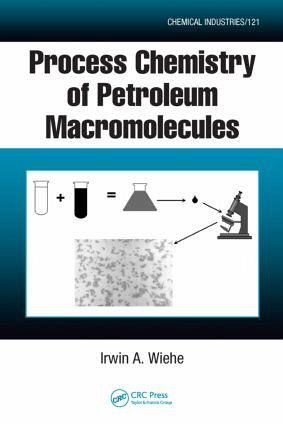
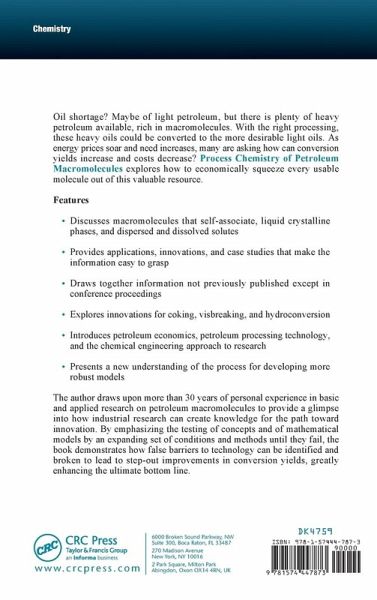
Although there is a shortage of light petroleum, there is plenty of heavy petroleum rich in macromolecules available, creating an increasing interest for processes that can convert these heavy oils to light oils. Process Chemistry of Petroleum Macromolecules provides the scientific basis for such processes. This book presents methods to determine the potential for improvement. Topics include characterization, thermal kinetics, phase behavior, and separation. Revealing that the science of petroleum macromolecules is much simpler and exciting than imagined, it also discusses macromolecules that self-associate, liquid crystalline phases, reactions triggered by phase separation, and solutes that are both dispersed and dissolved.
". . . this book will be invaluable for engineers engaged in operation of refining units or upgraders that process vacuum residues . . . As a scientific memoire and summary of an eminent career, this volume presents numerous insights for future development of both process technology and the science of petroleum macromolecules."
- Murray R. Gray, University of Alberta, in Energy & Fuels, May 2009, Vol. 23, No. 6
- Murray R. Gray, University of Alberta, in Energy & Fuels, May 2009, Vol. 23, No. 6