John Dupré explores recent revolutionary developments in biology and considers their relevance for our understanding of human nature and human society. Epigenetics and related areas of molecular biology have eroded the exceptional status of the gene and presented the genome as fully interactive with the rest of the cell. Developmental systems theory provides a space for a vision of evolution that takes full account of the fundamental importance of developmental processes. Dupré shows the importance of microbiology for a proper understanding of the living world, and reveals how it subverts such…mehr
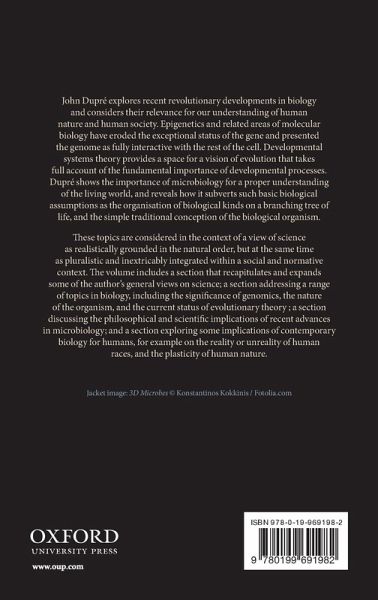
John Dupré explores recent revolutionary developments in biology and considers their relevance for our understanding of human nature and human society. Epigenetics and related areas of molecular biology have eroded the exceptional status of the gene and presented the genome as fully interactive with the rest of the cell. Developmental systems theory provides a space for a vision of evolution that takes full account of the fundamental importance of developmental processes. Dupré shows the importance of microbiology for a proper understanding of the living world, and reveals how it subverts such basic biological assumptions as the organisation of biological kinds on a branching tree of life, and the simple traditional conception of the biological organism. These topics are considered in the context of a view of science as realistically grounded in the natural order, but at the same time as pluralistic and inextricably integrated within a social and normative context. The volume includes a section that recapitulates and expands some of the author's general views on science; a section addressing a range of topics in biology, including the significance of genomics, the nature of the organism and the current status of evolutionary theory; and a section exploring some implications of contemporary biology for humans, for example on the reality or unreality of human races, and the plasticity of human nature.
John Dupré is Professor of Philosophy of Science at the University of Exeter and, since 2002, Director of the ESRC Centre for Genomics in Society (Egenis). He has formerly held posts at Oxford, Stanford, and Birkbeck College, London. In 2006 he held the Spinoza Visiting Professorship at the University of Amsterdam. He is the President-Elect of the British Society for the Philosophy of Science and a member of the Council of the International Society for the History, Philosophy and Social Studies of Biology. John Dupré has worked on a wide variety of biological issues of interest to philosophy, including the nature of species, organisms, and genes, the implications of evolutionary theory, and lately on genomics and various related areas of molecular biology (epigenetics, microbiology, systems biology and synthetic biology). He has also contributed to philosophical discussions on topics of relevance to science, such as the nature of causation and the status of natural kinds.
Inhaltsangabe
* Introduction * I. Science * 1: The Miracle of Monism * 2: What's the Fuss about Social Constructivism? * 3: The Inseparability of Science and Values * II. Biology * 4: The Constituents of Life 1: Species, Microbes and Genes * 5: The Constituents of Life 2: Organisms and Systems * 6: Understanding Contemporary Genomics * 7: The Polygenomic Organism * 8: It is not Possible to Reduce Biological Explanations to Explanations in Chemistry and/or Physics * 9: Postgenomic Darwinism * III. Microbes * 10: (with Maureen O'Malley): Size Doesn't Matter: Towards a More Inclusive Philosophy of Biology * 11: (with Maureen O'Malley): Metagenomics and Biological Ontology * 12: (with Maureen O'Malley): Varieties of living things: Life at the intersection of lineage and metabolism * 13: Emerging Sciences and New Conceptions of Disease: Or, Beyond the Monogenomic Differentiated Cell Lineage * IV. Humans * 14: Against Maladaptationism: or What's Wrong with Evolutionary Psychology * 15: What Genes Are, and Why There Are No Genes for Race * 16: Causality and Human Nature in the Social Sciences
* Introduction * I. Science * 1: The Miracle of Monism * 2: What's the Fuss about Social Constructivism? * 3: The Inseparability of Science and Values * II. Biology * 4: The Constituents of Life 1: Species, Microbes and Genes * 5: The Constituents of Life 2: Organisms and Systems * 6: Understanding Contemporary Genomics * 7: The Polygenomic Organism * 8: It is not Possible to Reduce Biological Explanations to Explanations in Chemistry and/or Physics * 9: Postgenomic Darwinism * III. Microbes * 10: (with Maureen O'Malley): Size Doesn't Matter: Towards a More Inclusive Philosophy of Biology * 11: (with Maureen O'Malley): Metagenomics and Biological Ontology * 12: (with Maureen O'Malley): Varieties of living things: Life at the intersection of lineage and metabolism * 13: Emerging Sciences and New Conceptions of Disease: Or, Beyond the Monogenomic Differentiated Cell Lineage * IV. Humans * 14: Against Maladaptationism: or What's Wrong with Evolutionary Psychology * 15: What Genes Are, and Why There Are No Genes for Race * 16: Causality and Human Nature in the Social Sciences
Es gelten unsere Allgemeinen Geschäftsbedingungen: www.buecher.de/agb
Impressum
www.buecher.de ist ein Internetauftritt der buecher.de internetstores GmbH
Geschäftsführung: Monica Sawhney | Roland Kölbl | Günter Hilger
Sitz der Gesellschaft: Batheyer Straße 115 - 117, 58099 Hagen
Postanschrift: Bürgermeister-Wegele-Str. 12, 86167 Augsburg
Amtsgericht Hagen HRB 13257
Steuernummer: 321/5800/1497
USt-IdNr: DE450055826