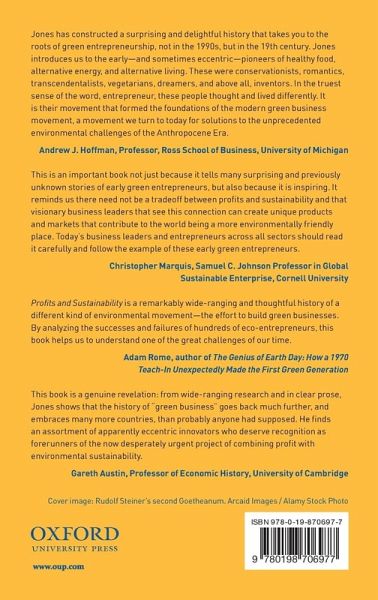
Are profits and sustainability compatible? This book brings unique perspectives to this key debate by exploring the history of green entrepreneurship since the nineteenth century, and its spread globally in industries including renewable energy, organic food, natural beauty, ecotourism, recycling, architecture, and finance. The book uses the lens of the extraordinary and often eccentric men and women who defied convention and imagined that business could help save the planet, rather than consume it. The social and religious beliefs that drove many of these individuals are explored as the book…mehr
Are profits and sustainability compatible? This book brings unique perspectives to this key debate by exploring the history of green entrepreneurship since the nineteenth century, and its spread globally in industries including renewable energy, organic food, natural beauty, ecotourism, recycling, architecture, and finance. The book uses the lens of the extraordinary and often eccentric men and women who defied convention and imagined that business could help save the planet, rather than consume it. The social and religious beliefs that drove many of these individuals are explored as the book looks at how they overcame huge obstacles to execute their strategies. The green entrepreneurs seen here are shown to have created new markets and industries, and driven innovations in sustainable practices, even at times when most consumers and governments marginalized the entire subject. The struggles of early pioneers appear to have been rewarded by the growth of environmental awareness among consumers, business leaders, and others in recent years, but the Earth's environmental health continues to deteriorate. If profits and sustainability have proved challenging to reconcile, the book argues that one reason was how they were both defined.
Geoffrey Jones is the Isidor Straus Professor of Business History at the Harvard Business School. He holds degrees of MA and PhD from Cambridge University, and taught previously at the London School of Economics, and Cambridge and Reading Universities in Britain, and at Erasmus University Rotterdam in the Netherlands. Professor Jones researches the evolution, impact, and responsibility of global business. He is a Fellow of the Academy of International Business and Fellow of the Royal Historical Society. His recent books include Multinationals and Global Capitalism: From the Nineteenth to Twenty First Century (Oxford University Press, 2005), Renewing Unilever. Transformation and Tradition (Oxford University Press, 2005), and Beauty Imagined (Oxford University Press, 2011)
Inhaltsangabe
Introduction: The Business of Sustainability Part 1: Green Intentions 1: Pioneering in Food and Energy 2: Poisoned Earth: Green Businesses 1930s-1950s 3: Earthrise and the Rise of Green Business 4: Accidental Sustainability: Waste and Tourism as Green Businesses PART 2: Green Business 5: Making Money By Saving the World 6: Building Green Institutions 7: Can Finance Change the World? 8: The Green Team: Government and Business 9: Corporate Environmentalism and the Boundaries of Sustainability 10: Conclusion
Introduction: The Business of Sustainability Part 1: Green Intentions 1: Pioneering in Food and Energy 2: Poisoned Earth: Green Businesses 1930s-1950s 3: Earthrise and the Rise of Green Business 4: Accidental Sustainability: Waste and Tourism as Green Businesses PART 2: Green Business 5: Making Money By Saving the World 6: Building Green Institutions 7: Can Finance Change the World? 8: The Green Team: Government and Business 9: Corporate Environmentalism and the Boundaries of Sustainability 10: Conclusion
Es gelten unsere Allgemeinen Geschäftsbedingungen: www.buecher.de/agb
Impressum
www.buecher.de ist ein Internetauftritt der buecher.de internetstores GmbH
Geschäftsführung: Monica Sawhney | Roland Kölbl | Günter Hilger
Sitz der Gesellschaft: Batheyer Straße 115 - 117, 58099 Hagen
Postanschrift: Bürgermeister-Wegele-Str. 12, 86167 Augsburg
Amtsgericht Hagen HRB 13257
Steuernummer: 321/5800/1497
USt-IdNr: DE450055826