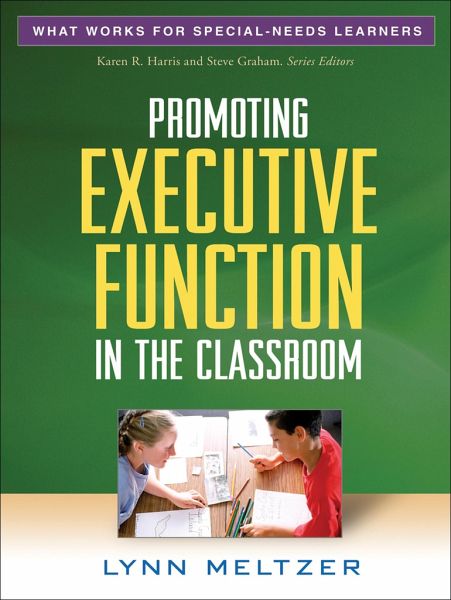
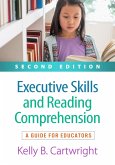
Helps teachers incorporate executive function processes - such as planning, organizing, prioritizing, and self-checking - into the classroom curriculum.
Helps teachers incorporate executive function processes - such as planning, organizing, prioritizing, and self-checking - into the classroom curriculum.
Lynn Meltzer, PhD, is President and Co-Founder of the Research Institute for Learning and Development (ResearchILD) in Lexington, Massachusetts. Since the 1980s, her clinical work, research, publications, and presentations have focused on understanding the complexity of learning and attention differences. Dr. Meltzer is founder and Program Chair of the annual Executive Function and Learning Differences Conference, which she established in 1984. A Fellow and past president of the International Academy for Research in Learning Disabilities, she served for 30 years as an Associate in Education at the Harvard Graduate School of Education and Adjunct Associate Professor in the Department of Child Development at Tufts University. Dr. Meltzer has been an invited speaker at numerous national and international conferences, and has received many awards, including the Outstanding Researcher Award from the Council for Learning Disabilities and the Innovative Program of the Year Award from Children and Adults with Attention-Deficit/Hyperactivity Disorder (CHADD). Together with her ResearchILD colleagues, she has developed SMARTS, an evidence-based executive function curriculum for elementary, middle, and high school students that is used bv schools in 48 states across the United States and in 38 countries worldwide (www.smarts-ef.org).
Inhaltsangabe
I. Understanding Executive Function: The Challenge for 21st-Century Teachers 1. Understanding Assessing and Teaching Executive Function Processes: The Why What and How Lynn Meltzer 2. Creating a Classroomwide Executive Function Culture That Fosters Strategy Use Motivation and Resilience Lynn Meltzer and Surina Basho II. Scaffolding Executive Function Processes into the Curriculum Content 3. Goal Setting Planning and Prioritizing: The Foundations of Effective Learning Kalyani Krishnan Melissa J. Feller and Melissa Orkin 4. Organizing: The Heart of Efficient and Successful Learning Kalyani Krishnan and Melissa J. Feller 5. Remembering: Teaching Students How to Retain and Mentally Manipulate Information Donna M. Kincaid and Nancy Trautman 6. Shifting and Flexible Problem Solving: The Anchors for Academic and Life Success Lynn Meltzer and Jennifer Sage Bagnato 7. Self-Monitoring and Self-Checking: The Cornerstones of Independent Learning Jennifer Sage Bagnato and Lynn Meltzer 8. Emotional Self-Regulation: A Critical Component of Executive Function Judith A. Stein III. Case Studies: Addressing Executive Function Weaknesses across the Grades Lena Hannus-Suksi Laura Sales Pollica Wendy Stacey Melissa J. Feller and Jason Bendezu Appendix: Reproducibles for the Classroom
I. Understanding Executive Function: The Challenge for 21st-Century Teachers 1. Understanding Assessing and Teaching Executive Function Processes: The Why What and How Lynn Meltzer 2. Creating a Classroomwide Executive Function Culture That Fosters Strategy Use Motivation and Resilience Lynn Meltzer and Surina Basho II. Scaffolding Executive Function Processes into the Curriculum Content 3. Goal Setting Planning and Prioritizing: The Foundations of Effective Learning Kalyani Krishnan Melissa J. Feller and Melissa Orkin 4. Organizing: The Heart of Efficient and Successful Learning Kalyani Krishnan and Melissa J. Feller 5. Remembering: Teaching Students How to Retain and Mentally Manipulate Information Donna M. Kincaid and Nancy Trautman 6. Shifting and Flexible Problem Solving: The Anchors for Academic and Life Success Lynn Meltzer and Jennifer Sage Bagnato 7. Self-Monitoring and Self-Checking: The Cornerstones of Independent Learning Jennifer Sage Bagnato and Lynn Meltzer 8. Emotional Self-Regulation: A Critical Component of Executive Function Judith A. Stein III. Case Studies: Addressing Executive Function Weaknesses across the Grades Lena Hannus-Suksi Laura Sales Pollica Wendy Stacey Melissa J. Feller and Jason Bendezu Appendix: Reproducibles for the Classroom
Es gelten unsere Allgemeinen Geschäftsbedingungen: www.buecher.de/agb
Impressum
www.buecher.de ist ein Internetauftritt der buecher.de internetstores GmbH
Geschäftsführung: Monica Sawhney | Roland Kölbl | Günter Hilger
Sitz der Gesellschaft: Batheyer Straße 115 - 117, 58099 Hagen
Postanschrift: Bürgermeister-Wegele-Str. 12, 86167 Augsburg
Amtsgericht Hagen HRB 13257
Steuernummer: 321/5800/1497
USt-IdNr: DE450055826