
Andere Kunden interessierten sich auch für
 Prosper Merimees Letters to an Incognita32,99 €
 Letters of Prosper Merimee to Panizzi, Volume 236,99 €
![Correspondance inÃ(c)dite [de] Stendhal. PrÃ(c)cÃ(c)dÃ(c)e d'une introd. par Prosper MÃ(c)rimÃ(c)e]( "Correspondance inÃ(c)dite [de] Stendhal. PrÃ(c)cÃ(c)dÃ(c)e d'une introd. par Prosper MÃ(c)rimÃ(c)e") Correspondance inÃ(c)dite [de] Stendhal. PrÃ(c)cÃ(c)dÃ(c)e d'une introd. par Prosper MÃ(c)rimÃ(c)e34,99 €
Correspondance inÃ(c)dite [de] Stendhal. PrÃ(c)cÃ(c)dÃ(c)e d'une introd. par Prosper MÃ(c)rimÃ(c)e34,99 € The Letters of Robert Louis Stevenson Part Four34,99 €
 The Letters Of Lord Nelson To Lady Hamilton V146,99 €
 Letters Of Samuel Wesley To Mr. Jacobs, Organist Of Surrey Chapel19,99 €
 A Bone To Gnaw For Grant Thorburn17,99 €
![Correspondance inÃ(c)dite [de] Stendhal. PrÃ(c)cÃ(c)dÃ(c)e d'une introd. par Prosper MÃ(c)rimÃ(c)e](https://bilder.buecher.de/produkte/74/74361/74361832m.jpg "Correspondance inÃ(c)dite [de] Stendhal. PrÃ(c)cÃ(c)dÃ(c)e d'une introd. par Prosper MÃ(c)rimÃ(c)e")




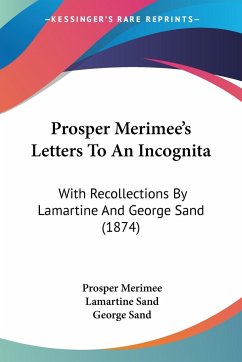
Prosper Merimee¿¿¿¿¿¿¿s Letters To An Incognita: With Recollections By Lamartine And George Sand (1874) is a collection of letters written by French author Prosper Merimee to an unknown recipient, along with recollections of Merimee by fellow French writers Alphonse de Lamartine and George Sand. The letters cover a wide range of topics, including literature, travel, and personal anecdotes. Merimee¿¿¿¿¿¿¿s writing style is witty and engaging, providing insight into his personality and worldview. The recollections by Lamartine and Sand offer additional context and perspective on Merimee¿¿¿¿¿¿¿s life and work. Overall, this book offers a fascinating glimpse into the mind of one of France¿¿¿¿¿¿¿s most celebrated authors.Edited By Richard Henry Stoddard.This scarce antiquarian book is a facsimile reprint of the old original and may contain some imperfections such as library marks and notations. Because we believe this work is culturally important, we have made it available as part of our commitment for protecting, preserving, and promoting the world's literature in affordable, high quality, modern editions, that are true to their original work.