34,99 €
inkl. MwSt.
Versandkostenfrei*Erscheint vorauss. 19. Januar 2026
Melden Sie sich
hier
hier
für den Produktalarm an, um über die Verfügbarkeit des Produkts informiert zu werden.
oder sofort lesen als eBook

17 °P sammeln
Andere Kunden interessierten sich auch für
 Adolescent Parenthood and Education22,99 €
 Cultural Disability Studies in Education50,99 €
 Death, Society, and Human Experience185,99 €
 Parenthood And Race Culture16,99 €
 Digital Healthcare and Expertise47,99 €
 Managing Medical Authority31,99 €
 Remapping Race in a Global Context52,99 €

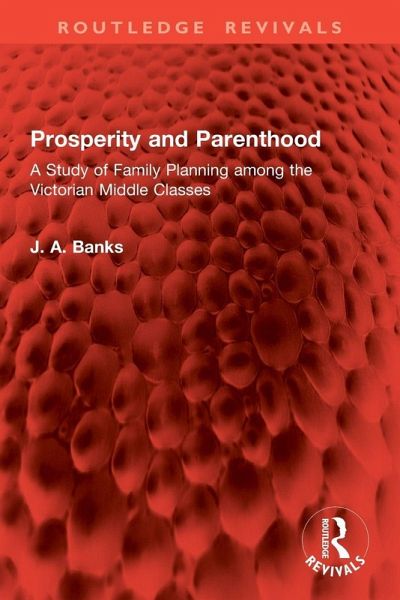
First Published in 1954, Prosperity and Parenthood is a study of Victorian middle-class ideas about the standard of living, marriage, and the responsibilities of family life. The book begins by tracing the fall in fertility in the 1870s to a change in the middle-class conception of parenthood and goes on to show that the standard of living considerably expanded during the period of great prosperity, roughly 1850 to 1870. The author also gives a detailed study of what the middle classes considered appropriate for a civilized existence and ends by considering the "Great Depression" as a possible factor attacking the actual level of living and making it possible for the middle classes to maintain established standards only by cutting down the size of their families. This is an important historical reference work for students and scholars of sociology, sociology of family, British sociology, social history, and medical sociology.