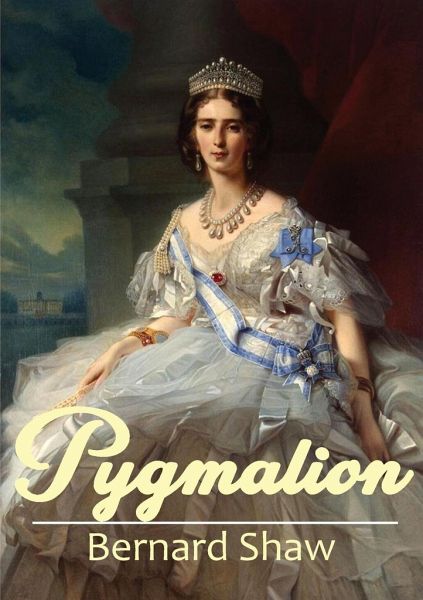
Pygmalion is a play by George Bernard Shaw, named after a Greek mythological figure. It was first presented on stage to the public in 1913. In ancient Greek mythology, Pygmalion fell in love with one of his sculptures, which then came to life. The general idea of that myth was a popular subject for Victorian era English playwrights, including one of Shaw's influences, W. S. Gilbert, who wrote a successful play based on the story called Pygmalion and Galatea that was first presented in 1871. Shaw would also have been familiar with the burlesque version, Galatea, or Pygmalion Reversed. Shaw's…mehr
Pygmalion is a play by George Bernard Shaw, named after a Greek mythological figure. It was first presented on stage to the public in 1913. In ancient Greek mythology, Pygmalion fell in love with one of his sculptures, which then came to life. The general idea of that myth was a popular subject for Victorian era English playwrights, including one of Shaw's influences, W. S. Gilbert, who wrote a successful play based on the story called Pygmalion and Galatea that was first presented in 1871. Shaw would also have been familiar with the burlesque version, Galatea, or Pygmalion Reversed. Shaw's play has been adapted numerous times, most notably as the musical My Fair Lady and its film version. Shaw mentioned that the character of Professor Henry Higgins was inspired by several British professors of phonetics: Alexander Melville Bell, Alexander J. Ellis, Tito Pagliardini, but above all, the cantankerous Henry Sweet.
From 26 July 1856 to 2 November 1950, Irish playwright, critic, polemicist, and political activist George Bernard Shaw was alive. He preferred to be referred to simply as Bernard Shaw. From the 1880s until his death and even after, he had a significant impact on Western politics, theater, and society. He produced more than sixty plays, including classics like Saint Joan (1913), Pygmalion (1913), and Man and Superman (1902). (1923). Shaw became a well-known playwright during his time and was awarded the Nobel Prize in literature in 1925 for his works that combine historical allegory and contemporary satire. Before Shaw's first play, Arms and the Man, published in 1894, became a success in the public eye, years passed. He tried to infuse new realism into English-language drama, influenced by Henrik Ibsen. He had established himself as a reputable theater and music critic by the mid-1880s. After having a political awakening, he joined the gradualist Fabian Society and swiftly advanced to the position of principal pamphleteer. Before Shaw's first play, Arms and the Man, published in 1894, became a success in the public eye, years passed. He tried to infuse new realism into English-language drama, influenced by Henrik Ibsen.
Es gelten unsere Allgemeinen Geschäftsbedingungen: www.buecher.de/agb
Impressum
www.buecher.de ist ein Internetauftritt der buecher.de internetstores GmbH
Geschäftsführung: Monica Sawhney | Roland Kölbl | Günter Hilger
Sitz der Gesellschaft: Batheyer Straße 115 - 117, 58099 Hagen
Postanschrift: Bürgermeister-Wegele-Str. 12, 86167 Augsburg
Amtsgericht Hagen HRB 13257
Steuernummer: 321/5800/1497
USt-IdNr: DE450055826