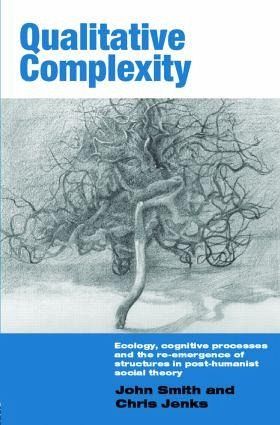
John Smith, Chris Jenks
Qualitative Complexity
Ecology, Cognitive Processes and the Re-Emergence of Structures in Post-Humanist Social Theory
John Smith, Chris Jenks
Qualitative Complexity
Ecology, Cognitive Processes and the Re-Emergence of Structures in Post-Humanist Social Theory
- Gebundenes Buch
- Merkliste
- Auf die Merkliste
- Bewerten Bewerten
- Teilen
- Produkt teilen
- Produkterinnerung
- Produkterinnerung
"Simultaneously published in the USA and Canada by Routledge."
Andere Kunden interessierten sich auch für
Nicholas RescherComplexity177,99 €
Paul CilliersComplexity and Postmodernism168,99 €
The Significance of Complexity176,99 €
Sandra D. MitchellBiological Complexity and Integrative Pluralism78,99 €
Managing in a VUCA World (Volatility, Uncertainty, Complexity and Ambiguity)137,99 €
Carlos Gershenson / Diederik Aerts / Bruce Edmonds (eds.)Worldviews, Science and Us: Philosophy and Complexity160,99 €
The Qualitative-Quantitative Distinction in the Social Sciences77,99 €-
-
-
Produktdetails
- Produktdetails
- Verlag: Routledge
- Seitenzahl: 312
- Erscheinungstermin: 9. März 2006
- Englisch
- Abmessung: 240mm x 161mm x 21mm
- Gewicht: 634g
- ISBN-13: 9780415336505
- ISBN-10: 0415336503
- Artikelnr.: 22516594
- Herstellerkennzeichnung
- Libri GmbH
- Europaallee 1
- 36244 Bad Hersfeld
- gpsr@libri.de
- Verlag: Routledge
- Seitenzahl: 312
- Erscheinungstermin: 9. März 2006
- Englisch
- Abmessung: 240mm x 161mm x 21mm
- Gewicht: 634g
- ISBN-13: 9780415336505
- ISBN-10: 0415336503
- Artikelnr.: 22516594
- Herstellerkennzeichnung
- Libri GmbH
- Europaallee 1
- 36244 Bad Hersfeld
- gpsr@libri.de
John David Smith is a pastor, author, and speaker with over 30 years of ministry and teaching experience. His work explores the intersection of faith, emotional honesty, and spiritual formation. As the founder of Scribe & Canvas Publishing, he is committed to creating resources that foster healing, reflection, and authentic connection with God. Unspoken: 12 Devotions for What We Carry in Silence is his first devotional in the 12-Devotions for the Journey Series, written for those navigating quiet struggles and unspoken burdens. John lives and serves in South Carolina.
Part 1: The Interdisciplinary Field 1. Complexity Theory: A Positioning
Paper 2. From Descartes' Conjecture to Kant's Subject and the Computo 3.
Autopoiesis in Cognitive Biology 4. Emergentism, Evolutionary Psychology
and Culture 5. Prigogine's Thermodynamics, Ontology and Sociology Part 2:
Critical Developments 6. Modernism and Determinism: Linear Expectations and
Qualitative Complexity Analyses 7. Complexity Theory as a Critique of
Postmodernism 8. Cognition and the Renewal of Systems Theory: Redundant
Idioms and Disputed Positions 9. The Evolution of Intelligence,
Consciousness and Language: Implications for Social Theory 10. Complexity,
Language and Culture: Social Systems in Qualitative, i.e. not Formal Terms
Part 3: The Fields of Complex Analysis: Contemporary Complexity Theory 11.
The Ethics of Pragmatism: Politics and Post-Structuralism in Transition
after the Complexity Turn 12. The Topology of Complexity 13.
Re-Interpreting Global Complexity as an Ontology: Human Ecology

Paper 2. From Descartes' Conjecture to Kant's Subject and the Computo 3.
Autopoiesis in Cognitive Biology 4. Emergentism, Evolutionary Psychology
and Culture 5. Prigogine's Thermodynamics, Ontology and Sociology Part 2:
Critical Developments 6. Modernism and Determinism: Linear Expectations and
Qualitative Complexity Analyses 7. Complexity Theory as a Critique of
Postmodernism 8. Cognition and the Renewal of Systems Theory: Redundant
Idioms and Disputed Positions 9. The Evolution of Intelligence,
Consciousness and Language: Implications for Social Theory 10. Complexity,
Language and Culture: Social Systems in Qualitative, i.e. not Formal Terms
Part 3: The Fields of Complex Analysis: Contemporary Complexity Theory 11.
The Ethics of Pragmatism: Politics and Post-Structuralism in Transition
after the Complexity Turn 12. The Topology of Complexity 13.
Re-Interpreting Global Complexity as an Ontology: Human Ecology
Part 1: The Interdisciplinary Field 1. Complexity Theory: A Positioning
Paper 2. From Descartes' Conjecture to Kant's Subject and the Computo 3.
Autopoiesis in Cognitive Biology 4. Emergentism, Evolutionary Psychology
and Culture 5. Prigogine's Thermodynamics, Ontology and Sociology Part 2:
Critical Developments 6. Modernism and Determinism: Linear Expectations and
Qualitative Complexity Analyses 7. Complexity Theory as a Critique of
Postmodernism 8. Cognition and the Renewal of Systems Theory: Redundant
Idioms and Disputed Positions 9. The Evolution of Intelligence,
Consciousness and Language: Implications for Social Theory 10. Complexity,
Language and Culture: Social Systems in Qualitative, i.e. not Formal Terms
Part 3: The Fields of Complex Analysis: Contemporary Complexity Theory 11.
The Ethics of Pragmatism: Politics and Post-Structuralism in Transition
after the Complexity Turn 12. The Topology of Complexity 13.
Re-Interpreting Global Complexity as an Ontology: Human Ecology
Paper 2. From Descartes' Conjecture to Kant's Subject and the Computo 3.
Autopoiesis in Cognitive Biology 4. Emergentism, Evolutionary Psychology
and Culture 5. Prigogine's Thermodynamics, Ontology and Sociology Part 2:
Critical Developments 6. Modernism and Determinism: Linear Expectations and
Qualitative Complexity Analyses 7. Complexity Theory as a Critique of
Postmodernism 8. Cognition and the Renewal of Systems Theory: Redundant
Idioms and Disputed Positions 9. The Evolution of Intelligence,
Consciousness and Language: Implications for Social Theory 10. Complexity,
Language and Culture: Social Systems in Qualitative, i.e. not Formal Terms
Part 3: The Fields of Complex Analysis: Contemporary Complexity Theory 11.
The Ethics of Pragmatism: Politics and Post-Structuralism in Transition
after the Complexity Turn 12. The Topology of Complexity 13.
Re-Interpreting Global Complexity as an Ontology: Human Ecology