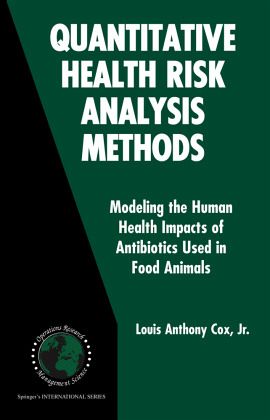
This book grew out of an effort to salvage a potentially useful idea for greatly simplifying traditional quantitative risk assessments of the human health consequences of using antibiotics in food animals. In 2001, the United States FDA's Center for Veterinary Medicine (CVM) (FDA-CVM, 2001) published a risk assessment model for potential adverse human health consequences of using a certain class of antibiotics, fluoroquinolones, to treat flocks of chickens with fatal respiratory disease caused by infectious bacteria. CVM's concern was that fluoroquinolones are also used in human medicine,…mehr
This book grew out of an effort to salvage a potentially useful idea for greatly simplifying traditional quantitative risk assessments of the human health consequences of using antibiotics in food animals. In 2001, the United States FDA's Center for Veterinary Medicine (CVM) (FDA-CVM, 2001) published a risk assessment model for potential adverse human health consequences of using a certain class of antibiotics, fluoroquinolones, to treat flocks of chickens with fatal respiratory disease caused by infectious bacteria. CVM's concern was that fluoroquinolones are also used in human medicine, raising the possibility that fluoroquinolone-resistant strains of bacteria selected by use of fluoroquinolones in chickens might infect humans and then prove resistant to treatment with human medicines in the same class of antibiotics, such as ciprofloxacin. As a foundation for its risk assessment model, CVM proposed a dramatically simple approach that skipped many of the steps in traditional risk assessment. The basic idea was to assume that human health risks were directly proportional to some suitably defined exposure metric. In symbols: Risk = K × Exposure, where "Exposure" would be defined in terms of a metric such as total production of chicken contaminated with fluoroquinolone-resistant bacteria that might cause human illnesses, and "Risk" would describe the expected number of cases per year of human illness due to fluoroquinolone-resistant bacterial infections caused by chicken and treated with fluoroquinolones.
Produktdetails
Produktdetails
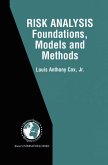
International Series in Operations Research & Management Science 82
Tony Cox is Professor of Business Analytics at the University of Colorado and President of Cox Associates, a Denver-based applied research company specializing in health, safety, and environmental risk analysis; epidemiology; policy analytics; data science; artificial intelligence; and operations research. Dr. Cox is Editor-in-Chief of Risk Analysis: An International Journal. He is Area Editor for Real World Applications for the Journal of Heuristics, and is on the Editorial Board of the International Journal of Operations Research and Information Systems. He has authored and co-authored over 200 journal articles and book chapters on these fields. His most recent books are Causal Analytics for Risk Analysis (Springer, 2018), Breakthroughs in Decision Science and Risk Analysis (Wiley, 2015), Improving Risk Analysis (Springer, 2013), and the Wiley Encyclopedia of Operations Research and Management Science (Wiley, 2011), which Dr. Cox co-edited. He has over a dozen U.S. patents on applications of artificial intelligence, signal processing, statistics and operations research in telecommunications. His current research interests include computational statistical methods for causal inference in public health risk analysis, data-mining, and advanced analytics for risk management, business, and public policy applications.
Inhaltsangabe
Qualitative and Quantitative Risk Analysis.- Risk Analysis: Goals and Methods.- Hazard Identification.- Exposure Assessment.- Dose-Response Modeling and Risk Characterization.- Human Health Risks from Virginiamycin: A Case Study.- Dynamic Modeling and Uncertainty Analysis.- Potential Human Health Benefits of Animal Antibiotics.
Qualitative and Quantitative Risk Analysis.- Risk Analysis: Goals and Methods.- Hazard Identification.- Exposure Assessment.- Dose-Response Modeling and Risk Characterization.- Human Health Risks from Virginiamycin: A Case Study.- Dynamic Modeling and Uncertainty Analysis.- Potential Human Health Benefits of Animal Antibiotics.
Rezensionen
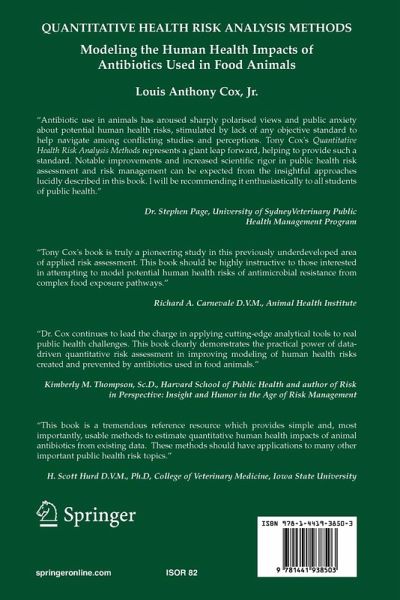
From the reviews: "This book grew out of an effort to salvage a potentially useful idea for greatly simplifying traditional quantitative risk assessments of the human health consequences of using antibiotics in food animals. ... It is truly a pioneering study in this previously underdeveloped area of applied risk assessment. This book should be highly instructive to those interested in attempting to model potential human risks of antimicrobial resistance from complex food exposure pathways. ... The book is a tremendous reference resource ... ." (T. Postelnicu, Zentralblatt MATH, Vol. 1095 (21), 2006) "This extensively treated application clarifies health risk analysis methods to the reader. It is very well readable. ... The book clearly demonstrates the practical power of data-driven quantitative risk assessment in improving modeling of human health risks created and prevented by antibiotics ... . I do recommend this book." (V. de Valk, Kwantitatieve Methoden, April, 2007)
Es gelten unsere Allgemeinen Geschäftsbedingungen: www.buecher.de/agb
Impressum
www.buecher.de ist ein Internetauftritt der buecher.de internetstores GmbH
Geschäftsführung: Monica Sawhney | Roland Kölbl | Günter Hilger
Sitz der Gesellschaft: Batheyer Straße 115 - 117, 58099 Hagen
Postanschrift: Bürgermeister-Wegele-Str. 12, 86167 Augsburg
Amtsgericht Hagen HRB 13257
Steuernummer: 321/5800/1497
USt-IdNr: DE450055826