
Andere Kunden interessierten sich auch für
 Quantum Mechanics46,99 €
 Quantum Mechanics61,99 €
 Quantum Mechanics57,99 €
 Quantum Mechanics39,99 €
 Geography of Order and Chaos in Mechanics129,99 €
 Lectures in Quantum Mechanics49,99 €
 Lectures in Quantum Mechanics46,99 €
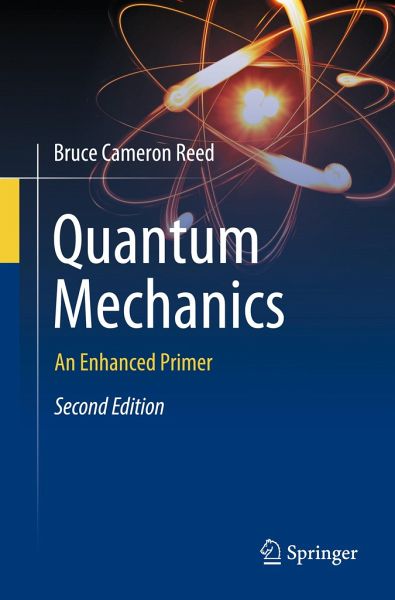
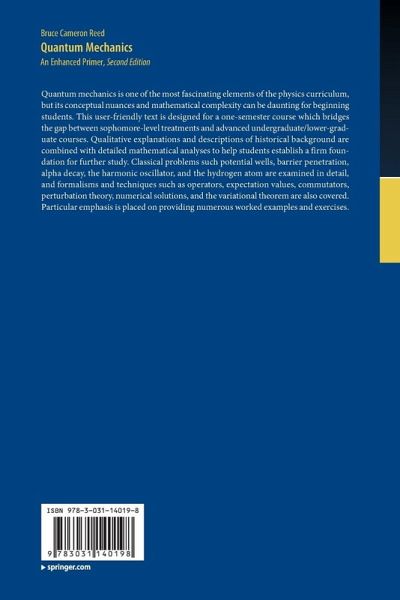
Quantum mechanics is one of the most fascinating elements of the physics curriculum, but its conceptual nuances and mathematical complexity can be daunting for beginning students. This user-friendly text is designed for a one-semester course which bridges the gap between sophomore-level treatments and advanced undergraduate/lower-graduate courses. Qualitative explanations and descriptions of historical background are combined with detailed mathematical analyses to help students establish a firm foundation for further study. Classical problems such potential wells, barrier penetration, alpha decay, the harmonic oscillator, and the hydrogen atom are examined in detail, and formalisms and techniques such as operators, expectation values, commutators, perturbation theory, numerical solutions, and the variational theorem are also covered. Particular emphasis is placed on providing numerous worked examples and exercises.