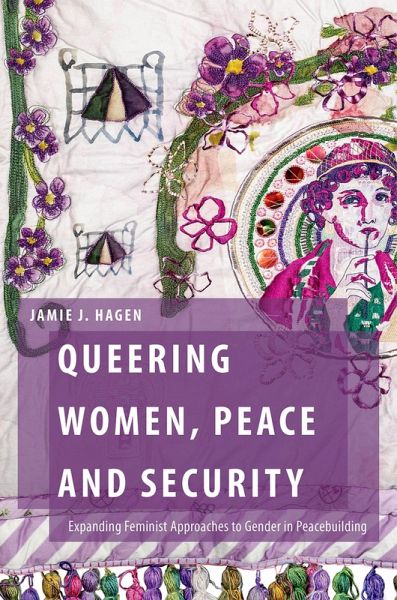
This book applies queer theory to the existing Women, Peace and Security (WPS) agenda to identify persistent gaps in the WPS framework's treatment of LGBTQ people in conflict, and to outline steps for LGBTQ leaders and WPS actors to better engage with these communities. Since the adoption in 2000 of resolution 1325 by the United Nations Security Council, the WPS architecture has grown and developed, and examples of implementation have begun to reveal the way in which "gender" has generally been used to mean women, and even more narrowly heterosexual women. Jamie J. Hagen evaluates how WPS…mehr
This book applies queer theory to the existing Women, Peace and Security (WPS) agenda to identify persistent gaps in the WPS framework's treatment of LGBTQ people in conflict, and to outline steps for LGBTQ leaders and WPS actors to better engage with these communities. Since the adoption in 2000 of resolution 1325 by the United Nations Security Council, the WPS architecture has grown and developed, and examples of implementation have begun to reveal the way in which "gender" has generally been used to mean women, and even more narrowly heterosexual women. Jamie J. Hagen evaluates how WPS practitioners understand the needs of LGBTQ people in war and peacebuilding, and what needs to change in order to take a more inclusive approach to gender.
Jamie J. Hagen is a Lecturer in Global Politics at the University of Manchester and a researcher applying a feminist and anti-racist approach to bridging gaps between academic, policy, and activism. Formerly Hagen was a Lecturer in International Relations at Queen's University Belfast where she co-founded the Centre for Gender in Politics. Working at the intersection of gender, security studies, and queer theory, Hagen is an expert on ways international bodies consider LGBTQ+ (lesbian, gay, bisexual, transgender, and queer) populations in peacebuilding, with a special focus on how Women, Peace and Security initiatives can better include LGBTQ voices and experiences, especially lesbian, bisexual, and transgender women. She is co-editor of Queer Conflict Research: New Approaches to the Study of Political Violence.
Inhaltsangabe
1: Introduction 2: Queering WPS Through Localization and Global South Leadership 3: Sex, Security, and Protecting Queer Lives 4: Tracing Queer Absence in Women, Peace and Security 5: Lesbian Rights Are Women's Rights 6: Queering Gender in WPS 7: Queer Futures for Implementing the WPS Agenda Coda: Why Queering WPS Matters Appendix: Interview
Es gelten unsere Allgemeinen Geschäftsbedingungen: www.buecher.de/agb
Impressum
www.buecher.de ist ein Internetauftritt der buecher.de internetstores GmbH
Geschäftsführung: Monica Sawhney | Roland Kölbl | Günter Hilger
Sitz der Gesellschaft: Batheyer Straße 115 - 117, 58099 Hagen
Postanschrift: Bürgermeister-Wegele-Str. 12, 86167 Augsburg
Amtsgericht Hagen HRB 13257
Steuernummer: 321/5800/1497
USt-IdNr: DE450055826