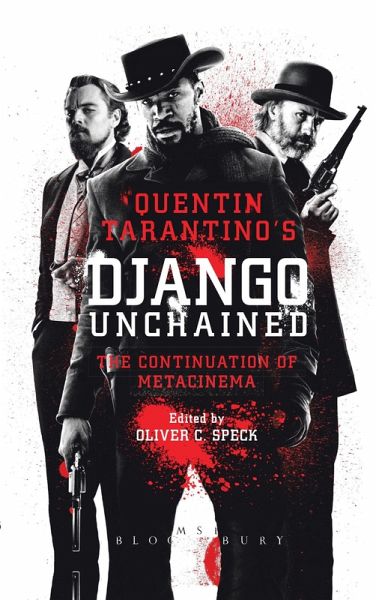
Django Unchained is certainly Quentin Tarantino's most commercially-successful film and is arguably also his most controversial. Fellow director Spike Lee has denounced the representation of race and slavery in the film, while many African American writers have defended the white auteur. The use of extremely graphic violence in the film, even by Tarantino's standards, at a time when gun control is being hotly debated, has sparked further controversy and has led to angry outbursts by the director himself. Moreover, Django Unchained has become a popular culture phenomenon, with t-shirts, highly…mehr
Django Unchained is certainly Quentin Tarantino's most commercially-successful film and is arguably also his most controversial. Fellow director Spike Lee has denounced the representation of race and slavery in the film, while many African American writers have defended the white auteur. The use of extremely graphic violence in the film, even by Tarantino's standards, at a time when gun control is being hotly debated, has sparked further controversy and has led to angry outbursts by the director himself. Moreover, Django Unchained has become a popular culture phenomenon, with t-shirts, highly contentious action figures, posters, and strong DVD/BluRay sales. The topic (slavery and revenge), the setting (a few years before the Civil War), the intentionally provocative generic roots (Spaghetti Western and Blaxploitation) and the many intertexts and references (to German and French culture) demand a thorough examination. Befitting such a complex film, the essays collected here represent a diverse group of scholars who examine Django Unchained from many perspectives.
Oliver C. Speck is Associate Professor of Film Studies at Virginia Commonwealth University, USA. His scholarly writing focuses on the representation of memory and history in French, German and other European cinema.
Inhaltsangabe
0. Introduction: A Southern State of Exception Oliver C. Speck, Virginia Commonwealth University, USA Part I. Cultural Roots and Intertexts: Germany, France, US 20 1. Dr. 'King' Schultz as Ideologue and Emblem: The German Enlightenment and the Legacy of the 1848 Revolutions in Django Unchained Robert von Dassanowsky, University of Colorado, Colorado Springs, USA 2. Franco-faux-ne : Django's jive Margaret Ozierski, Virginia Commonwealth University, USA 3. Of Handshakes and Dragons: Django's German Cousins Dana Weber, Florida State University, USA 4. Django and Lincoln: The Suffering Slave and the Law of Slavery Gregory L. Kaster, Gustavus Adolphus College, USA Part II. Philosophy Unchained: Ethics, Body Space and Evil 5. Bodies in and out of Place: Django Unchained and Body-Spaces Alexander D. Ornella, University of Hull, UK 6. The "D" is Silent, but Human Rights Are Not: Django Unchained as Human Rights Discourse Kate E. Temoney, Florida State University, USA 7. Hark, Hark, the (dis)Enchanted Kantian Or: Tarantino's 'Evil' and its Anti-Cathartic Resonance Dara Waldron, Limerick Institute of Technology, UK 8. Value and Violence in Django Unchained William Brown, University of Roehampton, UK Part III. Questions of Race and Representation: What is a "Black Film"? 9. "Thirteen Ways of Looking at a Black Film": "What does it mean to be a black film in twenty-first century America?" Heather Ashley Hayes, Whitman College, USA, and Gilbert B. Rodman, University of Minnesota, USA 10. Chained To It: The Recurrence of the Frontier Hero in the Films of Quentin Tarantino Samuel P. Perry 11. "Crowdsourcing" "The Bad-Ass Slave": A critique of Quentin Tarantino's Django Unchained Reynaldo Anderson, Harris-Stowe State University, USA, D.L. Stephenson, Western Connecticut State University, USA and Chante Anderson, Texas Southern University, USA 12. Guess Who's Coming to Get Her: Stereotypes, Mythification, and White Redemption Ryan J. Weaver and Nichole K. Kathol, University of Wisconsin-Barron County, USA 13. Django Blues: Whiteness and Hollywood's continued failures David J. Leonard, Washington State University, USA Works Cited Notes on Contributors Index
0. Introduction: A Southern State of Exception Oliver C. Speck, Virginia Commonwealth University, USA Part I. Cultural Roots and Intertexts: Germany, France, US 20 1. Dr. 'King' Schultz as Ideologue and Emblem: The German Enlightenment and the Legacy of the 1848 Revolutions in Django Unchained Robert von Dassanowsky, University of Colorado, Colorado Springs, USA 2. Franco-faux-ne : Django's jive Margaret Ozierski, Virginia Commonwealth University, USA 3. Of Handshakes and Dragons: Django's German Cousins Dana Weber, Florida State University, USA 4. Django and Lincoln: The Suffering Slave and the Law of Slavery Gregory L. Kaster, Gustavus Adolphus College, USA Part II. Philosophy Unchained: Ethics, Body Space and Evil 5. Bodies in and out of Place: Django Unchained and Body-Spaces Alexander D. Ornella, University of Hull, UK 6. The "D" is Silent, but Human Rights Are Not: Django Unchained as Human Rights Discourse Kate E. Temoney, Florida State University, USA 7. Hark, Hark, the (dis)Enchanted Kantian Or: Tarantino's 'Evil' and its Anti-Cathartic Resonance Dara Waldron, Limerick Institute of Technology, UK 8. Value and Violence in Django Unchained William Brown, University of Roehampton, UK Part III. Questions of Race and Representation: What is a "Black Film"? 9. "Thirteen Ways of Looking at a Black Film": "What does it mean to be a black film in twenty-first century America?" Heather Ashley Hayes, Whitman College, USA, and Gilbert B. Rodman, University of Minnesota, USA 10. Chained To It: The Recurrence of the Frontier Hero in the Films of Quentin Tarantino Samuel P. Perry 11. "Crowdsourcing" "The Bad-Ass Slave": A critique of Quentin Tarantino's Django Unchained Reynaldo Anderson, Harris-Stowe State University, USA, D.L. Stephenson, Western Connecticut State University, USA and Chante Anderson, Texas Southern University, USA 12. Guess Who's Coming to Get Her: Stereotypes, Mythification, and White Redemption Ryan J. Weaver and Nichole K. Kathol, University of Wisconsin-Barron County, USA 13. Django Blues: Whiteness and Hollywood's continued failures David J. Leonard, Washington State University, USA Works Cited Notes on Contributors Index
Es gelten unsere Allgemeinen Geschäftsbedingungen: www.buecher.de/agb
Impressum
www.buecher.de ist ein Internetauftritt der buecher.de internetstores GmbH
Geschäftsführung: Monica Sawhney | Roland Kölbl | Günter Hilger
Sitz der Gesellschaft: Batheyer Straße 115 - 117, 58099 Hagen
Postanschrift: Bürgermeister-Wegele-Str. 12, 86167 Augsburg
Amtsgericht Hagen HRB 13257
Steuernummer: 321/5800/1497
USt-IdNr: DE450055826