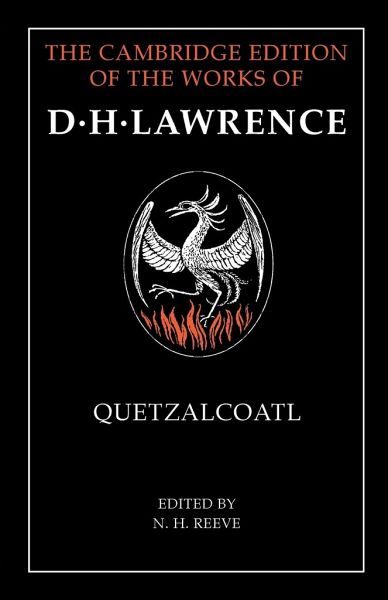
Quetzalcoatl was written during Lawrence's first stay in Mexico, in May and June 1923, and registers his initial responses to those aspects of Mexican landscape, religion, politics and culture which would fascinate him over the following two years. On leaving Mexico in July 1923, he described Quetzalcoatl as 'nearly finished', intending to revise it later, but in the event actually rewrote it almost completely, and it was published as The Plumed Serpent in 1926. This is the first scholarly edition of the original manuscripts and typescripts of Quetzalcoatl, and includes a record of all…mehr
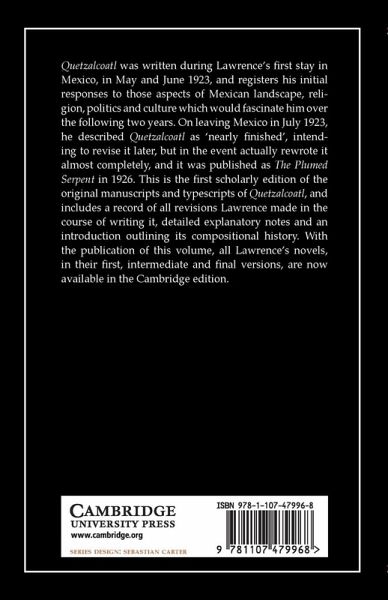
Quetzalcoatl was written during Lawrence's first stay in Mexico, in May and June 1923, and registers his initial responses to those aspects of Mexican landscape, religion, politics and culture which would fascinate him over the following two years. On leaving Mexico in July 1923, he described Quetzalcoatl as 'nearly finished', intending to revise it later, but in the event actually rewrote it almost completely, and it was published as The Plumed Serpent in 1926. This is the first scholarly edition of the original manuscripts and typescripts of Quetzalcoatl, and includes a record of all revisions Lawrence made in the course of writing it, detailed explanatory notes and an introduction outlining its compositional history. With the publication of this volume, all Lawrence's novels, in their first, intermediate and final versions, are now available in the Cambridge edition.
David Herbert Lawrence was born on September 11, 1885. He was not only an important but also disputable English essayist of the 20th century. He was one of the main scholars of English Modernism. Lawrence was a skilled author who wrote several books, brief tales, sonnets, plays, papers, travel guides, artistic creations, interpretations, abstract analyses, and individual letters. Lawrence is remembered today for stretching the boundaries beyond what was regarded as satisfactory in abstract fiction whereas different Modernists such as Joyce and Woolf were content to radicalize the types of writing, Lawrence focused on extending the scope of the artistic topic. Specifically, he consolidated Freudian therapy, forthright portrayals of sexuality, and enchanted strict subjects into his works that were very unexpected and fresh to the crowds of his time. Even though he is regarded as one of the main figures in the early history of Modernism, Lawrence stays questionable. His monstrous result is famously lopsided and he never lived to the point of refining his views into reasonable thoughts. Different pundits mock Lawrence unequivocally and it is the case that a portion of his lesser works was composed more to stun than to illuminate the brain with the brightness of workmanship genuinely. Regardless, Lawrence was a virtuoso of the greatest request, and his most modern sonnets and books are among the most persuasive works of 20th-century writing.
Inhaltsangabe
General editor's preface Acknowledgements Chronology Cue-titles Introduction Quetzalcoatl Appendix I. Deleted MS passage from Chapter III Appendix II. Deleted MS passage from Chapter VI Appendix III. Deleted MS passage from Chapter VII Appendix IV. Deleted MS passage from Chapter VII Explanatory notes Textual apparatus.
General editor's preface Acknowledgements Chronology Cue-titles Introduction Quetzalcoatl Appendix I. Deleted MS passage from Chapter III Appendix II. Deleted MS passage from Chapter VI Appendix III. Deleted MS passage from Chapter VII Appendix IV. Deleted MS passage from Chapter VII Explanatory notes Textual apparatus.
Es gelten unsere Allgemeinen Geschäftsbedingungen: www.buecher.de/agb
Impressum
www.buecher.de ist ein Internetauftritt der buecher.de internetstores GmbH
Geschäftsführung: Monica Sawhney | Roland Kölbl | Günter Hilger
Sitz der Gesellschaft: Batheyer Straße 115 - 117, 58099 Hagen
Postanschrift: Bürgermeister-Wegele-Str. 12, 86167 Augsburg
Amtsgericht Hagen HRB 13257
Steuernummer: 321/5800/1497
USt-IdNr: DE450055826