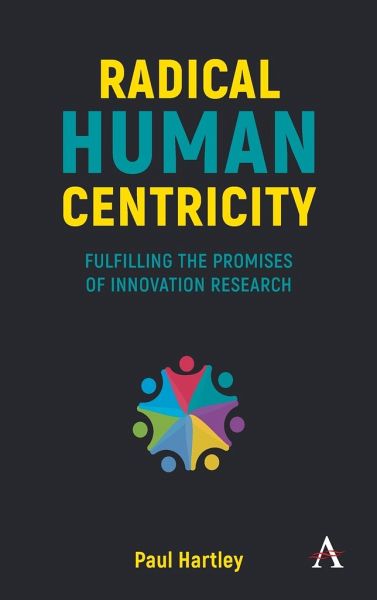
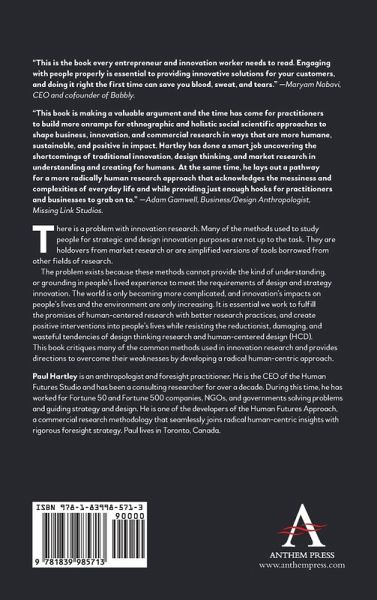
This book is a call to action. It is a critique of the poor state of commercial research and an articulation of the shifts and changes in thinking needed to fulfil the empty promises of human-centered research.
This book is a call to action. It is a critique of the poor state of commercial research and an articulation of the shifts and changes in thinking needed to fulfil the empty promises of human-centered research.
Paul Hartley is an anthropologist and foresight practitioner. He is the CEO of the Human Futures Studio.
Inhaltsangabe
Acknowledgments; Foreword by Alexander Manu; Introduction; Part I The Critique; Part II Core Considerations; Part III The RHC Approach; An Outline of the RHC Process; Scope; 1.0 The Idea, 1.1 The History of an Idea, 1.2 Assumptions behind a Need for Research, 1.3 The Expectations; 2.0 Framing the Research, 2.1 Getting the Brief Right, 2.2 Hypotheses Are Created to Be Wrong, 2.3 Understanding What Has Been Done Before, 2.4 Connecting the Need with Outcomes; 3.0 Making a Space for Planning, 3.1 The Ethics of Research, 3.2 Choosing the Right Tool for the Job, 3.3 The Right Team for the Job, 3.4 Leaving Space for Failure, Observe; 4.0 Set-up, 4.1 Recruiting, 4.2 The First Respondent Problem, 4.3 Pre-Research, 4.4 Know Your Field Site, 4.5 Thoughts on Screeners, Discussion Guides, and Moderators, 4.6 Planning for Remote/Online Interviews; 5.0 Entry, 5.1 Nothing Goes to Waste, 5.2 Leaving the Consultant's Ivory Tower; 6.0 In Field, 6.1 Recording Fieldnotes; 7.0 Leaving, 7.1 Getting Out, 7.2 Building Lasting Relationships, Understand; 8.0 Analysis, 8.1 Data Management, 8.2 Actually Managing Complexity, 8.3 Mitigating the Dreaded "Subjectivity"; 9.0 Synthesis; 10.0 Return-Test-Verify-Edit; Generate; 11.0 Insights, 11.1 Description, 11.2 Define, 11.3 Translate, 11.4 Actionability Notes on Activation; Conclusion; References; Index
Acknowledgments; Foreword by Alexander Manu; Introduction; Part I The Critique; Part II Core Considerations; Part III The RHC Approach; An Outline of the RHC Process; Scope; 1.0 The Idea, 1.1 The History of an Idea, 1.2 Assumptions behind a Need for Research, 1.3 The Expectations; 2.0 Framing the Research, 2.1 Getting the Brief Right, 2.2 Hypotheses Are Created to Be Wrong, 2.3 Understanding What Has Been Done Before, 2.4 Connecting the Need with Outcomes; 3.0 Making a Space for Planning, 3.1 The Ethics of Research, 3.2 Choosing the Right Tool for the Job, 3.3 The Right Team for the Job, 3.4 Leaving Space for Failure, Observe; 4.0 Set-up, 4.1 Recruiting, 4.2 The First Respondent Problem, 4.3 Pre-Research, 4.4 Know Your Field Site, 4.5 Thoughts on Screeners, Discussion Guides, and Moderators, 4.6 Planning for Remote/Online Interviews; 5.0 Entry, 5.1 Nothing Goes to Waste, 5.2 Leaving the Consultant's Ivory Tower; 6.0 In Field, 6.1 Recording Fieldnotes; 7.0 Leaving, 7.1 Getting Out, 7.2 Building Lasting Relationships, Understand; 8.0 Analysis, 8.1 Data Management, 8.2 Actually Managing Complexity, 8.3 Mitigating the Dreaded "Subjectivity"; 9.0 Synthesis; 10.0 Return-Test-Verify-Edit; Generate; 11.0 Insights, 11.1 Description, 11.2 Define, 11.3 Translate, 11.4 Actionability Notes on Activation; Conclusion; References; Index
Es gelten unsere Allgemeinen Geschäftsbedingungen: www.buecher.de/agb
Impressum
www.buecher.de ist ein Internetauftritt der buecher.de internetstores GmbH
Geschäftsführung: Monica Sawhney | Roland Kölbl | Günter Hilger
Sitz der Gesellschaft: Batheyer Straße 115 - 117, 58099 Hagen
Postanschrift: Bürgermeister-Wegele-Str. 12, 86167 Augsburg
Amtsgericht Hagen HRB 13257
Steuernummer: 321/5800/1497
USt-IdNr: DE450055826