V. Tamara Perchyonok is currently a Research Fellow at the School of Chemistry Centre for Green Chemistry at Monash University. Her research interests cover Analytical, Nano and Organic Chemistry with a specialization in free radical chemistry, green analytical chemistry, molecular recognition and polymer chemistry. She also lectures on heterocyclic chemistry and drug synthesis. Previous research appointments include: Marie Curie Senior Research Fellow at ISOF, CNR (Bologna, Italy); Senior Researcher (Chirogen PTY. Ltd., The University of Melbourne), and DFG Post Doctoral Fellow (LMU, Munich, Germany). Her research there covered both academic and commercial aspects of bio-compatible free radical chemistry via experimental and computational approaches. Her current research includes three broad areas of the development and commercialization of novel aspects of green analytical chemistry, synthesis and applications of novel nano-materials and bio-compatible free radical chemistry. The overall aim is to develop alternative and recyclable technology to facilitate the conversion of bio-actives from waste materials into value added and specialty chemicals, as well as the development of novel areas of green bio-compatible free radical chemistry.
Inhaltsangabe
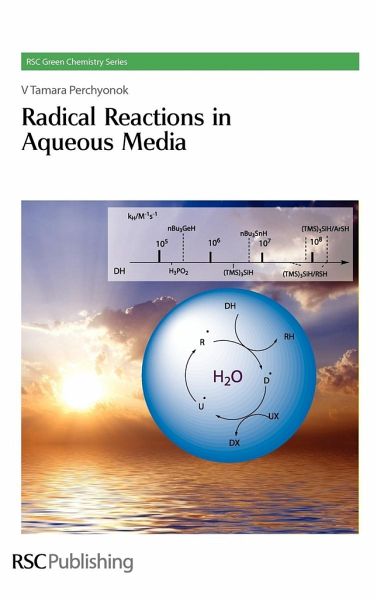
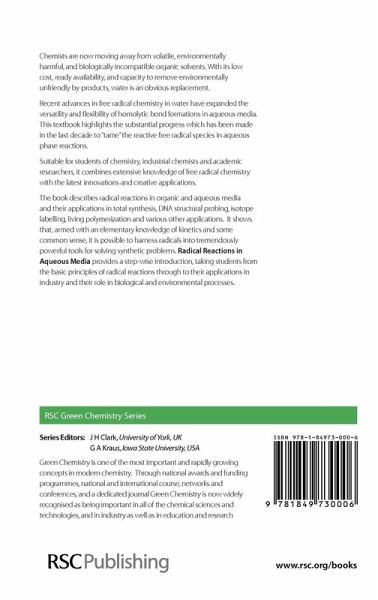
Contents: Free Radical Chemistry and Green Chemistry: The historical perspective Basic Radical Chemistry: General aspects of synthesis with radicals Why Water as a Solvent? Reasons and Advantages Reducing agents based Group 4 and Aqueous Media Hypophosporous acid (H3PO2) as a free radical hydrogen donors in aqueous media Organoboron Compounds as Radical Reducing Agents : Carbon-Carbon Bond formation and stereoaspects Redox Processes and Electron Transfer via Free Radicals Chain vs Non-Chain Free Radical Processes in Aqueous Media Future Directions and Practical considerations including methods of radical formation.
Contents: Free Radical Chemistry and Green Chemistry: The historical perspective Basic Radical Chemistry: General aspects of synthesis with radicals Why Water as a Solvent? Reasons and Advantages Reducing agents based Group 4 and Aqueous Media Hypophosporous acid (H3PO2) as a free radical hydrogen donors in aqueous media Organoboron Compounds as Radical Reducing Agents : Carbon-Carbon Bond formation and stereoaspects Redox Processes and Electron Transfer via Free Radicals Chain vs Non-Chain Free Radical Processes in Aqueous Media Future Directions and Practical considerations including methods of radical formation.
Es gelten unsere Allgemeinen Geschäftsbedingungen: www.buecher.de/agb
Impressum
www.buecher.de ist ein Internetauftritt der buecher.de internetstores GmbH
Geschäftsführung: Monica Sawhney | Roland Kölbl | Günter Hilger
Sitz der Gesellschaft: Batheyer Straße 115 - 117, 58099 Hagen
Postanschrift: Bürgermeister-Wegele-Str. 12, 86167 Augsburg
Amtsgericht Hagen HRB 13257
Steuernummer: 321/5800/1497
USt-IdNr: DE450055826