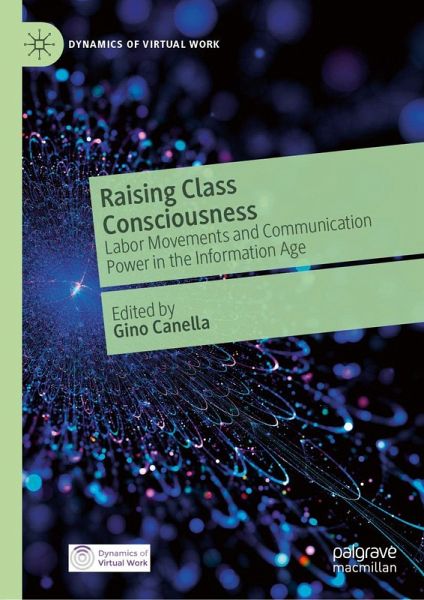
This book focuses on the unequal power dynamics embedded in technological change. Offering critical and international perspectives on labor and communication, the book demonstrates how the adoption and implementation of technologies are political processes shaped by economic incentives, worker organizing and state intervention. The book reviews how contemporary technologies like algorithms and artificial intelligence are deepening worker precarity, fragmenting labor movements and reinforcing echo chambers. Yet, it also highlights how workers have leveraged various communication technologies…mehr
This book focuses on the unequal power dynamics embedded in technological change. Offering critical and international perspectives on labor and communication, the book demonstrates how the adoption and implementation of technologies are political processes shaped by economic incentives, worker organizing and state intervention. The book reviews how contemporary technologies like algorithms and artificial intelligence are deepening worker precarity, fragmenting labor movements and reinforcing echo chambers. Yet, it also highlights how workers have leveraged various communication technologies past and present to reclaim their agency during moments of disruption.
Artikelnr. des Verlages: 89544943, 978-3-032-02237-0
Seitenzahl: 292
Erscheinungstermin: 22. November 2025
Englisch
Abmessung: 216mm x 153mm x 21mm
Gewicht: 470g
ISBN-13: 9783032022370
ISBN-10: 3032022371
Artikelnr.: 74872014
Herstellerkennzeichnung
Springer-Verlag GmbH
Tiergartenstr. 17
69121 Heidelberg
ProductSafety@springernature.com
Autorenporträt
Gino Canella is a documentary filmmaker and Associate Professor of Journalism at Emerson College, USA. His interests include social movements, visual culture, and labor. He studies how grassroots movements communicate their issues and organize campaigns for social justice.
Inhaltsangabe
Chapter 1: Raising Class Consciousness, Gino Canella.- Chapter 1: Raising Class Consciousness, Gino Canella.- Chapter 3: 1960s Detroit Revolutionary Union Movements and Using Newsletters to Organize, Todd Wolfson and Chris Robé.- Chapter 4: Making the News and The Wapping Dispute, Sam Kemp and Amil Mohanan.- Chapter 5: Union-Owned Newspapers and Trade Union Power, Torsten Geelan.- Chapter 6: Platforming Media Work, Tai Neilson.- Chapter 7: Digital Communicative Media Unionism, Errol Salamon.- Chapter 8: Workplace Bulletins and Digital Technology, Lydia Hughes and Jamie Woodcock.- Chapter 9: The Protest Paradigm, Labor News, and Geopolitics, Jinao Li, Carl Zhou, Linyi Gao, Yingqi Huang and Yan Zhang.- Chapter 10: Education, Unions, and Digital Disruption, Holger Pötzsch.- Chapter 11: A Digital Strike? Social Media Organizing in the 2018 Teachers Revolt, Eric Blanc.- Chapter 12: At Uber: Conditions, Opportunities and Obstacles in Building Worker Solidarity, Dragana Mrvos.- Chapter 13: Digital Labor-Sphere: Delivery Workers Resistance in Turkey, Mehmet Kayin, Ilker Kafali and Ugur Baloglu.
Es gelten unsere Allgemeinen Geschäftsbedingungen: www.buecher.de/agb
Impressum
www.buecher.de ist ein Internetauftritt der buecher.de internetstores GmbH
Geschäftsführung: Monica Sawhney | Roland Kölbl | Günter Hilger
Sitz der Gesellschaft: Batheyer Straße 115 - 117, 58099 Hagen
Postanschrift: Bürgermeister-Wegele-Str. 12, 86167 Augsburg
Amtsgericht Hagen HRB 13257
Steuernummer: 321/5800/1497
USt-IdNr: DE450055826