
Andere Kunden interessierten sich auch für
 Limits of Computation36,99 €
 A Panorama of Discrepancy Theory39,99 €
 Logical Foundations of Mathematics and Computational Complexity137,99 €
 Algorithmen und rekursive Funktionen44,99 €
 Large Scale Bi-Level Multi-Objective Decision Making53,99 €
 Operations Research, Engineering, and Cyber Security83,99 €
 Mathematical Models, Methods and Applications76,99 €
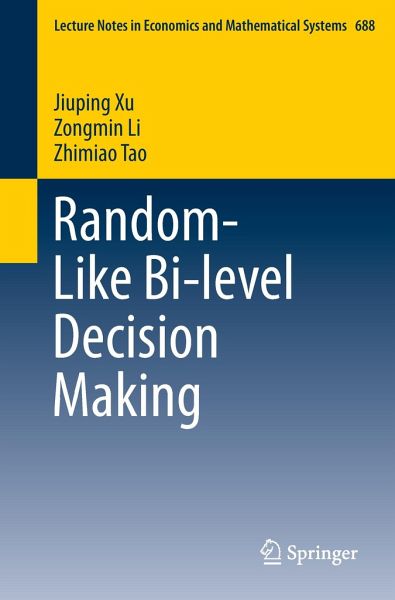
Among the various multi-level formulations of mathematical models in decision making processes, this book focuses on the bi-level model. Being the most frequently used, the bi-level model addresses conflicts which exist in multi-level decision making processes. From the perspective of bi-level structure and uncertainty, this book takes real-life problems as the background, focuses on the so-called random-like uncertainty, and develops the general framework of random-like bi-level decision making problems. The random-like uncertainty considered in this book includes random phenomenon, random-overlapped random (Ra-Ra) phenomenon and fuzzy-overlapped random (Ra-Fu) phenomenon. Basic theory, models, algorithms and practical applications for different types of random-like bi-level decision making problems are also presented in this book.