
Andere Kunden interessierten sich auch für
 Rehumanizing Muslim Subjectivities137,99 €
 The Ecology of Language in Multilingual India76,99 €
 Mystic Modernity38,99 €
 Postcolonial Indian City-Literature137,99 €
 Precarious Labour and the Contemporary Novel65,99 €
 Imperial Women Writers in Victorian India65,99 €
 Remapping the Indian Postcolonial Canon53,99 €

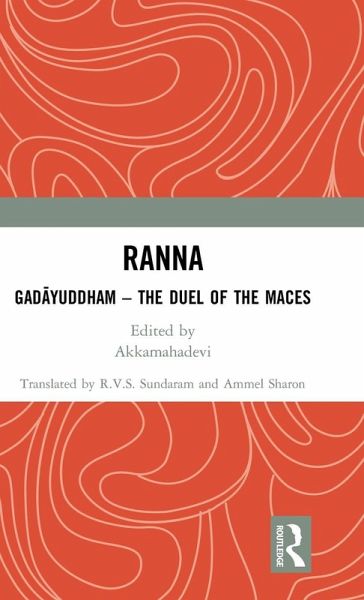
The Gadayuddham (The Duel of the Maces) is a kavya (poetry) composed in classical Kannada literary style at the turn of the eleventh century. It is written in campu, a genre that developed in the tenth century as a mixture of poetry and prose. Ranna's poem is remarkably dramatic in nature and is a meditation on the cost of war. Crisp dialogue, body gestures and imagery fill the poem. It is as if the poet were giving us directions for a play.
Ranna employs 'flashbacks', a technique called simhaval kana, that is, a lion turning casually to glance behind him. Ranna builds up to the duel through characters recalling episodes of injury or through lamentation. The duel occupies only a short space in the eighth canto, but Ranna takes this time to fill in past episodes and reflect on the impact of war. This thousand-year-old poem will interest scholars as well as lay readers.
Please note: This title is co-published with Manohar Publishers, New Delhi. Taylor & Francis does not sell or distribute the Hardback in India, Pakistan, Nepal, Bhutan, Bangladesh and Sri Lanka
Ranna employs 'flashbacks', a technique called simhaval kana, that is, a lion turning casually to glance behind him. Ranna builds up to the duel through characters recalling episodes of injury or through lamentation. The duel occupies only a short space in the eighth canto, but Ranna takes this time to fill in past episodes and reflect on the impact of war. This thousand-year-old poem will interest scholars as well as lay readers.
Please note: This title is co-published with Manohar Publishers, New Delhi. Taylor & Francis does not sell or distribute the Hardback in India, Pakistan, Nepal, Bhutan, Bangladesh and Sri Lanka