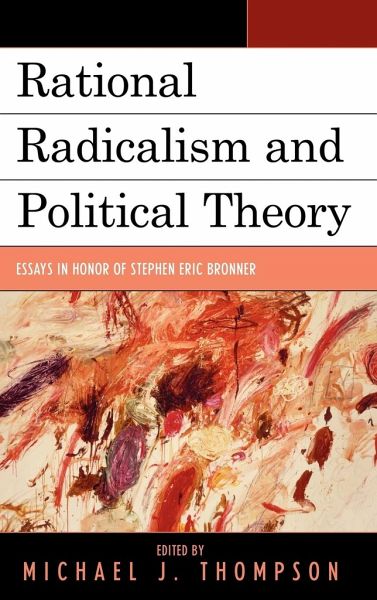
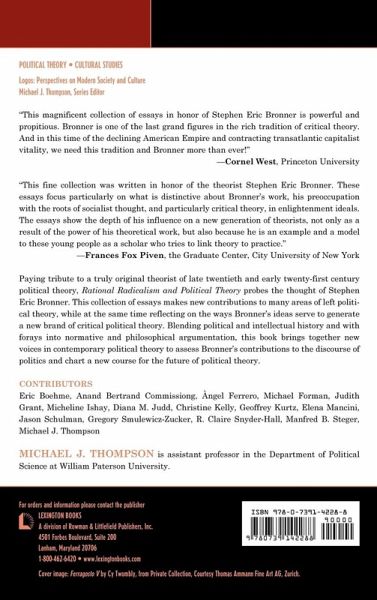
Paying tribute to one of the more original theorist of the late 20th and early 21st century, Rational Radicalism and Political Theory probes the thought of Stephen Eric Bronner. This book makes new contributions to many areas of left political theory, while at the same time reflecting on the ways Stephen Bronner's ideas serve to generate a new kind of critical political theory.
Paying tribute to one of the more original theorist of the late 20th and early 21st century, Rational Radicalism and Political Theory probes the thought of Stephen Eric Bronner. This book makes new contributions to many areas of left political theory, while at the same time reflecting on the ways Stephen Bronner's ideas serve to generate a new kind of critical political theory.
Michael J. Thompson is assistant professor in the Department of Political Science at William Paterson University.
Inhaltsangabe
1 Acknowledgments 2 Introduction Part 3 Part I: Reworking the Enlightenment Tradition Chapter 4 Chapter 1. On Organizing, Solidarity, and the Enlightenment Chapter 5 Chapter 2. Combating Inequalities of the Sexual Kind: Enlightenment Universalism and the Horizon of Inclusion Chapter 6 Chapter 3. Reason and Enlightenment: The Values of Modernity Part 7 Part II: Cosmopolitanism and Human Rights Chapter 8 Chapter 4. The Curious Case of Cosmopolitan Sensibility Chapter 9 Chapter 5. Reclaiming Internationalism for Our Times: The Cosmopolitan Ideal and Human Rights in the Global Era Chapter 10 Chapter 6. The History of Human Rights and Critical Theory Part 11 Part III: Reflections on Critical Theory Chapter 12 Chapter 7. Psychoanalysis and the Rational Subject: The Problem of Agency Chapter 13 Chapter 8. Feminism, Tradition, and Ideology Chapter 14 Chapter 9. Embodiment as Resistance: Evaluating Stephen Bronner's Contributions to Critical Theory Chapter 15 Chapter 10. Marxism, Ethics, and the Task of Critical Theory Part 16 Part IV: Rethinking Socialist Tradition and Theory Chapter 17 Chapter 11. Socialism: Liberal or Democratic-Republican? Chapter 18 Chapter 12. Concepts, Traditions, and Actions: Rescuing Political Theory from the History of Political Thought Chapter 19 Chapter 13. The Materialist Principle "Unbound": Socialist History and the Reconstruction of a Movement Chapter 20 Chapter 14. Bronner vs. Fukuyama: 1989, the End of History, and the New Internationalism 21 Appendix: An Interview with Stephen Eric Bronner: The Enlightenment and its Critics
1 Acknowledgments 2 Introduction Part 3 Part I: Reworking the Enlightenment Tradition Chapter 4 Chapter 1. On Organizing, Solidarity, and the Enlightenment Chapter 5 Chapter 2. Combating Inequalities of the Sexual Kind: Enlightenment Universalism and the Horizon of Inclusion Chapter 6 Chapter 3. Reason and Enlightenment: The Values of Modernity Part 7 Part II: Cosmopolitanism and Human Rights Chapter 8 Chapter 4. The Curious Case of Cosmopolitan Sensibility Chapter 9 Chapter 5. Reclaiming Internationalism for Our Times: The Cosmopolitan Ideal and Human Rights in the Global Era Chapter 10 Chapter 6. The History of Human Rights and Critical Theory Part 11 Part III: Reflections on Critical Theory Chapter 12 Chapter 7. Psychoanalysis and the Rational Subject: The Problem of Agency Chapter 13 Chapter 8. Feminism, Tradition, and Ideology Chapter 14 Chapter 9. Embodiment as Resistance: Evaluating Stephen Bronner's Contributions to Critical Theory Chapter 15 Chapter 10. Marxism, Ethics, and the Task of Critical Theory Part 16 Part IV: Rethinking Socialist Tradition and Theory Chapter 17 Chapter 11. Socialism: Liberal or Democratic-Republican? Chapter 18 Chapter 12. Concepts, Traditions, and Actions: Rescuing Political Theory from the History of Political Thought Chapter 19 Chapter 13. The Materialist Principle "Unbound": Socialist History and the Reconstruction of a Movement Chapter 20 Chapter 14. Bronner vs. Fukuyama: 1989, the End of History, and the New Internationalism 21 Appendix: An Interview with Stephen Eric Bronner: The Enlightenment and its Critics
Es gelten unsere Allgemeinen Geschäftsbedingungen: www.buecher.de/agb
Impressum
www.buecher.de ist ein Internetauftritt der buecher.de internetstores GmbH
Geschäftsführung: Monica Sawhney | Roland Kölbl | Günter Hilger
Sitz der Gesellschaft: Batheyer Straße 115 - 117, 58099 Hagen
Postanschrift: Bürgermeister-Wegele-Str. 12, 86167 Augsburg
Amtsgericht Hagen HRB 13257
Steuernummer: 321/5800/1497
USt-IdNr: DE450055826