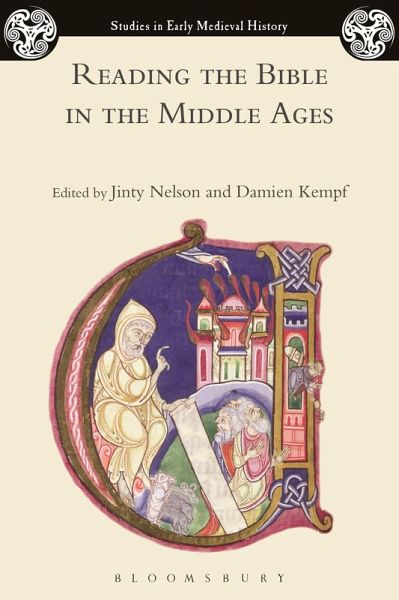
For earlier medieval Christians, the Bible was the book of guidance above all others, and the route to religious knowledge, used for all kinds of practical purposes, from divination to models of government in kingdom or household. This book's focus is on how medieval people accessed Scripture by reading, but also by hearing and memorizing sound-bites from the liturgy, chants and hymns, or sermons explicating Scripture in various vernaculars. Time, place and social class determined access to these varied forms of Scripture. Throughout the earlier medieval period, the Psalms attracted most…mehr
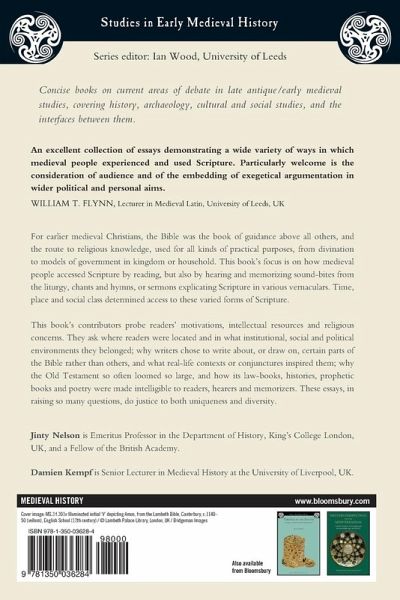
For earlier medieval Christians, the Bible was the book of guidance above all others, and the route to religious knowledge, used for all kinds of practical purposes, from divination to models of government in kingdom or household. This book's focus is on how medieval people accessed Scripture by reading, but also by hearing and memorizing sound-bites from the liturgy, chants and hymns, or sermons explicating Scripture in various vernaculars. Time, place and social class determined access to these varied forms of Scripture. Throughout the earlier medieval period, the Psalms attracted most readers and searchers for meanings. This book's contributors probe readers' motivations, intellectual resources and religious concerns. They ask for whom the readers wrote, where they expected their readers to be located and in what institutional, social and political environments they belonged; why writers chose to write about, or draw on, certain parts of the Bible rather than others, and what real-life contexts or conjunctures inspired them; why the Old Testament so often loomed so large, and how its law-books, its histories, its prophetic books and its poetry were made intelligible to readers, hearers and memorizers. This book's contributors, in raising so many questions, do justice to both uniqueness and diversity.
Jinty Nelson is Emeritus Professor in the Department of History, King's College London, UK. She is a Fellow of the British Academy and has published extensively on early medieval Europe. Her research focus has been on kingship, government and political ideas, on religion and ritual, and increasingly on women and gender. Damien Kempf is a Senior Lecturer in Medieval History at the University of Liverpool, UK. His research focuses on the political and cultural history of medieval Europe (400-1200). He has recently published a new edition and an English translation of Paul the Deacon's Liber de episcopis Mettensibus (2013).
Inhaltsangabe
Introduction Jinty Nelson (Kings College London UK) and Damien Kempf (University of Liverpool UK) 1. Twelfth-century Notions of the Canon of the Bible Cornelia Linde (German Historical Institute UK) 2. The Orator as Exegete: Cassiodorus as a Reader of the Psalms Gerda Heydemann (Österreichische Akademie der Wissenschaften Austria)) 3. Lay Readers of the Bible in the Carolingian Ninth Century Jinty Nelson (King's College London UK) 4. Jeremiah Job Terence and Paschasius Radbertus: Political Rhetoric and Biblical Authority in the Epitaphium Arsenii Mayke de Jong (University of Utrecht The Netherlands) 5. Biblical Readings for the Night Office in Eleventh-century Germany: Reconciling Theory and Practice Henry Parkes (Gonville and Caius College University of Cambridge UK) 6. 'Quid nobis cum allegoria?' The Literal Reading of the Bible in the Era of the Investiture Contest Florian Hartmann (University of Bonn Germany) 7. Sibyls Tanners and Leper Kings: Taking Notes from the Bible in Twelfth-century England Julie Barrau (Emmanuel College University of Cambridge UK) 7. Violence Control Prophecy and Power in Twelfth-century France and Germany Claire Weeda (University of Amsterdam The Netherlands) Further Reading Index
Introduction Jinty Nelson (Kings College London UK) and Damien Kempf (University of Liverpool UK) 1. Twelfth-century Notions of the Canon of the Bible Cornelia Linde (German Historical Institute UK) 2. The Orator as Exegete: Cassiodorus as a Reader of the Psalms Gerda Heydemann (Österreichische Akademie der Wissenschaften Austria)) 3. Lay Readers of the Bible in the Carolingian Ninth Century Jinty Nelson (King's College London UK) 4. Jeremiah Job Terence and Paschasius Radbertus: Political Rhetoric and Biblical Authority in the Epitaphium Arsenii Mayke de Jong (University of Utrecht The Netherlands) 5. Biblical Readings for the Night Office in Eleventh-century Germany: Reconciling Theory and Practice Henry Parkes (Gonville and Caius College University of Cambridge UK) 6. 'Quid nobis cum allegoria?' The Literal Reading of the Bible in the Era of the Investiture Contest Florian Hartmann (University of Bonn Germany) 7. Sibyls Tanners and Leper Kings: Taking Notes from the Bible in Twelfth-century England Julie Barrau (Emmanuel College University of Cambridge UK) 7. Violence Control Prophecy and Power in Twelfth-century France and Germany Claire Weeda (University of Amsterdam The Netherlands) Further Reading Index
Es gelten unsere Allgemeinen Geschäftsbedingungen: www.buecher.de/agb
Impressum
www.buecher.de ist ein Internetauftritt der buecher.de internetstores GmbH
Geschäftsführung: Monica Sawhney | Roland Kölbl | Günter Hilger
Sitz der Gesellschaft: Batheyer Straße 115 - 117, 58099 Hagen
Postanschrift: Bürgermeister-Wegele-Str. 12, 86167 Augsburg
Amtsgericht Hagen HRB 13257
Steuernummer: 321/5800/1497
USt-IdNr: DE450055826