
- Gebundenes Buch
- Merkliste
- Auf die Merkliste
- Bewerten Bewerten
- Teilen
- Produkt teilen
- Produkterinnerung
- Produkterinnerung
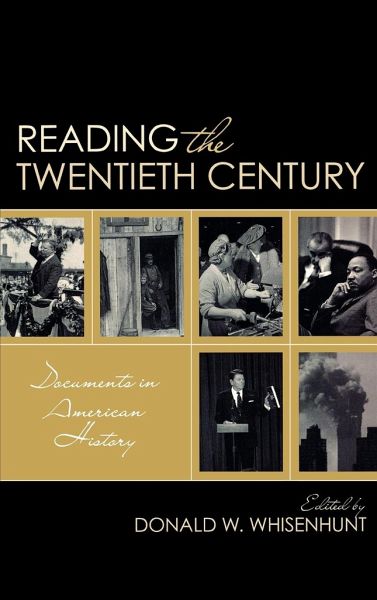
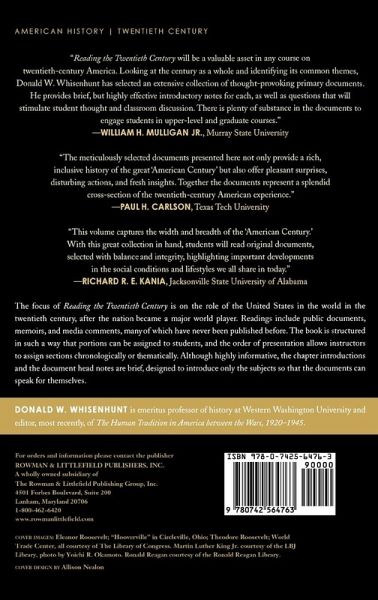
The focus of Reading the Twentieth Century is on the role of the United States in the world in the twentieth century, after the nation became a major world player. Readings include public documents, memoirs, and media comments, many of which have never been published before. The book is structured in such a way that portions can be assigned to students, and the order of presentation is such that instructors can assign sections chronologically or thematically. Though highly informative, the editor's chapter introductions and the document head notes are brief, designed only to introduce the subjects so that the documents can speak for themselves.…mehr
Andere Kunden interessierten sich auch für
 Jon AgarScience in the Twentieth Century and Beyond21,99 €
 The Land Of The Wine: Being An Account Of The Madeira Islands At The Beginning Of The Twentieth Century And From A New Point Of View31,99 €
 Carl HollidayEnglish Fiction From the Fifth to the Twentieth Century37,99 €
 Science in the Twentieth Century45,99 €
 Oscar HandlinThe American People in the Twentieth Century60,00 €
 The Religion of Christ in the Twentieth Century31,99 €
 Massimo SalvadoriThe Rise of Modern Communism; a Brief History of the Communist Movement in the Twentieth Century29,99 €
-
-
-





The focus of Reading the Twentieth Century is on the role of the United States in the world in the twentieth century, after the nation became a major world player. Readings include public documents, memoirs, and media comments, many of which have never been published before. The book is structured in such a way that portions can be assigned to students, and the order of presentation is such that instructors can assign sections chronologically or thematically. Though highly informative, the editor's chapter introductions and the document head notes are brief, designed only to introduce the subjects so that the documents can speak for themselves.
Produktdetails
- Produktdetails
- Verlag: Rowman & Littlefield Publishers
- Seitenzahl: 484
- Erscheinungstermin: 16. August 2009
- Englisch
- Abmessung: 240mm x 161mm x 30mm
- Gewicht: 886g
- ISBN-13: 9780742564763
- ISBN-10: 0742564762
- Artikelnr.: 26552768
- Herstellerkennzeichnung
- Libri GmbH
- Europaallee 1
- 36244 Bad Hersfeld
- gpsr@libri.de
- Verlag: Rowman & Littlefield Publishers
- Seitenzahl: 484
- Erscheinungstermin: 16. August 2009
- Englisch
- Abmessung: 240mm x 161mm x 30mm
- Gewicht: 886g
- ISBN-13: 9780742564763
- ISBN-10: 0742564762
- Artikelnr.: 26552768
- Herstellerkennzeichnung
- Libri GmbH
- Europaallee 1
- 36244 Bad Hersfeld
- gpsr@libri.de
Donald W. Whisenhunt is emeritus professor of history at Western Washington University, and the editor of The Human Tradition in America between the Wars, 1920-1945.
Prologue: Dawning of the Twentieth Century-Acquisition of an Empire
1. Peace Is established; President McKinley Tries to Reassure the
Filipinos: "Benevolent Assimilation" Proclamation of President William
McKinley (1898)
2. Aguinaldo Protests the U.S. Claim of Sovereignty: "Aguinaldo's Manifesto
Protesting the United States' Claim of Sovereignty Over the Philippines"
(1899)
3. Aguinaldo Surrenders: "Aguinaldo's Proclamation of Formal Surrender to
the United States" (1901)
4. The War Ends: "President Theodore Roosevelt's Proclamation Formally
Ending the Philippine 'Insurrection' and Granting of Pardon and Amnesty"
(1902)
5. Rudyard Kipling Checks In: Rudyard Kipling, "The White Man's Burden"
(1899)
6. McKinley Explains His Dilemma: President William McKinley, Speech to the
Methodist Episcopal Church (1903)
7. Senator Lodge Provides Justification for Taking the Philippines: Henry
Cabot Lodge, Speech to the Senate (1900)
8. William Jennings Bryan Rebuts and Provides Another Point of View:
William Jennings Bryan, Acceptance Speech to the Democratic National
Convention (1900)
9. African American Soldiers Report from the Philippines: Willard B.
Gatewood, Jr., "Smoked Yankees" and the Struggle for Empire: Letters from
Negro Soldiers (1898-1902)
Chapter 1: War and Peace
Part A: World War I-Neutrality, Propaganda and Civil Liberties
1. Wilson Declares Neutrality: President Woodrow Wilson, Message to
Congress (1914)
2. Wilson's War Message: President Woodrow Wilson, Address to Congress
(1917)
3. Espionage Act (1917)
4. Sedition Act (1918)
5. The Committee on Public Information: George Creel, Extracts from How We
Advertised America (1920)
6. The Creel Committee is Criticized: "Uncle Sam's Press-Agent," The
Literary Digest (1917)
7. Charges of Treason are Questioned: "Treason' on the Street Corners," The
Nation (1917)
8. The Nation Protests Arrests: "Civil Liberty Dead," The Nation (1918)
9. Palmer's Case Against the Reds: A. Mitchell Palmer, "The Case Against
the 'Reds'" (1920)
Part B: Kellogg-Briand Pact-A Search for Peace
1. The Text of the Treaty: President Herbert Hoover, Announcement of the
Ratification of the Kellogg-Briand Pact (1929)
2. The Origin of the Treaty: Edwin Borchard, Speech to the Williamstown
Institute of Politics (1928)
3. Questions Are Raised: Frank B. Kellogg, Testimony to the Senate (1928)
4. The Issue of Self-Defense: George W. Wickersham, "Making Real the Pact
of Paris," The Century Magazine (1929)
5. Opposition to the Pact Appears: Edwin Borchard, "The Multilateral Pact
for the 'Renunciation of War'," Speech to the Williamstown Institute of
Politics (1928)
6. The Pact Prevails: United States Department of State Memos (1929)
7. Kellogg Still Has Hopes for the Treaty: Frank B. Kellogg, Speech over
the CBS Radio Network (1935)
Chapter 2: Affluence, Anxiety, and Hard Times
Part A: Resurgence of the Ku Klux Klan
1. The Klan's Constitution (1925)
2. The Klan in Politics and Scandal: Alva W. Taylor, "What the Klan Did in
Indiana" (1927)
3. The Klan Gets New Leadership: Hiram W. Evans, "The Klan's Fight for
Americanism" (1926)
4. A Popular Writer Weighs in: Frederick Lewis Allen, Only Yesterday: An
Informal History of the 1920s (1931)
5. The New Republic Explains Some of the Origin of the Klan: "The K.K.K.,"
The New Republic (1921)
6. The African American Press Speaks: Comment from The Union (1922)
7. What was Wrong with the Klan?: Article in The Nation (1924)
8. The Klan and Politics: "Casting Out the Klan," The Independent (1924)
Part B: Bonus March
1. From the Military Point of View: General Lucian K. Truscott, Jr., The
Twilight of the U.S. Cavalry: Life in the Old Army, 1917-1942
2. Hoover Responds to the Marchers: President Hoover's Statements
(1932-1933)
3. An Eye Witness Account: Bera Roberts (1932)
4. President Hoover tells his side of the story: The Memoirs of Herbert
Hoover. The Great Depression, 1929-1941
5. A Democrat Recalls the Bonus March: Rexford G. Tugwell, "Roosevelt and
the Bonus Marchers of 1932"
Chapter 3: The New Deal
Part A: Security for the Elderly
1. Huey Long Supports Pensions: Senator Long, Speeches to the Senate
(1934-1935)
2. EPIC Includes Pensions: Upton Sinclair, Excerpts from Final EPIC: The
Final Statement of the Plan
3. The Plan in Brief: The Townsend Plan (1934)
4. The Plan Analyzed: Justification and Explanation of the Townsend Plan
(1934)
5. Townsend Defends Himself: Excerpts from Townsend's Congressional
Testimony (1935)
6. Secretary Perkins Explains: National Radio Address "Social Insurance for
U.S." (1935)
7. How the Committee Operated: Thomas H. Eliot, Recollections of the New
Deal: When the People Mattered (1992)
8. The Press Comments: Abraham Epstein, "Social Security Under the New
Deal" (1935)
Part B: Isolation and Antiwar Sentiment
1. The Nye Report: Report of the Senate Munitions Committee (1936)
2. Defense of the Nye Committee: "The Attack on the Nye Committee," The
Christian Century (1936)
3. Nye Indicts International Bankers: "Conclusions of the Nye Committee"
(1936)
4. Neutrality Act of 1937
5. Senator Nye Continues His Struggle: Speech to the Senate (1941)
6. National Committee for the Student Congress Against War: "FIGHT WAR!"
(1932)
7. The American Youth Congress: "The Declaration of the Rights of American
Youth" (1936)
8. The Veterans of Future Wars Manifesto: Lewis J. Gorin, Jr., Founder of
the VFW (1936)
9. The Amateur Poets Speak Out: Poems to President Hoover and Roosevelt
(1937-1940)
Chapter 4: World War II
Part A: Rosie the Riveter
1. Katie's Story: From the Rosie the Riveter Website
2. Irene's Story: From the Rosie the Riveter Website
3. Katherine Worked in a Factory: Interview with Katherine O'Grady
4. Some Had Family Responsibilities: Interview with Mary Gardner
5. Some Were Not Allowed to Serve in the Military: Interview with Eileen
Hughes
6. Some Faced Discrimination in the Military: Interview with Genevieve
Chasm
Part B: Americans on the Battlefront
1. Military training: Private Morton D. Elevitch, Letter to His Mother
2. Fighting in Italy: Private Paul Curtis, Letter to His Brother (1944)
3. Death in the Pacific: Lieutenant Tommie Kennedy, Letter to His Parents
(1945)
4. An American Jew Helps Liberate Dachau: Lieutenant Fritz Schnaittacher,
Letter to His Wife (1945)
5. Ernie Pyle's Report from the Front: "The Death of Captain Waskow" (1944)
6. Pyle from Africa: "The God-Damned Infantry" (1943)
7. Pyle's Last Column (1945)
8. Rooney From Germany: Andy Rooney, "How it Feels to Bomb Germany . . ."
(1943)
9. Rooney Remembers: Michelle Ferrari, Reporting America at War: An Oral
History (2003)
Chapter 5: The Cold War
Part A: The Cold War Begins
1. Kennan's "Long Telegram": George Kennan, Excerpts from Telegraphic
Message from Moscow (1946)
2. An "Iron Curtain" Falls: Winston Churchill, Excerpt of Speech at
Westminster College in Missouri (1946)
3. Stalin Replies: Josef Stalin, Interview with Pravda (1946)
4. Acheson Remembers: Dean Acheson, Present at the Creation: My Years in
the State Department (1969)
5. The Truman Doctrine: Excerpt from President Truman's Speech to Congress
(1947)
6. The Marshall Plan: Excerpt from Secretary of State George Marshall's
Speech to Congress (1947)
7. Truman Speaks: Excerpt from President's Truman's Speech in San Francisco
(1950)
Part B: Sputnik-The Cold War in Action
1. Soviets Announce Satellite: Press Release in Pravda (1957)
2. Assorted Reactions: American Reactions to the Launching of Sputnik
3. Eisenhower Reacts: The President's News Conference (1957)
4. Eisenhower' Official Statement (1957)
5. The Secretary of State Tries to Quiet Fears: John Foster Dulles, "Draft
Statements on the Soviet Satellite" (1957)
6. Soviet Beginnings of Satellites: Mikhail K. Tikhonravov, Report
Proposing a Soviet Space Program (1954)
7. Massachusetts Responds: Owen B. Kiernan, "Sputnik Shot Still
Reverberates Here" (1958)
8. Eisenhower Meets with Advisors: General A. J. Goodpaster, Summary of
Meeting (1957)
9. How Did Americans Really React?: Donald N. Michael, Remarks on Public
Reaction (1957)
10. Eisenhower Proposes Legislation: Special Message to Congress (1958)
Chapter 6: The Civil Rights Movement
Part A: Civil Rights in the Post-War Era
1. Truman Takes Action and Orders Desegregation of the Armed Services:
Executive Order (1948)
2. Brown v. Board of Education (1954)
3. Violence in Little Rock: President Eisenhower's Speech to the American
Public (1957)
4. Protest in Montgomery: Martin Luther King, Jr., Excerpt of Speech to the
Montgomery Improvement Association (1955)
5. John Kennedy Weighs in: Speech to the American People (1963)
6. "I Have a Dream" (1963)
7. President Johnson Steps In: State of the Union Address (1964)
Part B: Racial Violence
1. Urban Violence Begins-the Watts Riot: Excerpt from the Governor's
Commission Report (1965)
2. Hutchinson Remembers: Earl Ofari Hutchinson, Interview with the
Huffington Post
3. Mosley Remembers: Walter Mosley, Interview with Powell's Bookstore in
Portland, Oregon
4. Kerner Commission Report (1968)
Chapter 7: A New Society
Part A: The New Feminism
1. Declaration of American Women: Wisconsin Women's Network, Statement at
the National Women's Conference Houston (1977)
2. Friedan Defines the "Problem": Betty Friedan, The Feminine Mystique
(1963)
3. A New Women's Magazine: Excerpt from the First Regular Issue of MS
(1972)
4. The Equal Rights Amendment (1972)
5. A Catholic Magazine Speaks Out: Mary Burke, "The Church and the Equal
Rights Amendment" (1975)
6. Supporters Appeal to Women: James M. Wall, "New Wisdom From Rosie the
Riveter" (1981)
7. Attempt to Revive the Amendment: James M. Wall, "The Real Issue for
Women is Power" (1982)
8. Opponents Believe the Amendment will be Approved: "Equal Rights for
Women" (1972)
9. Opponents Believe the Courts Are Implementing the Amendment: "What Do
Women Want?" (1980)
10. Schlafly Explains Her Role: Interview with Fran Eaton (2004)
Part B: The Rise of the Religious Right
1. Falwell Makes His Case: The Fundamentalist Phenomenon (1981)
2. Another Leader of the Religious Right Makes His Case: Charles W. Colson,
"The Lures and Limits of Political Power" (1986)
3. Another Point of View from the Right: Paul Weyrich, Christianity Today
(1999)
4. Lessons Can be Learned from the Moral Majority: Robert McAfee Brown,
"The Need for a Moral Minority" (1982)
5. A Humanist Reacts to Weyrich: Carleton Coon, "The New Moral Majority"
(1999)
6. A Foreign View: Iwan Russell-Jones, "Give Me That Prime Time Religion"
(1984)
Chapter 8: American Society in Flux
Part A: Counterculture and Protest
1. The Summer of Love: Excerpt from the Memoir of Allen Cohen (1995)
2. Growing Up Hippie: Sarah Beach, "Curse of the Hippie Parents" (2001)
3. Students Organize: Port Huron Statement of the Students for a Democratic
Society (1962)
4. Timothy Leary Testifies: Chicago Seven Trial (1969-1970)
5. A Protester Remembers: Interview with Rennie Davis (2009)
Part B: Atrocities in Vietnam
1. Ridenhour's Letter: Letter from Mr. Ronald Ridenhour to the Secretary of
Defense (1969)
2. Hugh Thompson's Story: Testimony to the Peers Commission (1969)
3. The Viet Cong Tell Their Story: "The Americans Devils Devulge [sic] the
Truth"
4. The Peers Report (1970)
5. Calley Testifies (1971)
Chapter 9: Continuing Crises
Part A.: Cuban Missile Crisis-How Close to War?
1. Khrushchev Reacts to American Surveillance: Foy Kohler, Report to the
Department of State (1962)
2. Kennedy Announces Quarantine: Excerpt from Speech (1962)
3. Khrushchev Writes Kennedy (1962)
4. Robert Kennedy Reports: Excerpt of Report to President Kennedy (1962)
5. Another Exchange of Letters Between Khrushchev and Kennedy (1962)
6. America and the Soviet Union Exchange Insults at the United Nations
(1962)
7. The Press Gets Involved: John Scali, Memorandum to the Director of the
Bureau of Intelligence and Research (1962)
8. Khrushchev Makes Two Proposals (1962)
9. Khrushchev Ends the Crisis (1962)
Part B: Watergate and the Imperial Presidency
1. Sirica Comments on the Break-in: To Set the Record Straight: The
Break-in, the Tapes, and the Conspirators, the Pardon (1979)
2. Nixon Speaks on the Watergate Issue: Address to the Nation (1973)
3. Nixon's Troubles Deepen; Sirica Named Man of the Year (1973-1974)
4. Barbara Jordan's Position: Speech during the Impeachment Hearings of
Richard Nixon (1974)
5. Judiciary Committee Approves Impeachment Articles (1974)
6. The "Smoking Gun" Tape (1972)
7. Nixon Resigns (1974)
8. President Ford Pardons Nixon (1974)
Chapter 10: High Tech
Part A: Personal Computers
1. The Emergence of Personal Computers: Christopher Roper, "Microcomputers
and the Left" (1983)
2. Dan Bricklin, Inventor: VisiCalc Spreadsheets (1978)
3. Wozniak Speaks: Interview with the Wharton School of Business at the
University of Pennsylvania (2008)
4. The Future of Computers: Interview with Dr. Gary A. Kildall, in Susan M.
Lammers, Programmers at Work (1986)
5. The Evolution of Computers: Interview with John Page, in Susan M.
Lammers, Programmers at Work (1986)
6. The Software King: Bill Gates, The Road Ahead (1996)
Part B: News All the Time: The 24-hour News Cycle
1. How CNN Began: Reese Schonfeld, The Unauthorized Story of the Founding
of CNN (2001)
2. "Terrible Ted": Joseph B. Cumming, Jr. "Ted Turner: 'Captain
Outrageous'" (1980)
3. Turner Remembers: Ted Turner, "My Beef with Big Media" (2004)
4. CNN Succeeds: Jay Rosen, "The Whole World Is Watching CNN" (1991)
5. CNN Gets Praise: Mary Jo Melone, "Live From Iraq: CNN Filters War's Grim
Reality" (2003)
6. Coverage Expands: Peter Johnson, "For Cable News, Iraq War is a Clear
Victory" (2003)
7. Why Fox Won: Neil Hickey, "In a Desperate Race for Ratings, the Public
Falls Behind" (2003)
8. Fox Evaluated: "In Depth: FOX News Has Won the Perception War (For Now)"
(2005)
Chapter 11: The Culmination of the Cold War
Part A: Iran Contra
1. The Boland Amendment (1984)
2. Reagan Admits to the Arms Deal: Announcement of the Review of the
National Security Council's Role in the Iran Arms and Contra Aid
Controversy (1986)
3. The Reagan Administration Responds: "Iran, Contra Aid Link Ousts 2
Advisers: Kept in Dark, Reagan Says, but Still OKs Policy" (1986)
4. Reagan Charges the Review Board: Remarks at a Meeting With the
President's Special Review Board for the National Security Council (1986)
5. Weinberger's Memo: Caspar Weinberger, Memorandum for the Record,
"Meeting on November 10, 1986, with the President, et al." (1986)
6. The Independent Counsel Reports: Lawrence E. Walsh, Final Report of the
Independent Counsel for Iran/Contra Matters (1993)
7. Bush Pardons the Participants: Presidential Pardon of Caspar Weinberger,
et al. (1992)
8. The Independent Counsel Responds: Lawrence Walsh, Response to
Presidential Pardon (1992)
Part B: End of Cold War
1. Fall of the Berlin Wall: Douglas Hamilton, "Fall of the Berlin Wall: A
Week That Changed the World" (1989)
2. Bush Reacts: Remarks With Reporters on the Relaxation of East German
Border Controls (1989)
3. Gorbachev Faces Parliament: "Gorbachev, Yeltsin in Public" (1991)
4. Gorbachev Resigns (1991)
5. America's Place in the New World: James McCartney, "America's Place in a
New Kind of World" (1991)
Postscript: Crises at Century's End: Clinton Impeachment and the 9/11
Attacks
Part A: The Impeachment of President Clinton
1. The Starr Report (1998)
2. Clinton Speaks to the Nation (1998)
3. Impeachment Resolutions (1998)
4. Hyde Testimony in the Senate (1999)
Part B: The 9/11 Attacks
1. The Attack: Final Report of the National Commission on Terrorist Attacks
Upon the United States (2004)
2. Bush's Comments from Florida (2001)
3. President Bush Addresses the Nation (2001)
4. The Nation Urges Caution: "A Great Wound" (2001)
5. Did the Government Have Advance Knowledge?: Alexander Cockburn,
"Faceless Cowards" (2001)
6. "At War" Says the National Review (2001)
7. The Attacks Were War, Not Crimes: Daniel Pipes (2001)
8. The Commission Reports: Excerpt of the Executive Summary (2004)
1. Peace Is established; President McKinley Tries to Reassure the
Filipinos: "Benevolent Assimilation" Proclamation of President William
McKinley (1898)
2. Aguinaldo Protests the U.S. Claim of Sovereignty: "Aguinaldo's Manifesto
Protesting the United States' Claim of Sovereignty Over the Philippines"
(1899)
3. Aguinaldo Surrenders: "Aguinaldo's Proclamation of Formal Surrender to
the United States" (1901)
4. The War Ends: "President Theodore Roosevelt's Proclamation Formally
Ending the Philippine 'Insurrection' and Granting of Pardon and Amnesty"
(1902)
5. Rudyard Kipling Checks In: Rudyard Kipling, "The White Man's Burden"
(1899)
6. McKinley Explains His Dilemma: President William McKinley, Speech to the
Methodist Episcopal Church (1903)
7. Senator Lodge Provides Justification for Taking the Philippines: Henry
Cabot Lodge, Speech to the Senate (1900)
8. William Jennings Bryan Rebuts and Provides Another Point of View:
William Jennings Bryan, Acceptance Speech to the Democratic National
Convention (1900)
9. African American Soldiers Report from the Philippines: Willard B.
Gatewood, Jr., "Smoked Yankees" and the Struggle for Empire: Letters from
Negro Soldiers (1898-1902)
Chapter 1: War and Peace
Part A: World War I-Neutrality, Propaganda and Civil Liberties
1. Wilson Declares Neutrality: President Woodrow Wilson, Message to
Congress (1914)
2. Wilson's War Message: President Woodrow Wilson, Address to Congress
(1917)
3. Espionage Act (1917)
4. Sedition Act (1918)
5. The Committee on Public Information: George Creel, Extracts from How We
Advertised America (1920)
6. The Creel Committee is Criticized: "Uncle Sam's Press-Agent," The
Literary Digest (1917)
7. Charges of Treason are Questioned: "Treason' on the Street Corners," The
Nation (1917)
8. The Nation Protests Arrests: "Civil Liberty Dead," The Nation (1918)
9. Palmer's Case Against the Reds: A. Mitchell Palmer, "The Case Against
the 'Reds'" (1920)
Part B: Kellogg-Briand Pact-A Search for Peace
1. The Text of the Treaty: President Herbert Hoover, Announcement of the
Ratification of the Kellogg-Briand Pact (1929)
2. The Origin of the Treaty: Edwin Borchard, Speech to the Williamstown
Institute of Politics (1928)
3. Questions Are Raised: Frank B. Kellogg, Testimony to the Senate (1928)
4. The Issue of Self-Defense: George W. Wickersham, "Making Real the Pact
of Paris," The Century Magazine (1929)
5. Opposition to the Pact Appears: Edwin Borchard, "The Multilateral Pact
for the 'Renunciation of War'," Speech to the Williamstown Institute of
Politics (1928)
6. The Pact Prevails: United States Department of State Memos (1929)
7. Kellogg Still Has Hopes for the Treaty: Frank B. Kellogg, Speech over
the CBS Radio Network (1935)
Chapter 2: Affluence, Anxiety, and Hard Times
Part A: Resurgence of the Ku Klux Klan
1. The Klan's Constitution (1925)
2. The Klan in Politics and Scandal: Alva W. Taylor, "What the Klan Did in
Indiana" (1927)
3. The Klan Gets New Leadership: Hiram W. Evans, "The Klan's Fight for
Americanism" (1926)
4. A Popular Writer Weighs in: Frederick Lewis Allen, Only Yesterday: An
Informal History of the 1920s (1931)
5. The New Republic Explains Some of the Origin of the Klan: "The K.K.K.,"
The New Republic (1921)
6. The African American Press Speaks: Comment from The Union (1922)
7. What was Wrong with the Klan?: Article in The Nation (1924)
8. The Klan and Politics: "Casting Out the Klan," The Independent (1924)
Part B: Bonus March
1. From the Military Point of View: General Lucian K. Truscott, Jr., The
Twilight of the U.S. Cavalry: Life in the Old Army, 1917-1942
2. Hoover Responds to the Marchers: President Hoover's Statements
(1932-1933)
3. An Eye Witness Account: Bera Roberts (1932)
4. President Hoover tells his side of the story: The Memoirs of Herbert
Hoover. The Great Depression, 1929-1941
5. A Democrat Recalls the Bonus March: Rexford G. Tugwell, "Roosevelt and
the Bonus Marchers of 1932"
Chapter 3: The New Deal
Part A: Security for the Elderly
1. Huey Long Supports Pensions: Senator Long, Speeches to the Senate
(1934-1935)
2. EPIC Includes Pensions: Upton Sinclair, Excerpts from Final EPIC: The
Final Statement of the Plan
3. The Plan in Brief: The Townsend Plan (1934)
4. The Plan Analyzed: Justification and Explanation of the Townsend Plan
(1934)
5. Townsend Defends Himself: Excerpts from Townsend's Congressional
Testimony (1935)
6. Secretary Perkins Explains: National Radio Address "Social Insurance for
U.S." (1935)
7. How the Committee Operated: Thomas H. Eliot, Recollections of the New
Deal: When the People Mattered (1992)
8. The Press Comments: Abraham Epstein, "Social Security Under the New
Deal" (1935)
Part B: Isolation and Antiwar Sentiment
1. The Nye Report: Report of the Senate Munitions Committee (1936)
2. Defense of the Nye Committee: "The Attack on the Nye Committee," The
Christian Century (1936)
3. Nye Indicts International Bankers: "Conclusions of the Nye Committee"
(1936)
4. Neutrality Act of 1937
5. Senator Nye Continues His Struggle: Speech to the Senate (1941)
6. National Committee for the Student Congress Against War: "FIGHT WAR!"
(1932)
7. The American Youth Congress: "The Declaration of the Rights of American
Youth" (1936)
8. The Veterans of Future Wars Manifesto: Lewis J. Gorin, Jr., Founder of
the VFW (1936)
9. The Amateur Poets Speak Out: Poems to President Hoover and Roosevelt
(1937-1940)
Chapter 4: World War II
Part A: Rosie the Riveter
1. Katie's Story: From the Rosie the Riveter Website
2. Irene's Story: From the Rosie the Riveter Website
3. Katherine Worked in a Factory: Interview with Katherine O'Grady
4. Some Had Family Responsibilities: Interview with Mary Gardner
5. Some Were Not Allowed to Serve in the Military: Interview with Eileen
Hughes
6. Some Faced Discrimination in the Military: Interview with Genevieve
Chasm
Part B: Americans on the Battlefront
1. Military training: Private Morton D. Elevitch, Letter to His Mother
2. Fighting in Italy: Private Paul Curtis, Letter to His Brother (1944)
3. Death in the Pacific: Lieutenant Tommie Kennedy, Letter to His Parents
(1945)
4. An American Jew Helps Liberate Dachau: Lieutenant Fritz Schnaittacher,
Letter to His Wife (1945)
5. Ernie Pyle's Report from the Front: "The Death of Captain Waskow" (1944)
6. Pyle from Africa: "The God-Damned Infantry" (1943)
7. Pyle's Last Column (1945)
8. Rooney From Germany: Andy Rooney, "How it Feels to Bomb Germany . . ."
(1943)
9. Rooney Remembers: Michelle Ferrari, Reporting America at War: An Oral
History (2003)
Chapter 5: The Cold War
Part A: The Cold War Begins
1. Kennan's "Long Telegram": George Kennan, Excerpts from Telegraphic
Message from Moscow (1946)
2. An "Iron Curtain" Falls: Winston Churchill, Excerpt of Speech at
Westminster College in Missouri (1946)
3. Stalin Replies: Josef Stalin, Interview with Pravda (1946)
4. Acheson Remembers: Dean Acheson, Present at the Creation: My Years in
the State Department (1969)
5. The Truman Doctrine: Excerpt from President Truman's Speech to Congress
(1947)
6. The Marshall Plan: Excerpt from Secretary of State George Marshall's
Speech to Congress (1947)
7. Truman Speaks: Excerpt from President's Truman's Speech in San Francisco
(1950)
Part B: Sputnik-The Cold War in Action
1. Soviets Announce Satellite: Press Release in Pravda (1957)
2. Assorted Reactions: American Reactions to the Launching of Sputnik
3. Eisenhower Reacts: The President's News Conference (1957)
4. Eisenhower' Official Statement (1957)
5. The Secretary of State Tries to Quiet Fears: John Foster Dulles, "Draft
Statements on the Soviet Satellite" (1957)
6. Soviet Beginnings of Satellites: Mikhail K. Tikhonravov, Report
Proposing a Soviet Space Program (1954)
7. Massachusetts Responds: Owen B. Kiernan, "Sputnik Shot Still
Reverberates Here" (1958)
8. Eisenhower Meets with Advisors: General A. J. Goodpaster, Summary of
Meeting (1957)
9. How Did Americans Really React?: Donald N. Michael, Remarks on Public
Reaction (1957)
10. Eisenhower Proposes Legislation: Special Message to Congress (1958)
Chapter 6: The Civil Rights Movement
Part A: Civil Rights in the Post-War Era
1. Truman Takes Action and Orders Desegregation of the Armed Services:
Executive Order (1948)
2. Brown v. Board of Education (1954)
3. Violence in Little Rock: President Eisenhower's Speech to the American
Public (1957)
4. Protest in Montgomery: Martin Luther King, Jr., Excerpt of Speech to the
Montgomery Improvement Association (1955)
5. John Kennedy Weighs in: Speech to the American People (1963)
6. "I Have a Dream" (1963)
7. President Johnson Steps In: State of the Union Address (1964)
Part B: Racial Violence
1. Urban Violence Begins-the Watts Riot: Excerpt from the Governor's
Commission Report (1965)
2. Hutchinson Remembers: Earl Ofari Hutchinson, Interview with the
Huffington Post
3. Mosley Remembers: Walter Mosley, Interview with Powell's Bookstore in
Portland, Oregon
4. Kerner Commission Report (1968)
Chapter 7: A New Society
Part A: The New Feminism
1. Declaration of American Women: Wisconsin Women's Network, Statement at
the National Women's Conference Houston (1977)
2. Friedan Defines the "Problem": Betty Friedan, The Feminine Mystique
(1963)
3. A New Women's Magazine: Excerpt from the First Regular Issue of MS
(1972)
4. The Equal Rights Amendment (1972)
5. A Catholic Magazine Speaks Out: Mary Burke, "The Church and the Equal
Rights Amendment" (1975)
6. Supporters Appeal to Women: James M. Wall, "New Wisdom From Rosie the
Riveter" (1981)
7. Attempt to Revive the Amendment: James M. Wall, "The Real Issue for
Women is Power" (1982)
8. Opponents Believe the Amendment will be Approved: "Equal Rights for
Women" (1972)
9. Opponents Believe the Courts Are Implementing the Amendment: "What Do
Women Want?" (1980)
10. Schlafly Explains Her Role: Interview with Fran Eaton (2004)
Part B: The Rise of the Religious Right
1. Falwell Makes His Case: The Fundamentalist Phenomenon (1981)
2. Another Leader of the Religious Right Makes His Case: Charles W. Colson,
"The Lures and Limits of Political Power" (1986)
3. Another Point of View from the Right: Paul Weyrich, Christianity Today
(1999)
4. Lessons Can be Learned from the Moral Majority: Robert McAfee Brown,
"The Need for a Moral Minority" (1982)
5. A Humanist Reacts to Weyrich: Carleton Coon, "The New Moral Majority"
(1999)
6. A Foreign View: Iwan Russell-Jones, "Give Me That Prime Time Religion"
(1984)
Chapter 8: American Society in Flux
Part A: Counterculture and Protest
1. The Summer of Love: Excerpt from the Memoir of Allen Cohen (1995)
2. Growing Up Hippie: Sarah Beach, "Curse of the Hippie Parents" (2001)
3. Students Organize: Port Huron Statement of the Students for a Democratic
Society (1962)
4. Timothy Leary Testifies: Chicago Seven Trial (1969-1970)
5. A Protester Remembers: Interview with Rennie Davis (2009)
Part B: Atrocities in Vietnam
1. Ridenhour's Letter: Letter from Mr. Ronald Ridenhour to the Secretary of
Defense (1969)
2. Hugh Thompson's Story: Testimony to the Peers Commission (1969)
3. The Viet Cong Tell Their Story: "The Americans Devils Devulge [sic] the
Truth"
4. The Peers Report (1970)
5. Calley Testifies (1971)
Chapter 9: Continuing Crises
Part A.: Cuban Missile Crisis-How Close to War?
1. Khrushchev Reacts to American Surveillance: Foy Kohler, Report to the
Department of State (1962)
2. Kennedy Announces Quarantine: Excerpt from Speech (1962)
3. Khrushchev Writes Kennedy (1962)
4. Robert Kennedy Reports: Excerpt of Report to President Kennedy (1962)
5. Another Exchange of Letters Between Khrushchev and Kennedy (1962)
6. America and the Soviet Union Exchange Insults at the United Nations
(1962)
7. The Press Gets Involved: John Scali, Memorandum to the Director of the
Bureau of Intelligence and Research (1962)
8. Khrushchev Makes Two Proposals (1962)
9. Khrushchev Ends the Crisis (1962)
Part B: Watergate and the Imperial Presidency
1. Sirica Comments on the Break-in: To Set the Record Straight: The
Break-in, the Tapes, and the Conspirators, the Pardon (1979)
2. Nixon Speaks on the Watergate Issue: Address to the Nation (1973)
3. Nixon's Troubles Deepen; Sirica Named Man of the Year (1973-1974)
4. Barbara Jordan's Position: Speech during the Impeachment Hearings of
Richard Nixon (1974)
5. Judiciary Committee Approves Impeachment Articles (1974)
6. The "Smoking Gun" Tape (1972)
7. Nixon Resigns (1974)
8. President Ford Pardons Nixon (1974)
Chapter 10: High Tech
Part A: Personal Computers
1. The Emergence of Personal Computers: Christopher Roper, "Microcomputers
and the Left" (1983)
2. Dan Bricklin, Inventor: VisiCalc Spreadsheets (1978)
3. Wozniak Speaks: Interview with the Wharton School of Business at the
University of Pennsylvania (2008)
4. The Future of Computers: Interview with Dr. Gary A. Kildall, in Susan M.
Lammers, Programmers at Work (1986)
5. The Evolution of Computers: Interview with John Page, in Susan M.
Lammers, Programmers at Work (1986)
6. The Software King: Bill Gates, The Road Ahead (1996)
Part B: News All the Time: The 24-hour News Cycle
1. How CNN Began: Reese Schonfeld, The Unauthorized Story of the Founding
of CNN (2001)
2. "Terrible Ted": Joseph B. Cumming, Jr. "Ted Turner: 'Captain
Outrageous'" (1980)
3. Turner Remembers: Ted Turner, "My Beef with Big Media" (2004)
4. CNN Succeeds: Jay Rosen, "The Whole World Is Watching CNN" (1991)
5. CNN Gets Praise: Mary Jo Melone, "Live From Iraq: CNN Filters War's Grim
Reality" (2003)
6. Coverage Expands: Peter Johnson, "For Cable News, Iraq War is a Clear
Victory" (2003)
7. Why Fox Won: Neil Hickey, "In a Desperate Race for Ratings, the Public
Falls Behind" (2003)
8. Fox Evaluated: "In Depth: FOX News Has Won the Perception War (For Now)"
(2005)
Chapter 11: The Culmination of the Cold War
Part A: Iran Contra
1. The Boland Amendment (1984)
2. Reagan Admits to the Arms Deal: Announcement of the Review of the
National Security Council's Role in the Iran Arms and Contra Aid
Controversy (1986)
3. The Reagan Administration Responds: "Iran, Contra Aid Link Ousts 2
Advisers: Kept in Dark, Reagan Says, but Still OKs Policy" (1986)
4. Reagan Charges the Review Board: Remarks at a Meeting With the
President's Special Review Board for the National Security Council (1986)
5. Weinberger's Memo: Caspar Weinberger, Memorandum for the Record,
"Meeting on November 10, 1986, with the President, et al." (1986)
6. The Independent Counsel Reports: Lawrence E. Walsh, Final Report of the
Independent Counsel for Iran/Contra Matters (1993)
7. Bush Pardons the Participants: Presidential Pardon of Caspar Weinberger,
et al. (1992)
8. The Independent Counsel Responds: Lawrence Walsh, Response to
Presidential Pardon (1992)
Part B: End of Cold War
1. Fall of the Berlin Wall: Douglas Hamilton, "Fall of the Berlin Wall: A
Week That Changed the World" (1989)
2. Bush Reacts: Remarks With Reporters on the Relaxation of East German
Border Controls (1989)
3. Gorbachev Faces Parliament: "Gorbachev, Yeltsin in Public" (1991)
4. Gorbachev Resigns (1991)
5. America's Place in the New World: James McCartney, "America's Place in a
New Kind of World" (1991)
Postscript: Crises at Century's End: Clinton Impeachment and the 9/11
Attacks
Part A: The Impeachment of President Clinton
1. The Starr Report (1998)
2. Clinton Speaks to the Nation (1998)
3. Impeachment Resolutions (1998)
4. Hyde Testimony in the Senate (1999)
Part B: The 9/11 Attacks
1. The Attack: Final Report of the National Commission on Terrorist Attacks
Upon the United States (2004)
2. Bush's Comments from Florida (2001)
3. President Bush Addresses the Nation (2001)
4. The Nation Urges Caution: "A Great Wound" (2001)
5. Did the Government Have Advance Knowledge?: Alexander Cockburn,
"Faceless Cowards" (2001)
6. "At War" Says the National Review (2001)
7. The Attacks Were War, Not Crimes: Daniel Pipes (2001)
8. The Commission Reports: Excerpt of the Executive Summary (2004)
Prologue: Dawning of the Twentieth Century-Acquisition of an Empire
1. Peace Is established; President McKinley Tries to Reassure the
Filipinos: "Benevolent Assimilation" Proclamation of President William
McKinley (1898)
2. Aguinaldo Protests the U.S. Claim of Sovereignty: "Aguinaldo's Manifesto
Protesting the United States' Claim of Sovereignty Over the Philippines"
(1899)
3. Aguinaldo Surrenders: "Aguinaldo's Proclamation of Formal Surrender to
the United States" (1901)
4. The War Ends: "President Theodore Roosevelt's Proclamation Formally
Ending the Philippine 'Insurrection' and Granting of Pardon and Amnesty"
(1902)
5. Rudyard Kipling Checks In: Rudyard Kipling, "The White Man's Burden"
(1899)
6. McKinley Explains His Dilemma: President William McKinley, Speech to the
Methodist Episcopal Church (1903)
7. Senator Lodge Provides Justification for Taking the Philippines: Henry
Cabot Lodge, Speech to the Senate (1900)
8. William Jennings Bryan Rebuts and Provides Another Point of View:
William Jennings Bryan, Acceptance Speech to the Democratic National
Convention (1900)
9. African American Soldiers Report from the Philippines: Willard B.
Gatewood, Jr., "Smoked Yankees" and the Struggle for Empire: Letters from
Negro Soldiers (1898-1902)
Chapter 1: War and Peace
Part A: World War I-Neutrality, Propaganda and Civil Liberties
1. Wilson Declares Neutrality: President Woodrow Wilson, Message to
Congress (1914)
2. Wilson's War Message: President Woodrow Wilson, Address to Congress
(1917)
3. Espionage Act (1917)
4. Sedition Act (1918)
5. The Committee on Public Information: George Creel, Extracts from How We
Advertised America (1920)
6. The Creel Committee is Criticized: "Uncle Sam's Press-Agent," The
Literary Digest (1917)
7. Charges of Treason are Questioned: "Treason' on the Street Corners," The
Nation (1917)
8. The Nation Protests Arrests: "Civil Liberty Dead," The Nation (1918)
9. Palmer's Case Against the Reds: A. Mitchell Palmer, "The Case Against
the 'Reds'" (1920)
Part B: Kellogg-Briand Pact-A Search for Peace
1. The Text of the Treaty: President Herbert Hoover, Announcement of the
Ratification of the Kellogg-Briand Pact (1929)
2. The Origin of the Treaty: Edwin Borchard, Speech to the Williamstown
Institute of Politics (1928)
3. Questions Are Raised: Frank B. Kellogg, Testimony to the Senate (1928)
4. The Issue of Self-Defense: George W. Wickersham, "Making Real the Pact
of Paris," The Century Magazine (1929)
5. Opposition to the Pact Appears: Edwin Borchard, "The Multilateral Pact
for the 'Renunciation of War'," Speech to the Williamstown Institute of
Politics (1928)
6. The Pact Prevails: United States Department of State Memos (1929)
7. Kellogg Still Has Hopes for the Treaty: Frank B. Kellogg, Speech over
the CBS Radio Network (1935)
Chapter 2: Affluence, Anxiety, and Hard Times
Part A: Resurgence of the Ku Klux Klan
1. The Klan's Constitution (1925)
2. The Klan in Politics and Scandal: Alva W. Taylor, "What the Klan Did in
Indiana" (1927)
3. The Klan Gets New Leadership: Hiram W. Evans, "The Klan's Fight for
Americanism" (1926)
4. A Popular Writer Weighs in: Frederick Lewis Allen, Only Yesterday: An
Informal History of the 1920s (1931)
5. The New Republic Explains Some of the Origin of the Klan: "The K.K.K.,"
The New Republic (1921)
6. The African American Press Speaks: Comment from The Union (1922)
7. What was Wrong with the Klan?: Article in The Nation (1924)
8. The Klan and Politics: "Casting Out the Klan," The Independent (1924)
Part B: Bonus March
1. From the Military Point of View: General Lucian K. Truscott, Jr., The
Twilight of the U.S. Cavalry: Life in the Old Army, 1917-1942
2. Hoover Responds to the Marchers: President Hoover's Statements
(1932-1933)
3. An Eye Witness Account: Bera Roberts (1932)
4. President Hoover tells his side of the story: The Memoirs of Herbert
Hoover. The Great Depression, 1929-1941
5. A Democrat Recalls the Bonus March: Rexford G. Tugwell, "Roosevelt and
the Bonus Marchers of 1932"
Chapter 3: The New Deal
Part A: Security for the Elderly
1. Huey Long Supports Pensions: Senator Long, Speeches to the Senate
(1934-1935)
2. EPIC Includes Pensions: Upton Sinclair, Excerpts from Final EPIC: The
Final Statement of the Plan
3. The Plan in Brief: The Townsend Plan (1934)
4. The Plan Analyzed: Justification and Explanation of the Townsend Plan
(1934)
5. Townsend Defends Himself: Excerpts from Townsend's Congressional
Testimony (1935)
6. Secretary Perkins Explains: National Radio Address "Social Insurance for
U.S." (1935)
7. How the Committee Operated: Thomas H. Eliot, Recollections of the New
Deal: When the People Mattered (1992)
8. The Press Comments: Abraham Epstein, "Social Security Under the New
Deal" (1935)
Part B: Isolation and Antiwar Sentiment
1. The Nye Report: Report of the Senate Munitions Committee (1936)
2. Defense of the Nye Committee: "The Attack on the Nye Committee," The
Christian Century (1936)
3. Nye Indicts International Bankers: "Conclusions of the Nye Committee"
(1936)
4. Neutrality Act of 1937
5. Senator Nye Continues His Struggle: Speech to the Senate (1941)
6. National Committee for the Student Congress Against War: "FIGHT WAR!"
(1932)
7. The American Youth Congress: "The Declaration of the Rights of American
Youth" (1936)
8. The Veterans of Future Wars Manifesto: Lewis J. Gorin, Jr., Founder of
the VFW (1936)
9. The Amateur Poets Speak Out: Poems to President Hoover and Roosevelt
(1937-1940)
Chapter 4: World War II
Part A: Rosie the Riveter
1. Katie's Story: From the Rosie the Riveter Website
2. Irene's Story: From the Rosie the Riveter Website
3. Katherine Worked in a Factory: Interview with Katherine O'Grady
4. Some Had Family Responsibilities: Interview with Mary Gardner
5. Some Were Not Allowed to Serve in the Military: Interview with Eileen
Hughes
6. Some Faced Discrimination in the Military: Interview with Genevieve
Chasm
Part B: Americans on the Battlefront
1. Military training: Private Morton D. Elevitch, Letter to His Mother
2. Fighting in Italy: Private Paul Curtis, Letter to His Brother (1944)
3. Death in the Pacific: Lieutenant Tommie Kennedy, Letter to His Parents
(1945)
4. An American Jew Helps Liberate Dachau: Lieutenant Fritz Schnaittacher,
Letter to His Wife (1945)
5. Ernie Pyle's Report from the Front: "The Death of Captain Waskow" (1944)
6. Pyle from Africa: "The God-Damned Infantry" (1943)
7. Pyle's Last Column (1945)
8. Rooney From Germany: Andy Rooney, "How it Feels to Bomb Germany . . ."
(1943)
9. Rooney Remembers: Michelle Ferrari, Reporting America at War: An Oral
History (2003)
Chapter 5: The Cold War
Part A: The Cold War Begins
1. Kennan's "Long Telegram": George Kennan, Excerpts from Telegraphic
Message from Moscow (1946)
2. An "Iron Curtain" Falls: Winston Churchill, Excerpt of Speech at
Westminster College in Missouri (1946)
3. Stalin Replies: Josef Stalin, Interview with Pravda (1946)
4. Acheson Remembers: Dean Acheson, Present at the Creation: My Years in
the State Department (1969)
5. The Truman Doctrine: Excerpt from President Truman's Speech to Congress
(1947)
6. The Marshall Plan: Excerpt from Secretary of State George Marshall's
Speech to Congress (1947)
7. Truman Speaks: Excerpt from President's Truman's Speech in San Francisco
(1950)
Part B: Sputnik-The Cold War in Action
1. Soviets Announce Satellite: Press Release in Pravda (1957)
2. Assorted Reactions: American Reactions to the Launching of Sputnik
3. Eisenhower Reacts: The President's News Conference (1957)
4. Eisenhower' Official Statement (1957)
5. The Secretary of State Tries to Quiet Fears: John Foster Dulles, "Draft
Statements on the Soviet Satellite" (1957)
6. Soviet Beginnings of Satellites: Mikhail K. Tikhonravov, Report
Proposing a Soviet Space Program (1954)
7. Massachusetts Responds: Owen B. Kiernan, "Sputnik Shot Still
Reverberates Here" (1958)
8. Eisenhower Meets with Advisors: General A. J. Goodpaster, Summary of
Meeting (1957)
9. How Did Americans Really React?: Donald N. Michael, Remarks on Public
Reaction (1957)
10. Eisenhower Proposes Legislation: Special Message to Congress (1958)
Chapter 6: The Civil Rights Movement
Part A: Civil Rights in the Post-War Era
1. Truman Takes Action and Orders Desegregation of the Armed Services:
Executive Order (1948)
2. Brown v. Board of Education (1954)
3. Violence in Little Rock: President Eisenhower's Speech to the American
Public (1957)
4. Protest in Montgomery: Martin Luther King, Jr., Excerpt of Speech to the
Montgomery Improvement Association (1955)
5. John Kennedy Weighs in: Speech to the American People (1963)
6. "I Have a Dream" (1963)
7. President Johnson Steps In: State of the Union Address (1964)
Part B: Racial Violence
1. Urban Violence Begins-the Watts Riot: Excerpt from the Governor's
Commission Report (1965)
2. Hutchinson Remembers: Earl Ofari Hutchinson, Interview with the
Huffington Post
3. Mosley Remembers: Walter Mosley, Interview with Powell's Bookstore in
Portland, Oregon
4. Kerner Commission Report (1968)
Chapter 7: A New Society
Part A: The New Feminism
1. Declaration of American Women: Wisconsin Women's Network, Statement at
the National Women's Conference Houston (1977)
2. Friedan Defines the "Problem": Betty Friedan, The Feminine Mystique
(1963)
3. A New Women's Magazine: Excerpt from the First Regular Issue of MS
(1972)
4. The Equal Rights Amendment (1972)
5. A Catholic Magazine Speaks Out: Mary Burke, "The Church and the Equal
Rights Amendment" (1975)
6. Supporters Appeal to Women: James M. Wall, "New Wisdom From Rosie the
Riveter" (1981)
7. Attempt to Revive the Amendment: James M. Wall, "The Real Issue for
Women is Power" (1982)
8. Opponents Believe the Amendment will be Approved: "Equal Rights for
Women" (1972)
9. Opponents Believe the Courts Are Implementing the Amendment: "What Do
Women Want?" (1980)
10. Schlafly Explains Her Role: Interview with Fran Eaton (2004)
Part B: The Rise of the Religious Right
1. Falwell Makes His Case: The Fundamentalist Phenomenon (1981)
2. Another Leader of the Religious Right Makes His Case: Charles W. Colson,
"The Lures and Limits of Political Power" (1986)
3. Another Point of View from the Right: Paul Weyrich, Christianity Today
(1999)
4. Lessons Can be Learned from the Moral Majority: Robert McAfee Brown,
"The Need for a Moral Minority" (1982)
5. A Humanist Reacts to Weyrich: Carleton Coon, "The New Moral Majority"
(1999)
6. A Foreign View: Iwan Russell-Jones, "Give Me That Prime Time Religion"
(1984)
Chapter 8: American Society in Flux
Part A: Counterculture and Protest
1. The Summer of Love: Excerpt from the Memoir of Allen Cohen (1995)
2. Growing Up Hippie: Sarah Beach, "Curse of the Hippie Parents" (2001)
3. Students Organize: Port Huron Statement of the Students for a Democratic
Society (1962)
4. Timothy Leary Testifies: Chicago Seven Trial (1969-1970)
5. A Protester Remembers: Interview with Rennie Davis (2009)
Part B: Atrocities in Vietnam
1. Ridenhour's Letter: Letter from Mr. Ronald Ridenhour to the Secretary of
Defense (1969)
2. Hugh Thompson's Story: Testimony to the Peers Commission (1969)
3. The Viet Cong Tell Their Story: "The Americans Devils Devulge [sic] the
Truth"
4. The Peers Report (1970)
5. Calley Testifies (1971)
Chapter 9: Continuing Crises
Part A.: Cuban Missile Crisis-How Close to War?
1. Khrushchev Reacts to American Surveillance: Foy Kohler, Report to the
Department of State (1962)
2. Kennedy Announces Quarantine: Excerpt from Speech (1962)
3. Khrushchev Writes Kennedy (1962)
4. Robert Kennedy Reports: Excerpt of Report to President Kennedy (1962)
5. Another Exchange of Letters Between Khrushchev and Kennedy (1962)
6. America and the Soviet Union Exchange Insults at the United Nations
(1962)
7. The Press Gets Involved: John Scali, Memorandum to the Director of the
Bureau of Intelligence and Research (1962)
8. Khrushchev Makes Two Proposals (1962)
9. Khrushchev Ends the Crisis (1962)
Part B: Watergate and the Imperial Presidency
1. Sirica Comments on the Break-in: To Set the Record Straight: The
Break-in, the Tapes, and the Conspirators, the Pardon (1979)
2. Nixon Speaks on the Watergate Issue: Address to the Nation (1973)
3. Nixon's Troubles Deepen; Sirica Named Man of the Year (1973-1974)
4. Barbara Jordan's Position: Speech during the Impeachment Hearings of
Richard Nixon (1974)
5. Judiciary Committee Approves Impeachment Articles (1974)
6. The "Smoking Gun" Tape (1972)
7. Nixon Resigns (1974)
8. President Ford Pardons Nixon (1974)
Chapter 10: High Tech
Part A: Personal Computers
1. The Emergence of Personal Computers: Christopher Roper, "Microcomputers
and the Left" (1983)
2. Dan Bricklin, Inventor: VisiCalc Spreadsheets (1978)
3. Wozniak Speaks: Interview with the Wharton School of Business at the
University of Pennsylvania (2008)
4. The Future of Computers: Interview with Dr. Gary A. Kildall, in Susan M.
Lammers, Programmers at Work (1986)
5. The Evolution of Computers: Interview with John Page, in Susan M.
Lammers, Programmers at Work (1986)
6. The Software King: Bill Gates, The Road Ahead (1996)
Part B: News All the Time: The 24-hour News Cycle
1. How CNN Began: Reese Schonfeld, The Unauthorized Story of the Founding
of CNN (2001)
2. "Terrible Ted": Joseph B. Cumming, Jr. "Ted Turner: 'Captain
Outrageous'" (1980)
3. Turner Remembers: Ted Turner, "My Beef with Big Media" (2004)
4. CNN Succeeds: Jay Rosen, "The Whole World Is Watching CNN" (1991)
5. CNN Gets Praise: Mary Jo Melone, "Live From Iraq: CNN Filters War's Grim
Reality" (2003)
6. Coverage Expands: Peter Johnson, "For Cable News, Iraq War is a Clear
Victory" (2003)
7. Why Fox Won: Neil Hickey, "In a Desperate Race for Ratings, the Public
Falls Behind" (2003)
8. Fox Evaluated: "In Depth: FOX News Has Won the Perception War (For Now)"
(2005)
Chapter 11: The Culmination of the Cold War
Part A: Iran Contra
1. The Boland Amendment (1984)
2. Reagan Admits to the Arms Deal: Announcement of the Review of the
National Security Council's Role in the Iran Arms and Contra Aid
Controversy (1986)
3. The Reagan Administration Responds: "Iran, Contra Aid Link Ousts 2
Advisers: Kept in Dark, Reagan Says, but Still OKs Policy" (1986)
4. Reagan Charges the Review Board: Remarks at a Meeting With the
President's Special Review Board for the National Security Council (1986)
5. Weinberger's Memo: Caspar Weinberger, Memorandum for the Record,
"Meeting on November 10, 1986, with the President, et al." (1986)
6. The Independent Counsel Reports: Lawrence E. Walsh, Final Report of the
Independent Counsel for Iran/Contra Matters (1993)
7. Bush Pardons the Participants: Presidential Pardon of Caspar Weinberger,
et al. (1992)
8. The Independent Counsel Responds: Lawrence Walsh, Response to
Presidential Pardon (1992)
Part B: End of Cold War
1. Fall of the Berlin Wall: Douglas Hamilton, "Fall of the Berlin Wall: A
Week That Changed the World" (1989)
2. Bush Reacts: Remarks With Reporters on the Relaxation of East German
Border Controls (1989)
3. Gorbachev Faces Parliament: "Gorbachev, Yeltsin in Public" (1991)
4. Gorbachev Resigns (1991)
5. America's Place in the New World: James McCartney, "America's Place in a
New Kind of World" (1991)
Postscript: Crises at Century's End: Clinton Impeachment and the 9/11
Attacks
Part A: The Impeachment of President Clinton
1. The Starr Report (1998)
2. Clinton Speaks to the Nation (1998)
3. Impeachment Resolutions (1998)
4. Hyde Testimony in the Senate (1999)
Part B: The 9/11 Attacks
1. The Attack: Final Report of the National Commission on Terrorist Attacks
Upon the United States (2004)
2. Bush's Comments from Florida (2001)
3. President Bush Addresses the Nation (2001)
4. The Nation Urges Caution: "A Great Wound" (2001)
5. Did the Government Have Advance Knowledge?: Alexander Cockburn,
"Faceless Cowards" (2001)
6. "At War" Says the National Review (2001)
7. The Attacks Were War, Not Crimes: Daniel Pipes (2001)
8. The Commission Reports: Excerpt of the Executive Summary (2004)
1. Peace Is established; President McKinley Tries to Reassure the
Filipinos: "Benevolent Assimilation" Proclamation of President William
McKinley (1898)
2. Aguinaldo Protests the U.S. Claim of Sovereignty: "Aguinaldo's Manifesto
Protesting the United States' Claim of Sovereignty Over the Philippines"
(1899)
3. Aguinaldo Surrenders: "Aguinaldo's Proclamation of Formal Surrender to
the United States" (1901)
4. The War Ends: "President Theodore Roosevelt's Proclamation Formally
Ending the Philippine 'Insurrection' and Granting of Pardon and Amnesty"
(1902)
5. Rudyard Kipling Checks In: Rudyard Kipling, "The White Man's Burden"
(1899)
6. McKinley Explains His Dilemma: President William McKinley, Speech to the
Methodist Episcopal Church (1903)
7. Senator Lodge Provides Justification for Taking the Philippines: Henry
Cabot Lodge, Speech to the Senate (1900)
8. William Jennings Bryan Rebuts and Provides Another Point of View:
William Jennings Bryan, Acceptance Speech to the Democratic National
Convention (1900)
9. African American Soldiers Report from the Philippines: Willard B.
Gatewood, Jr., "Smoked Yankees" and the Struggle for Empire: Letters from
Negro Soldiers (1898-1902)
Chapter 1: War and Peace
Part A: World War I-Neutrality, Propaganda and Civil Liberties
1. Wilson Declares Neutrality: President Woodrow Wilson, Message to
Congress (1914)
2. Wilson's War Message: President Woodrow Wilson, Address to Congress
(1917)
3. Espionage Act (1917)
4. Sedition Act (1918)
5. The Committee on Public Information: George Creel, Extracts from How We
Advertised America (1920)
6. The Creel Committee is Criticized: "Uncle Sam's Press-Agent," The
Literary Digest (1917)
7. Charges of Treason are Questioned: "Treason' on the Street Corners," The
Nation (1917)
8. The Nation Protests Arrests: "Civil Liberty Dead," The Nation (1918)
9. Palmer's Case Against the Reds: A. Mitchell Palmer, "The Case Against
the 'Reds'" (1920)
Part B: Kellogg-Briand Pact-A Search for Peace
1. The Text of the Treaty: President Herbert Hoover, Announcement of the
Ratification of the Kellogg-Briand Pact (1929)
2. The Origin of the Treaty: Edwin Borchard, Speech to the Williamstown
Institute of Politics (1928)
3. Questions Are Raised: Frank B. Kellogg, Testimony to the Senate (1928)
4. The Issue of Self-Defense: George W. Wickersham, "Making Real the Pact
of Paris," The Century Magazine (1929)
5. Opposition to the Pact Appears: Edwin Borchard, "The Multilateral Pact
for the 'Renunciation of War'," Speech to the Williamstown Institute of
Politics (1928)
6. The Pact Prevails: United States Department of State Memos (1929)
7. Kellogg Still Has Hopes for the Treaty: Frank B. Kellogg, Speech over
the CBS Radio Network (1935)
Chapter 2: Affluence, Anxiety, and Hard Times
Part A: Resurgence of the Ku Klux Klan
1. The Klan's Constitution (1925)
2. The Klan in Politics and Scandal: Alva W. Taylor, "What the Klan Did in
Indiana" (1927)
3. The Klan Gets New Leadership: Hiram W. Evans, "The Klan's Fight for
Americanism" (1926)
4. A Popular Writer Weighs in: Frederick Lewis Allen, Only Yesterday: An
Informal History of the 1920s (1931)
5. The New Republic Explains Some of the Origin of the Klan: "The K.K.K.,"
The New Republic (1921)
6. The African American Press Speaks: Comment from The Union (1922)
7. What was Wrong with the Klan?: Article in The Nation (1924)
8. The Klan and Politics: "Casting Out the Klan," The Independent (1924)
Part B: Bonus March
1. From the Military Point of View: General Lucian K. Truscott, Jr., The
Twilight of the U.S. Cavalry: Life in the Old Army, 1917-1942
2. Hoover Responds to the Marchers: President Hoover's Statements
(1932-1933)
3. An Eye Witness Account: Bera Roberts (1932)
4. President Hoover tells his side of the story: The Memoirs of Herbert
Hoover. The Great Depression, 1929-1941
5. A Democrat Recalls the Bonus March: Rexford G. Tugwell, "Roosevelt and
the Bonus Marchers of 1932"
Chapter 3: The New Deal
Part A: Security for the Elderly
1. Huey Long Supports Pensions: Senator Long, Speeches to the Senate
(1934-1935)
2. EPIC Includes Pensions: Upton Sinclair, Excerpts from Final EPIC: The
Final Statement of the Plan
3. The Plan in Brief: The Townsend Plan (1934)
4. The Plan Analyzed: Justification and Explanation of the Townsend Plan
(1934)
5. Townsend Defends Himself: Excerpts from Townsend's Congressional
Testimony (1935)
6. Secretary Perkins Explains: National Radio Address "Social Insurance for
U.S." (1935)
7. How the Committee Operated: Thomas H. Eliot, Recollections of the New
Deal: When the People Mattered (1992)
8. The Press Comments: Abraham Epstein, "Social Security Under the New
Deal" (1935)
Part B: Isolation and Antiwar Sentiment
1. The Nye Report: Report of the Senate Munitions Committee (1936)
2. Defense of the Nye Committee: "The Attack on the Nye Committee," The
Christian Century (1936)
3. Nye Indicts International Bankers: "Conclusions of the Nye Committee"
(1936)
4. Neutrality Act of 1937
5. Senator Nye Continues His Struggle: Speech to the Senate (1941)
6. National Committee for the Student Congress Against War: "FIGHT WAR!"
(1932)
7. The American Youth Congress: "The Declaration of the Rights of American
Youth" (1936)
8. The Veterans of Future Wars Manifesto: Lewis J. Gorin, Jr., Founder of
the VFW (1936)
9. The Amateur Poets Speak Out: Poems to President Hoover and Roosevelt
(1937-1940)
Chapter 4: World War II
Part A: Rosie the Riveter
1. Katie's Story: From the Rosie the Riveter Website
2. Irene's Story: From the Rosie the Riveter Website
3. Katherine Worked in a Factory: Interview with Katherine O'Grady
4. Some Had Family Responsibilities: Interview with Mary Gardner
5. Some Were Not Allowed to Serve in the Military: Interview with Eileen
Hughes
6. Some Faced Discrimination in the Military: Interview with Genevieve
Chasm
Part B: Americans on the Battlefront
1. Military training: Private Morton D. Elevitch, Letter to His Mother
2. Fighting in Italy: Private Paul Curtis, Letter to His Brother (1944)
3. Death in the Pacific: Lieutenant Tommie Kennedy, Letter to His Parents
(1945)
4. An American Jew Helps Liberate Dachau: Lieutenant Fritz Schnaittacher,
Letter to His Wife (1945)
5. Ernie Pyle's Report from the Front: "The Death of Captain Waskow" (1944)
6. Pyle from Africa: "The God-Damned Infantry" (1943)
7. Pyle's Last Column (1945)
8. Rooney From Germany: Andy Rooney, "How it Feels to Bomb Germany . . ."
(1943)
9. Rooney Remembers: Michelle Ferrari, Reporting America at War: An Oral
History (2003)
Chapter 5: The Cold War
Part A: The Cold War Begins
1. Kennan's "Long Telegram": George Kennan, Excerpts from Telegraphic
Message from Moscow (1946)
2. An "Iron Curtain" Falls: Winston Churchill, Excerpt of Speech at
Westminster College in Missouri (1946)
3. Stalin Replies: Josef Stalin, Interview with Pravda (1946)
4. Acheson Remembers: Dean Acheson, Present at the Creation: My Years in
the State Department (1969)
5. The Truman Doctrine: Excerpt from President Truman's Speech to Congress
(1947)
6. The Marshall Plan: Excerpt from Secretary of State George Marshall's
Speech to Congress (1947)
7. Truman Speaks: Excerpt from President's Truman's Speech in San Francisco
(1950)
Part B: Sputnik-The Cold War in Action
1. Soviets Announce Satellite: Press Release in Pravda (1957)
2. Assorted Reactions: American Reactions to the Launching of Sputnik
3. Eisenhower Reacts: The President's News Conference (1957)
4. Eisenhower' Official Statement (1957)
5. The Secretary of State Tries to Quiet Fears: John Foster Dulles, "Draft
Statements on the Soviet Satellite" (1957)
6. Soviet Beginnings of Satellites: Mikhail K. Tikhonravov, Report
Proposing a Soviet Space Program (1954)
7. Massachusetts Responds: Owen B. Kiernan, "Sputnik Shot Still
Reverberates Here" (1958)
8. Eisenhower Meets with Advisors: General A. J. Goodpaster, Summary of
Meeting (1957)
9. How Did Americans Really React?: Donald N. Michael, Remarks on Public
Reaction (1957)
10. Eisenhower Proposes Legislation: Special Message to Congress (1958)
Chapter 6: The Civil Rights Movement
Part A: Civil Rights in the Post-War Era
1. Truman Takes Action and Orders Desegregation of the Armed Services:
Executive Order (1948)
2. Brown v. Board of Education (1954)
3. Violence in Little Rock: President Eisenhower's Speech to the American
Public (1957)
4. Protest in Montgomery: Martin Luther King, Jr., Excerpt of Speech to the
Montgomery Improvement Association (1955)
5. John Kennedy Weighs in: Speech to the American People (1963)
6. "I Have a Dream" (1963)
7. President Johnson Steps In: State of the Union Address (1964)
Part B: Racial Violence
1. Urban Violence Begins-the Watts Riot: Excerpt from the Governor's
Commission Report (1965)
2. Hutchinson Remembers: Earl Ofari Hutchinson, Interview with the
Huffington Post
3. Mosley Remembers: Walter Mosley, Interview with Powell's Bookstore in
Portland, Oregon
4. Kerner Commission Report (1968)
Chapter 7: A New Society
Part A: The New Feminism
1. Declaration of American Women: Wisconsin Women's Network, Statement at
the National Women's Conference Houston (1977)
2. Friedan Defines the "Problem": Betty Friedan, The Feminine Mystique
(1963)
3. A New Women's Magazine: Excerpt from the First Regular Issue of MS
(1972)
4. The Equal Rights Amendment (1972)
5. A Catholic Magazine Speaks Out: Mary Burke, "The Church and the Equal
Rights Amendment" (1975)
6. Supporters Appeal to Women: James M. Wall, "New Wisdom From Rosie the
Riveter" (1981)
7. Attempt to Revive the Amendment: James M. Wall, "The Real Issue for
Women is Power" (1982)
8. Opponents Believe the Amendment will be Approved: "Equal Rights for
Women" (1972)
9. Opponents Believe the Courts Are Implementing the Amendment: "What Do
Women Want?" (1980)
10. Schlafly Explains Her Role: Interview with Fran Eaton (2004)
Part B: The Rise of the Religious Right
1. Falwell Makes His Case: The Fundamentalist Phenomenon (1981)
2. Another Leader of the Religious Right Makes His Case: Charles W. Colson,
"The Lures and Limits of Political Power" (1986)
3. Another Point of View from the Right: Paul Weyrich, Christianity Today
(1999)
4. Lessons Can be Learned from the Moral Majority: Robert McAfee Brown,
"The Need for a Moral Minority" (1982)
5. A Humanist Reacts to Weyrich: Carleton Coon, "The New Moral Majority"
(1999)
6. A Foreign View: Iwan Russell-Jones, "Give Me That Prime Time Religion"
(1984)
Chapter 8: American Society in Flux
Part A: Counterculture and Protest
1. The Summer of Love: Excerpt from the Memoir of Allen Cohen (1995)
2. Growing Up Hippie: Sarah Beach, "Curse of the Hippie Parents" (2001)
3. Students Organize: Port Huron Statement of the Students for a Democratic
Society (1962)
4. Timothy Leary Testifies: Chicago Seven Trial (1969-1970)
5. A Protester Remembers: Interview with Rennie Davis (2009)
Part B: Atrocities in Vietnam
1. Ridenhour's Letter: Letter from Mr. Ronald Ridenhour to the Secretary of
Defense (1969)
2. Hugh Thompson's Story: Testimony to the Peers Commission (1969)
3. The Viet Cong Tell Their Story: "The Americans Devils Devulge [sic] the
Truth"
4. The Peers Report (1970)
5. Calley Testifies (1971)
Chapter 9: Continuing Crises
Part A.: Cuban Missile Crisis-How Close to War?
1. Khrushchev Reacts to American Surveillance: Foy Kohler, Report to the
Department of State (1962)
2. Kennedy Announces Quarantine: Excerpt from Speech (1962)
3. Khrushchev Writes Kennedy (1962)
4. Robert Kennedy Reports: Excerpt of Report to President Kennedy (1962)
5. Another Exchange of Letters Between Khrushchev and Kennedy (1962)
6. America and the Soviet Union Exchange Insults at the United Nations
(1962)
7. The Press Gets Involved: John Scali, Memorandum to the Director of the
Bureau of Intelligence and Research (1962)
8. Khrushchev Makes Two Proposals (1962)
9. Khrushchev Ends the Crisis (1962)
Part B: Watergate and the Imperial Presidency
1. Sirica Comments on the Break-in: To Set the Record Straight: The
Break-in, the Tapes, and the Conspirators, the Pardon (1979)
2. Nixon Speaks on the Watergate Issue: Address to the Nation (1973)
3. Nixon's Troubles Deepen; Sirica Named Man of the Year (1973-1974)
4. Barbara Jordan's Position: Speech during the Impeachment Hearings of
Richard Nixon (1974)
5. Judiciary Committee Approves Impeachment Articles (1974)
6. The "Smoking Gun" Tape (1972)
7. Nixon Resigns (1974)
8. President Ford Pardons Nixon (1974)
Chapter 10: High Tech
Part A: Personal Computers
1. The Emergence of Personal Computers: Christopher Roper, "Microcomputers
and the Left" (1983)
2. Dan Bricklin, Inventor: VisiCalc Spreadsheets (1978)
3. Wozniak Speaks: Interview with the Wharton School of Business at the
University of Pennsylvania (2008)
4. The Future of Computers: Interview with Dr. Gary A. Kildall, in Susan M.
Lammers, Programmers at Work (1986)
5. The Evolution of Computers: Interview with John Page, in Susan M.
Lammers, Programmers at Work (1986)
6. The Software King: Bill Gates, The Road Ahead (1996)
Part B: News All the Time: The 24-hour News Cycle
1. How CNN Began: Reese Schonfeld, The Unauthorized Story of the Founding
of CNN (2001)
2. "Terrible Ted": Joseph B. Cumming, Jr. "Ted Turner: 'Captain
Outrageous'" (1980)
3. Turner Remembers: Ted Turner, "My Beef with Big Media" (2004)
4. CNN Succeeds: Jay Rosen, "The Whole World Is Watching CNN" (1991)
5. CNN Gets Praise: Mary Jo Melone, "Live From Iraq: CNN Filters War's Grim
Reality" (2003)
6. Coverage Expands: Peter Johnson, "For Cable News, Iraq War is a Clear
Victory" (2003)
7. Why Fox Won: Neil Hickey, "In a Desperate Race for Ratings, the Public
Falls Behind" (2003)
8. Fox Evaluated: "In Depth: FOX News Has Won the Perception War (For Now)"
(2005)
Chapter 11: The Culmination of the Cold War
Part A: Iran Contra
1. The Boland Amendment (1984)
2. Reagan Admits to the Arms Deal: Announcement of the Review of the
National Security Council's Role in the Iran Arms and Contra Aid
Controversy (1986)
3. The Reagan Administration Responds: "Iran, Contra Aid Link Ousts 2
Advisers: Kept in Dark, Reagan Says, but Still OKs Policy" (1986)
4. Reagan Charges the Review Board: Remarks at a Meeting With the
President's Special Review Board for the National Security Council (1986)
5. Weinberger's Memo: Caspar Weinberger, Memorandum for the Record,
"Meeting on November 10, 1986, with the President, et al." (1986)
6. The Independent Counsel Reports: Lawrence E. Walsh, Final Report of the
Independent Counsel for Iran/Contra Matters (1993)
7. Bush Pardons the Participants: Presidential Pardon of Caspar Weinberger,
et al. (1992)
8. The Independent Counsel Responds: Lawrence Walsh, Response to
Presidential Pardon (1992)
Part B: End of Cold War
1. Fall of the Berlin Wall: Douglas Hamilton, "Fall of the Berlin Wall: A
Week That Changed the World" (1989)
2. Bush Reacts: Remarks With Reporters on the Relaxation of East German
Border Controls (1989)
3. Gorbachev Faces Parliament: "Gorbachev, Yeltsin in Public" (1991)
4. Gorbachev Resigns (1991)
5. America's Place in the New World: James McCartney, "America's Place in a
New Kind of World" (1991)
Postscript: Crises at Century's End: Clinton Impeachment and the 9/11
Attacks
Part A: The Impeachment of President Clinton
1. The Starr Report (1998)
2. Clinton Speaks to the Nation (1998)
3. Impeachment Resolutions (1998)
4. Hyde Testimony in the Senate (1999)
Part B: The 9/11 Attacks
1. The Attack: Final Report of the National Commission on Terrorist Attacks
Upon the United States (2004)
2. Bush's Comments from Florida (2001)
3. President Bush Addresses the Nation (2001)
4. The Nation Urges Caution: "A Great Wound" (2001)
5. Did the Government Have Advance Knowledge?: Alexander Cockburn,
"Faceless Cowards" (2001)
6. "At War" Says the National Review (2001)
7. The Attacks Were War, Not Crimes: Daniel Pipes (2001)
8. The Commission Reports: Excerpt of the Executive Summary (2004)