This book includes two objectives. The first goal is to present advances and developments which have proved to be effective in their application to several complex problems. The second objective is to present the performance comparison of various metaheuristic techniques when they face complex optimization problems. The material has been compiled from a teaching perspective. Most of the problems in science, engineering, economics, and other areas can be translated as an optimization or a search problem. According to their characteristics, some problems can be simple that can be solved by…mehr
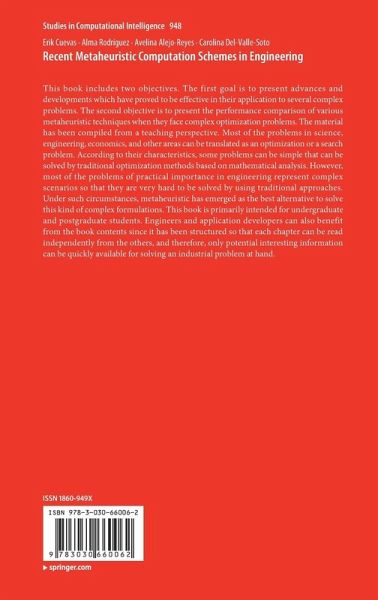
This book includes two objectives. The first goal is to present advances and developments which have proved to be effective in their application to several complex problems. The second objective is to present the performance comparison of various metaheuristic techniques when they face complex optimization problems. The material has been compiled from a teaching perspective. Most of the problems in science, engineering, economics, and other areas can be translated as an optimization or a search problem. According to their characteristics, some problems can be simple that can be solved by traditional optimization methods based on mathematical analysis. However, most of the problems of practical importance in engineering represent complex scenarios so that they are very hard to be solved by using traditional approaches. Under such circumstances, metaheuristic has emerged as the best alternative to solve this kind of complex formulations. This book is primarily intended for undergraduate and postgraduate students. Engineers and application developers can also benefit from the book contents since it has been structured so that each chapter can be read independently from the others, and therefore, only potential interesting information can be quickly available for solving an industrial problem at hand.
Dr. Erik Cuevas received his B.S. degree with distinction in Electronics and Communications Engineering from the University of Guadalajara, Mexico, in 1995, the M.Sc. degree in Industrial Electronics from ITESO, Mexico, in 2000, and the Ph.D. degree from Freie Universität Berlin, Germany in 2006. Since 2006 he has been with the University of Guadalajara, where he is currently a full-time Professor in the Department of Computer Science. Since 2008, he is a member of the Mexican National Research System (SNI III). He is the author of several books and articles. His current research interest includes Meta-heuristics, computer vision, and mathematical methods. He serves as an editor in Expert System with Applications, ISA Transactions, and Applied Soft Computing, Applied Mathematical Modeling and Mathematics and Computers in Simulation. Daniel Zaldivar graduated from the University of Guadalajara, Mexico in 1995 with a B.S. degree in Electronics and Communications Engineering. Later, in 2000, he earned his M.Sc. degree in Industrial Electronics from ITESO, Mexico, and in 2006 he received his Ph.D. degree from Freie Universität Berlin, Germany. Since then, he has been employed as a full-time Professor in the Department of Computer Science at the University of Guadalajara, where he currently holds his position. Ernesto Ayala, originally from León, Guanajuato was born in 1982. He received the title of Electrical Mechanical Engineer in 2017 and in 2019 the master's degree in Applied Computing at the University of Guadalajara. He is currently a PhD candidate in Electronics and Computing Sciences. Since 2018, he has been teaching curricular courses in Robotics Engineering and Electronic Engineering in the Division of Technologies for Cyber-human Integration of the University Center for Exact Sciences and Engineering. His area of expertise is computer vision and evolutionary computing. Mr. Ayala collaborates with a research group atthe University of Guadalajara focused on the development of ecological and autonomous driving vehicles. Oscar González received his B.S. with distinction in Electronic Engineering and Communications from the University of Guadalajara, Mexico, in 2022. During the COVID-19 pandemic, he was a member of the advisory committee for the COVID-19 pandemic of the University of Guadalajara. For his contributions and studies on COVID-19, he has been awarded the Irene Robledo García Award, the highest distinction of the University of Guadalajara for social service in 2022. Fernando Vega received the title of technical career in electricity by C.B.E.T.I.S. in 2014. Obtained a B.S. degree in Mechatronics from the National Technologist of Mexico, campus Culiacan, Mexico, in 2019. He is part of the University of Guadalajara, a full-time student M.S. in the Electronics and Computer Science program. His current research interests include motors design, electric vehicle design, Metaheuristics.
Inhaltsangabe
Introductory Concepts of Metaheuristic Computation.- A Metaheuristic Scheme Based on the Hunting Model of Yellow Saddle Goatfish.- Metaheuristic Algorithm Based on Hybridization of Invasive Weed Optimization and Estimation Distribution Methods.- Corner Detection Algorithm Based on Cellular Neural Networks (CNN) and Differential Evolution (DE).- Blood Vessel Segmentation Using Differential Evolution Algorithm.- Clustering Model Based on the Human Visual System.- Metaheuristic Algorithms for Wireless Sensor Networks.- Metaheuristic Algorithms Applied to the Inventory Problem.
Introductory Concepts of Metaheuristic Computation.- A Metaheuristic Scheme Based on the Hunting Model of Yellow Saddle Goatfish.- Metaheuristic Algorithm Based on Hybridization of Invasive Weed Optimization and Estimation Distribution Methods.- Corner Detection Algorithm Based on Cellular Neural Networks (CNN) and Differential Evolution (DE).- Blood Vessel Segmentation Using Differential Evolution Algorithm.- Clustering Model Based on the Human Visual System.- Metaheuristic Algorithms for Wireless Sensor Networks.- Metaheuristic Algorithms Applied to the Inventory Problem.
Es gelten unsere Allgemeinen Geschäftsbedingungen: www.buecher.de/agb
Impressum
www.buecher.de ist ein Internetauftritt der buecher.de internetstores GmbH
Geschäftsführung: Monica Sawhney | Roland Kölbl | Günter Hilger
Sitz der Gesellschaft: Batheyer Straße 115 - 117, 58099 Hagen
Postanschrift: Bürgermeister-Wegele-Str. 12, 86167 Augsburg
Amtsgericht Hagen HRB 13257
Steuernummer: 321/5800/1497
USt-IdNr: DE450055826