- Gebundenes Buch
- Merkliste
- Auf die Merkliste
- Bewerten Bewerten
- Teilen
- Produkt teilen
- Produkterinnerung
- Produkterinnerung
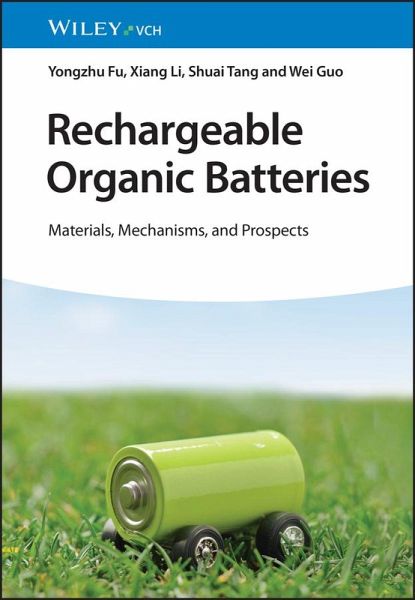
This book focuses on the next generation sustainable organic electrodes and provides a guideline for the future development of these materials.
Andere Kunden interessierten sich auch für
Flow Batteries, 3 Volume Set293,99 €
Alkaline Anion Exchange Membranes for Fuel Cells112,99 €
Sodium-Ion Batteries90,99 €
Xiao LinRecycling of Power Lithium-Ion Batteries125,00 €
Yuping WuElectrochemical Energy Conversion and Storage60,99 €
T. Daniel ThangaduraiPolymer Nanocomposites for Energy Applications139,00 €
Alexander BörgerBattery Technology83,99 €-
-
-
This book focuses on the next generation sustainable organic electrodes and provides a guideline for the future development of these materials.
Produktdetails
- Produktdetails
- Verlag: Wiley-VCH
- Artikelnr. des Verlages: 1135080 000
- 1. Auflage
- Seitenzahl: 304
- Erscheinungstermin: 17. April 2024
- Englisch
- Abmessung: 257mm x 187mm x 20mm
- Gewicht: 750g
- ISBN-13: 9783527350803
- ISBN-10: 3527350802
- Artikelnr.: 68978675
- Herstellerkennzeichnung
- Wiley-VCH GmbH
- Boschstraße 12
- 69469 Weinheim
- wiley-vch@kolibri360.de
- Verlag: Wiley-VCH
- Artikelnr. des Verlages: 1135080 000
- 1. Auflage
- Seitenzahl: 304
- Erscheinungstermin: 17. April 2024
- Englisch
- Abmessung: 257mm x 187mm x 20mm
- Gewicht: 750g
- ISBN-13: 9783527350803
- ISBN-10: 3527350802
- Artikelnr.: 68978675
- Herstellerkennzeichnung
- Wiley-VCH GmbH
- Boschstraße 12
- 69469 Weinheim
- wiley-vch@kolibri360.de
Yongzhu Fu is a Professor in the College of Chemistry at Zhengzhou University in the People's Republic of China. He received his Ph.D. degree in Materials Science and Engineering from the University of Texas at Austin (USA) in 2007. He was an Assistant Professor at Indiana University-Purdue University, Indianapolis, in the United States before he joined Zhengzhou University in 2017. His research is focused on electrochemical energy materials. Xiang Li is an Associate Professor in the College of Chemistry at Zhengzhou University in the People's Republic of China. He received his Ph.D. degree in University of Tsukuba (Japan) in 2019. His research is focused on positive electrode materials for Li/Na-ion batteries and electrolyte design related to electrochemical energy storage. Shuai Tang is an Associate Professor in the College of Chemistry at Zhengzhou University in the People's Republic of China. He received his Ph.D. in Physical Chemistry from Xiamen University in 2019 and bachelor degree in metallurgy engineering from Central South University in 2013. His research is focused on interfacial electrochemistry and energy materials related to electrochemical energy storage, especially on the organic electrode materials and sodium batteries. Wei Guo is a Professor in the College of Chemistry at the Zhengzhou University in the People's Republic of China. She received her Ph.D. degree in Inorganic Chemistry from Nankai University in 2014. Her research is focused on nanostructured and hybrid materials for rechargeable batteries.
1. Necessity and advantages of developing rechargeable organic batteries
2. Redox mechanisms and characterization methods of organic electrode materials
3. Carbonyl-based Organic Cathodes
4. Sulfur-containing Organic Cathodes
5. Radical-based organic cathodes
6. Organometallic complexes-based electrodes
7. Polymer-based organic cathodes
8. Organic anode
9: All-Organic Batteries
10. Outlook

2. Redox mechanisms and characterization methods of organic electrode materials
3. Carbonyl-based Organic Cathodes
4. Sulfur-containing Organic Cathodes
5. Radical-based organic cathodes
6. Organometallic complexes-based electrodes
7. Polymer-based organic cathodes
8. Organic anode
9: All-Organic Batteries
10. Outlook
1. Necessity and advantages of developing rechargeable organic batteries
2. Redox mechanisms and characterization methods of organic electrode materials
3. Carbonyl-based Organic Cathodes
4. Sulfur-containing Organic Cathodes
5. Radical-based organic cathodes
6. Organometallic complexes-based electrodes
7. Polymer-based organic cathodes
8. Organic anode
9: All-Organic Batteries
10. Outlook

2. Redox mechanisms and characterization methods of organic electrode materials
3. Carbonyl-based Organic Cathodes
4. Sulfur-containing Organic Cathodes
5. Radical-based organic cathodes
6. Organometallic complexes-based electrodes
7. Polymer-based organic cathodes
8. Organic anode
9: All-Organic Batteries
10. Outlook