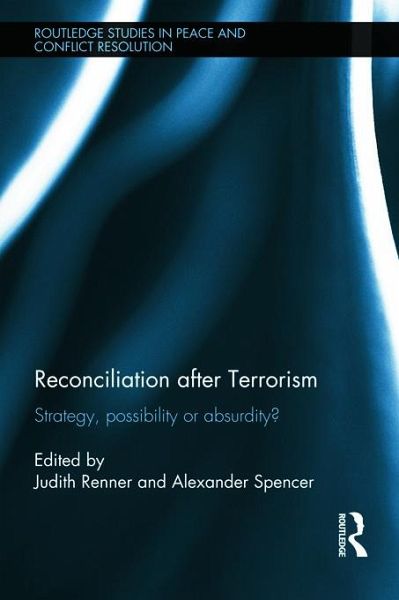
This book brings together scholars from the hitherto disparate fields of terrorism and reconciliation studies to examine whether reconciliation is a possible strategy for dealing with and ending a terrorist conflict.
This book brings together scholars from the hitherto disparate fields of terrorism and reconciliation studies to examine whether reconciliation is a possible strategy for dealing with and ending a terrorist conflict.
Judith Renner is a Research Fellow at the Ludwig-Maximilians University, Munich, Germany. Alexander Spencer is an Assistant Professor at the Ludwig-Maximilians University, Munich, Germany.
Inhaltsangabe
Introduction: Reconciling the Seemingly Irreconcilable? Part I: Theoretical Reflections on Reconciliation after Terrorism 1. Orthodox Terrorism Theory and Reconciliation: The Transition out of Terrorism 2. Marginalizing 'Victims' and 'Terrorists': Modes of Exclusion in the Reconciliation Process Part II: Empirical Case Studies of Reconciliation in Terrorist Conflicts 3. Reconciliation following Terrorism in South Tyrol: A Successful Story of Peacemaking by Consociational Democracy and Power-Sharing 4. Reconciliation and Paramilitaries in Nothern Ireland 5. Reconciliation with 'Terrorists': Understanding the Legacy of Terror in South Africa 6. Overcoming Terrorism in Peru without Negotiation or Reconciliation 7. Undermining Reconciliation: Colombian Peace Spoilers in- and outside the Negotiation Process 8. Talking: A Potential Path to Reconciliation in Mindanao 9. Terror, Empathy and Reconciliation in the Israeli-Palestinian Conflict 10. Conclusion: The (im)Possibility of Reconciliation in Afghanistan and the 'War on Terror'
Introduction: Reconciling the Seemingly Irreconcilable? Part I: Theoretical Reflections on Reconciliation after Terrorism 1. Orthodox Terrorism Theory and Reconciliation: The Transition out of Terrorism 2. Marginalizing 'Victims' and 'Terrorists': Modes of Exclusion in the Reconciliation Process Part II: Empirical Case Studies of Reconciliation in Terrorist Conflicts 3. Reconciliation following Terrorism in South Tyrol: A Successful Story of Peacemaking by Consociational Democracy and Power-Sharing 4. Reconciliation and Paramilitaries in Nothern Ireland 5. Reconciliation with 'Terrorists': Understanding the Legacy of Terror in South Africa 6. Overcoming Terrorism in Peru without Negotiation or Reconciliation 7. Undermining Reconciliation: Colombian Peace Spoilers in- and outside the Negotiation Process 8. Talking: A Potential Path to Reconciliation in Mindanao 9. Terror, Empathy and Reconciliation in the Israeli-Palestinian Conflict 10. Conclusion: The (im)Possibility of Reconciliation in Afghanistan and the 'War on Terror'
Es gelten unsere Allgemeinen Geschäftsbedingungen: www.buecher.de/agb
Impressum
www.buecher.de ist ein Internetauftritt der buecher.de internetstores GmbH
Geschäftsführung: Monica Sawhney | Roland Kölbl | Günter Hilger
Sitz der Gesellschaft: Batheyer Straße 115 - 117, 58099 Hagen
Postanschrift: Bürgermeister-Wegele-Str. 12, 86167 Augsburg
Amtsgericht Hagen HRB 13257
Steuernummer: 321/5800/1497
USt-IdNr: DE450055826