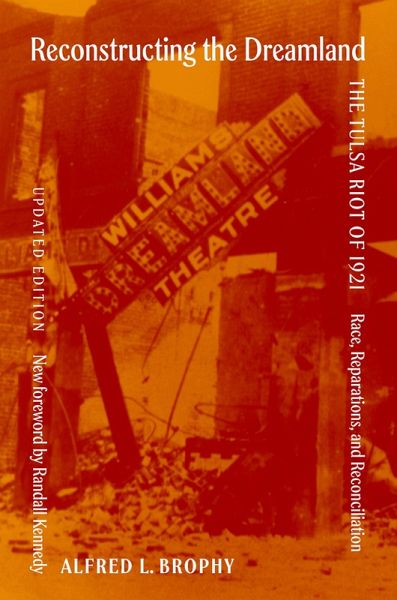
The 1921 Tulsa Race Riot was the country's bloodiest civil disturbance of the century. Thirty city blocks were burned to the ground, perhaps 150 died, and the prosperous black community of Greenwood, Oklahoma, was turned to rubble. Alfred L. Brophy draws on his own extensive research into contemporary accounts and court documents to chronicle this devastating riot, showing how and why the rule of law quickly eroded. Brophy shines his lights on mob violence and racism run amok, both on the night of the riot and the following morning. Equally important, he shows how the city government and…mehr
The 1921 Tulsa Race Riot was the country's bloodiest civil disturbance of the century. Thirty city blocks were burned to the ground, perhaps 150 died, and the prosperous black community of Greenwood, Oklahoma, was turned to rubble. Alfred L. Brophy draws on his own extensive research into contemporary accounts and court documents to chronicle this devastating riot, showing how and why the rule of law quickly eroded. Brophy shines his lights on mob violence and racism run amok, both on the night of the riot and the following morning. Equally important, he shows how the city government and police not only permitted looting, shootings, and the burning of Greenwood, but actively participated in it by deputizing white citizens haphazardly, giving out guns and badges, or sending men to arm themselves. Likewise, the National Guard acted unconstitutionally, arresting every black resident they found, leaving property vulnerable to the white mob. Brophy's stark narrative concludes with a discussion of reparations for victims of the riot through lawsuits and legislative action. That case has implications for other reparations movements, including reparations for slavery. This updated edition features a new foreword by Randall Kennedy.
Alfred L. Brophy is the former D. Paul Jones, Jr. & Charlene Jones Chairholder of Law at the University of Alabama School of Law. He is the author of University, Court, and Slave: Proslavery Thoughts in Southern Colleges and Courts and the Coming of Civil War (OUP, 2016) and Reparations: Pro and Con (OUP, 2006), among other books. He contributed to the report to the Tulsa Race Riot Commission, a body created by the Oklahoma Legislature to investigate the riot and make recommendations for reparations. Brophy has appeared on CNN's News Night with Aaron Brown, NBC Nightly News, NPR's "Fresh Air," the "Tavis Smiley Show," and "Talk of the Nation," and has been quoted in such newspapers as the Chicago Tribune, Los Angeles Times, New York Times, and Washington Post.
Inhaltsangabe
* New foreword by Randall Kennedy * Acknowledgments * Prologue * 1. Seeking Justice and the Origins of the Riot * 2. "Thinking He Can Whip the World": The Riot * 3. Picturing the Riot * 4. "A White Wash Brush and a Big One in Operation in Tulsa": Tulsa Interprets the Riot * 5. Tulsa Will! Tulsa Will? Tulsa Will Dodge: The Failure of Reconstruction * Epilogue * Notes * Bibliographic Essay * Index
* New foreword by Randall Kennedy * Acknowledgments * Prologue * 1. Seeking Justice and the Origins of the Riot * 2. "Thinking He Can Whip the World": The Riot * 3. Picturing the Riot * 4. "A White Wash Brush and a Big One in Operation in Tulsa": Tulsa Interprets the Riot * 5. Tulsa Will! Tulsa Will? Tulsa Will Dodge: The Failure of Reconstruction * Epilogue * Notes * Bibliographic Essay * Index
Es gelten unsere Allgemeinen Geschäftsbedingungen: www.buecher.de/agb
Impressum
www.buecher.de ist ein Internetauftritt der buecher.de internetstores GmbH
Geschäftsführung: Monica Sawhney | Roland Kölbl | Günter Hilger
Sitz der Gesellschaft: Batheyer Straße 115 - 117, 58099 Hagen
Postanschrift: Bürgermeister-Wegele-Str. 12, 86167 Augsburg
Amtsgericht Hagen HRB 13257
Steuernummer: 321/5800/1497
USt-IdNr: DE450055826