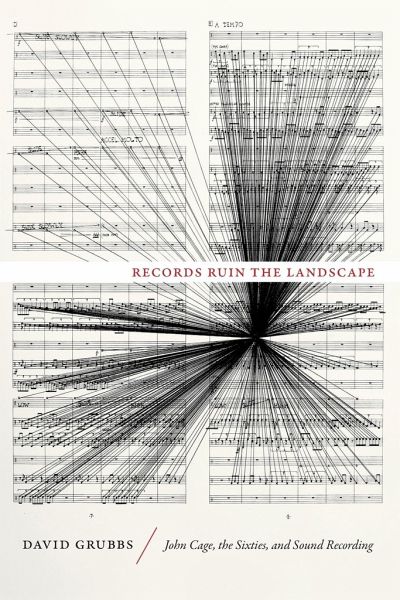
John Cage's disdain for records was legendary. He repeatedly spoke of the ways in which recorded music was antithetical to his work. In Records Ruin the Landscape, David Grubbs argues that, following Cage, new genres in experimental and avant-garde music in the 1960s were particularly ill suited to be represented in the form of a recording. These activities include indeterminate music, long-duration minimalism, text scores, happenings, live electronic music, free jazz, and free improvisation. How could these proudly evanescent performance practices have been adequately represented on an LP? In…mehr
John Cage's disdain for records was legendary. He repeatedly spoke of the ways in which recorded music was antithetical to his work. In Records Ruin the Landscape, David Grubbs argues that, following Cage, new genres in experimental and avant-garde music in the 1960s were particularly ill suited to be represented in the form of a recording. These activities include indeterminate music, long-duration minimalism, text scores, happenings, live electronic music, free jazz, and free improvisation. How could these proudly evanescent performance practices have been adequately represented on an LP? In their day, few of these works circulated in recorded form. By contrast, contemporary listeners can encounter this music not only through a flood of LP and CD releases of archival recordings but also in even greater volume through Internet file sharing and online resources. Present-day listeners are coming to know that era's experimental music through the recorded artifacts of composers and musicians who largely disavowed recordings. In Records Ruin the Landscape, Grubbs surveys a musical landscape marked by altered listening practices.
David Grubbs is Associate Professor in the Conservatory of Music at Brooklyn College, City University of New York, where he also teaches in the M.F.A. programs in Performance and Interactive Media Arts and Creative Writing. As a musician, he has released twelve solo albums and appeared on more than 150 commercially released recordings. Grubbs was a founding member of the groups Gastr del Sol, Bastro, and Squirrel Bait, and has appeared on recordings by the Red Krayola, Tony Conrad, Pauline Oliveros, Will Oldham, and Matmos, among other artists. He is known for cross-disciplinary collaborations with the writers Susan Howe and Rick Moody and the visual artists Anthony McCall, Angela Bulloch, and Stephen Prina. A grant recipient in music/sound from the Foundation for Contemporary Arts, Grubbs has written for The Wire, Bookforum, and the SÜddeutsche Zeitung.
Inhaltsangabe
Preface ix Acknowledgments xxiii Introduction 1 1. Henry Flynt on the Air 19 2. Landscape with Cage 45 3. John Cage, Recording Artist 67 4. The Antiques Trade: Free Improvisation and Record Culture 105 5. Remove the Records from Texas: Online Resources and Impermanent Archives 135 Notes 167 Selected Disography 195 Bibliography 199 Index 209
Preface ix Acknowledgments xxiii Introduction 1 1. Henry Flynt on the Air 19 2. Landscape with Cage 45 3. John Cage, Recording Artist 67 4. The Antiques Trade: Free Improvisation and Record Culture 105 5. Remove the Records from Texas: Online Resources and Impermanent Archives 135 Notes 167 Selected Disography 195 Bibliography 199 Index 209
Es gelten unsere Allgemeinen Geschäftsbedingungen: www.buecher.de/agb
Impressum
www.buecher.de ist ein Internetauftritt der buecher.de internetstores GmbH
Geschäftsführung: Monica Sawhney | Roland Kölbl | Günter Hilger
Sitz der Gesellschaft: Batheyer Straße 115 - 117, 58099 Hagen
Postanschrift: Bürgermeister-Wegele-Str. 12, 86167 Augsburg
Amtsgericht Hagen HRB 13257
Steuernummer: 321/5800/1497
USt-IdNr: DE450055826