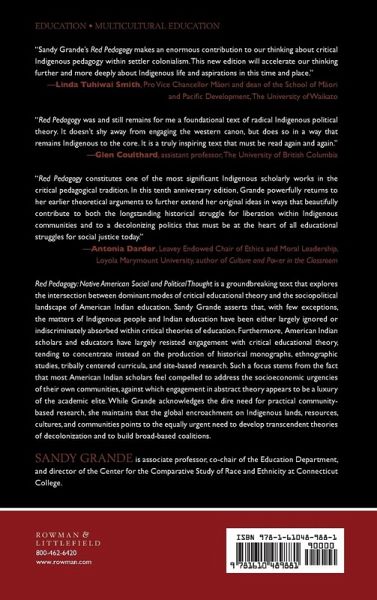
This ground-breaking text explores the intersection between dominant modes of critical educational theory and the socio-political landscape of American Indian education. Grande asserts that, with few exceptions, the matters of Indigenous people and Indian education have been either largely ignored or indiscriminately absorbed within critical theories of education.
This ground-breaking text explores the intersection between dominant modes of critical educational theory and the socio-political landscape of American Indian education. Grande asserts that, with few exceptions, the matters of Indigenous people and Indian education have been either largely ignored or indiscriminately absorbed within critical theories of education.
Sandy Grande is associate professor and Chair of the Education Department at Connecticut College. Her research interfaces critical Indigenous theories with the concerns of education. In addition to Red Pedagogy: Native American Social and Political Thought (2004, 2015), she has also published several book chapters and articles including: Accumulation of the Primitive: The Limits of Liberalism and the Politics of Occupy Wall Street.
Inhaltsangabe
Foreword Miryam Yataco, Independent Scholar (Quechua) Preface Acknowledgments Introduction Chapter 1: Mapping the Terrain of Struggle: From Genocide, Colonization, and Resistance to Red Power and Red Pedagogy Critical Theory, Red Pedagogy and Indigenous Knowledge: The Missing Links to Improving Education- John Tippeconnic, Arizona State University Colonialism Undone: Pedagogies of Entanglement - Alyosha Goldstein, University of New Mexico Chapter 2: Competing Moral Visions: At the Crossroads of Democracy and Sovereignty At the Crossroads of Constraint: Competing Moral Visions in Grande's Red Pedagogy - Audra Simpson, Columbia University Red Bones: Towards a Pedagogy of Common Struggle - Peter McLaren, Chapman University Chapter 3: Red Land, White Power Where There Is No Name For Science - Greg Cajete, University of New Mexico Red Land, Living Pedagogies: Re-animating Critical Pedagogy through American Indian Land Justice - Donna Houston, Macquarie University Chapter 4: American Identity Geographies of Identity and Power Reframing the Geographies of Power: Indigenous Identities and Other Red Pedagogical Paradoxes - Jodi Byrd, University of Illinois-Urbana Champagne Situating the Grip of Identity - Leigh Patel, Boston College Chapter 5: Whitestream Feminism and the Colonial Project Challenging Whitestream Feminism - Eve Tuck, SUNY, New Paltz The Indigenous Feminist Revolution - Andrea Smith, University of California, Riverside Chapter 6: Better Red than Dead: Toward a Nation-Peoples and a Peoples Nation The Dream of Sovereignty & the Struggle for Life Itself - Malia Villegas, National Congress of American Indians (NCAI) Refusing Colonialism and Resisting White Supremacy: A Collaborative Project - Kevin Bruyneel, Babson College Teaching/Learning Red Pedagogy The Red Atlantic Dialogue - Robert Stam and Ella Shohat, New York University Mii gaa-izhiwinag: And then I brought her along - Mary Hermes, University of Minnesota Red Pedagogy: Reflections From the Field - Sweeney Windchief, Montana State University; Jeremy Garcia, University of Arizona; Timothy San Pedro, The Ohio State University Mobilizing Transgression: Red Pedagogy and Maya Migrant Positionalities - Flori Boj Lopez, University of Southern California Keep Calm and Decolonize - Lakota Pochedly, University of Texas-Austin Teaching Red Pedagogy - Mary Louise Pratt, New York University Epilogue Bibliography About the Author About the Contributors
Foreword Miryam Yataco, Independent Scholar (Quechua) Preface Acknowledgments Introduction Chapter 1: Mapping the Terrain of Struggle: From Genocide, Colonization, and Resistance to Red Power and Red Pedagogy Critical Theory, Red Pedagogy and Indigenous Knowledge: The Missing Links to Improving Education- John Tippeconnic, Arizona State University Colonialism Undone: Pedagogies of Entanglement - Alyosha Goldstein, University of New Mexico Chapter 2: Competing Moral Visions: At the Crossroads of Democracy and Sovereignty At the Crossroads of Constraint: Competing Moral Visions in Grande's Red Pedagogy - Audra Simpson, Columbia University Red Bones: Towards a Pedagogy of Common Struggle - Peter McLaren, Chapman University Chapter 3: Red Land, White Power Where There Is No Name For Science - Greg Cajete, University of New Mexico Red Land, Living Pedagogies: Re-animating Critical Pedagogy through American Indian Land Justice - Donna Houston, Macquarie University Chapter 4: American Identity Geographies of Identity and Power Reframing the Geographies of Power: Indigenous Identities and Other Red Pedagogical Paradoxes - Jodi Byrd, University of Illinois-Urbana Champagne Situating the Grip of Identity - Leigh Patel, Boston College Chapter 5: Whitestream Feminism and the Colonial Project Challenging Whitestream Feminism - Eve Tuck, SUNY, New Paltz The Indigenous Feminist Revolution - Andrea Smith, University of California, Riverside Chapter 6: Better Red than Dead: Toward a Nation-Peoples and a Peoples Nation The Dream of Sovereignty & the Struggle for Life Itself - Malia Villegas, National Congress of American Indians (NCAI) Refusing Colonialism and Resisting White Supremacy: A Collaborative Project - Kevin Bruyneel, Babson College Teaching/Learning Red Pedagogy The Red Atlantic Dialogue - Robert Stam and Ella Shohat, New York University Mii gaa-izhiwinag: And then I brought her along - Mary Hermes, University of Minnesota Red Pedagogy: Reflections From the Field - Sweeney Windchief, Montana State University; Jeremy Garcia, University of Arizona; Timothy San Pedro, The Ohio State University Mobilizing Transgression: Red Pedagogy and Maya Migrant Positionalities - Flori Boj Lopez, University of Southern California Keep Calm and Decolonize - Lakota Pochedly, University of Texas-Austin Teaching Red Pedagogy - Mary Louise Pratt, New York University Epilogue Bibliography About the Author About the Contributors
Es gelten unsere Allgemeinen Geschäftsbedingungen: www.buecher.de/agb
Impressum
www.buecher.de ist ein Internetauftritt der buecher.de internetstores GmbH
Geschäftsführung: Monica Sawhney | Roland Kölbl | Günter Hilger
Sitz der Gesellschaft: Batheyer Straße 115 - 117, 58099 Hagen
Postanschrift: Bürgermeister-Wegele-Str. 12, 86167 Augsburg
Amtsgericht Hagen HRB 13257
Steuernummer: 321/5800/1497
USt-IdNr: DE450055826