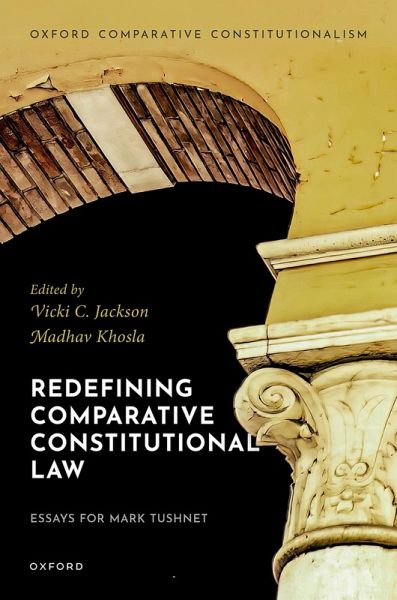
Redefining Comparative Constitutional Law: Essays for Mark Tushnet commemorates the writings of Mark Tushnet, a significant voice in the study of comparative constitutional law. Each essay is written by a leading scholar and discusses timely topics such as empiricism and language, democracy and entrenchment, and analyses of rights and courts.
Redefining Comparative Constitutional Law: Essays for Mark Tushnet commemorates the writings of Mark Tushnet, a significant voice in the study of comparative constitutional law. Each essay is written by a leading scholar and discusses timely topics such as empiricism and language, democracy and entrenchment, and analyses of rights and courts.
Madhav Khosla is an Associate Professor of Law at Columbia University. He is interested in the nature and form of constitutions, especially from a comparative and theoretical perspective. Khosla studied political theory at Harvard University, and law at Yale Law School and the National Law School of India University, Bangalore. Before joining Columbia Law School, he was a Junior Fellow at the Harvard Society of Fellows. Khosla's books include India's Founding Moment, which was an Economist Best Book of 2020 and co-winner of the Order of the Coif Book Award 2021. Vicki C. Jackson, Laurence H. Tribe Professor of Constitutional Law at Harvard, works on comparative constitutional law, U.S. constitutional law, and federal courts. Previously she was Carmack Waterhouse Professor of Constitutional Law at Georgetown University. She is the author of Constitutional Engagement in a Transnational Era (2010), coauthor, with Mark Tushnet, of Comparative Constitutional Law (3d ed. 2014), and co-editor, with Yasmin Dawood, of Constitutionalism and a Right to Effective Government? (2022), among other works. Her scholarship concerns knowledge institutions, effective government and constitutionalism; judicial independence and the Supreme Court, free expression, federalism, pro-constitutional representation, proportionality review, equality, unconstitutional amendments, and standing.
Inhaltsangabe
* 1: Rosalind Dixon: How to Compare Constitutionally: An Essay in Honor of Mark Tushnet * 2: Ran Hirschl: Comparative Constitutional Law: Reflections on a Field Transformed * 3: Tom Ginsburg and Mila Versteeg: Are Constitutions So Indeterminate that We Cannot Compare Them? * 4: Sanford Levinson: Mark Tushnet's Central Contribution-and Challenge-to the Enterprise of Comparative Constitutionalism * 5: David S. Law: Canon and Comparative Constitutional Law * 6: Kim Lane Scheppele: Foxes, Hedgehogs, and Ants * 7: Maartje De Visser: Constitutional Comparisons and Language * 8: Frank I. Michelman: Reasonable Disagreement: Mark Tushnet, John Rawls, and a Democratic Point to Constitutionalism * 9: Pratap Bhanu Mehta: The Challenge to Liberal Constitutionalism * 10: Peter Cane: The Architecture of Constitutionalism * 11: Richard Albert: Global Values in National Constitutions * 12: Aharon Barak: The Constituent Power and Its Limits * 13: Cheryl Saunders: Toward Deeper Dialogue: Constitutional and International Law * 14: David Landau: Ancillary Powers of Constitution-Making Bodies * 15: Dieter Grimm: Legal Reasoning Matters * 16: Catherine O'Regan: The Political Paradox of African Constitutionalism Revisited: Kenya's BBI Case * 17: Jeremy Waldron: Rights as the Domain of Weak-Form Review * 18: David C. Donald: Common Law and the Liberation of Self-Interest from Regulation * 19: Po Jen Yap: Dialogic Judicial Review and First World Autocracies * 20: Yaniv Roznai: We the Fourth Branch? The People as an Institution Protecting Democracy * 21: Sujit Choudhry: Constitutional Design and Political Parties * 22: Vicki C. Jackson: Civic Virtue, Civic Obligation, Knowledge Institutions, and Proconstitutional Actors * 23: Bojan BugariÄ: Popular Constitutionalism during Populist Times * 24: Cora Chan: Pluralizing Constitutionalism * 25: Madhav Khosla: Competitive Populism * 26: Erin F. Delaney: Mapping Power Constitutionalism and Its Colonial Legacy * 27: Jamal Greene: The Possibilities of Constitutional Tourism * 28: Mark Tushnet: Constituent Power in Constitutional Theory, with a Note on Language and Method
* 1: Rosalind Dixon: How to Compare Constitutionally: An Essay in Honor of Mark Tushnet * 2: Ran Hirschl: Comparative Constitutional Law: Reflections on a Field Transformed * 3: Tom Ginsburg and Mila Versteeg: Are Constitutions So Indeterminate that We Cannot Compare Them? * 4: Sanford Levinson: Mark Tushnet's Central Contribution-and Challenge-to the Enterprise of Comparative Constitutionalism * 5: David S. Law: Canon and Comparative Constitutional Law * 6: Kim Lane Scheppele: Foxes, Hedgehogs, and Ants * 7: Maartje De Visser: Constitutional Comparisons and Language * 8: Frank I. Michelman: Reasonable Disagreement: Mark Tushnet, John Rawls, and a Democratic Point to Constitutionalism * 9: Pratap Bhanu Mehta: The Challenge to Liberal Constitutionalism * 10: Peter Cane: The Architecture of Constitutionalism * 11: Richard Albert: Global Values in National Constitutions * 12: Aharon Barak: The Constituent Power and Its Limits * 13: Cheryl Saunders: Toward Deeper Dialogue: Constitutional and International Law * 14: David Landau: Ancillary Powers of Constitution-Making Bodies * 15: Dieter Grimm: Legal Reasoning Matters * 16: Catherine O'Regan: The Political Paradox of African Constitutionalism Revisited: Kenya's BBI Case * 17: Jeremy Waldron: Rights as the Domain of Weak-Form Review * 18: David C. Donald: Common Law and the Liberation of Self-Interest from Regulation * 19: Po Jen Yap: Dialogic Judicial Review and First World Autocracies * 20: Yaniv Roznai: We the Fourth Branch? The People as an Institution Protecting Democracy * 21: Sujit Choudhry: Constitutional Design and Political Parties * 22: Vicki C. Jackson: Civic Virtue, Civic Obligation, Knowledge Institutions, and Proconstitutional Actors * 23: Bojan BugariÄ: Popular Constitutionalism during Populist Times * 24: Cora Chan: Pluralizing Constitutionalism * 25: Madhav Khosla: Competitive Populism * 26: Erin F. Delaney: Mapping Power Constitutionalism and Its Colonial Legacy * 27: Jamal Greene: The Possibilities of Constitutional Tourism * 28: Mark Tushnet: Constituent Power in Constitutional Theory, with a Note on Language and Method
Es gelten unsere Allgemeinen Geschäftsbedingungen: www.buecher.de/agb
Impressum
www.buecher.de ist ein Internetauftritt der buecher.de internetstores GmbH
Geschäftsführung: Monica Sawhney | Roland Kölbl | Günter Hilger
Sitz der Gesellschaft: Batheyer Straße 115 - 117, 58099 Hagen
Postanschrift: Bürgermeister-Wegele-Str. 12, 86167 Augsburg
Amtsgericht Hagen HRB 13257
Steuernummer: 321/5800/1497
USt-IdNr: DE450055826