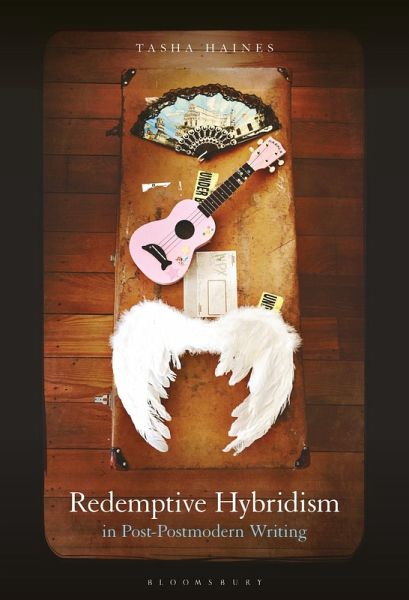
"From Virginia Woolf to David Foster Wallace and beyond, 'redemptive hybridism' - a new way of reading texts full of possibility and genre blending - emerges as a key trajectory for post-postmodernity"--
"From Virginia Woolf to David Foster Wallace and beyond, 'redemptive hybridism' - a new way of reading texts full of possibility and genre blending - emerges as a key trajectory for post-postmodernity"--
Tasha Haines is an artist and writer based in New Zealand. She has a PhD in literary theory and creative writing as well as an MFA and a BFA in photomontage, a diploma in tertiary teaching, and years of teaching experience. Haines has exhibited and published her hybrid work since late last century.
Inhaltsangabe
Preface Introduction: The Enemy Within Taking Enemies In This Multivariant Plot The Vitality of Difference A Lineage of Wariness and Influence The Terrible Postmodern Party Part I: Features of Redemptive Hybridism 1. The Redemptive Textual Body Etymologies Umbilical Connection, Author to Text The Word Made Flesh 2. The Hybrid Middle Pushing out towards Ends Sarraute as Middle Parataxis and the Middle Time and Unfinishedness 3. Family Traits of Fragmentation The Fragmented Mind Constraint, Minimalism, and the Caveat Vestibule and Fringe Ethics, Alterity, and the Reader The Ethical, The Moral, and the Difference High, Low, High Low, It's Off to Blend We Go Part II: Figures of Redemptive Hybridism 4. Woolf's Atom; The Image of Hybridity Begin with the Atom, Virginia Woolf Saturation in Woolf and Wallace Mrs. Dalloway as Fertile Ground Inter-genre Woolf It Ends Where It Begins, with the Atom 5. Finding a Name for Possibility Postmodernism, Feminism, and Agency Finding Names and Building Frames Call Me[a]taxy: Some Recent Pre-fixes 6. The Pale King's Constellation; Factoids, Ghosts, and Boredom Tell the Truth, David Foster Wallace Everyday Ghosts, Souls, & Phantoms Ambiguity & Contradiction in The Pale King Boredom: Between Crisis & Epiphany A Conclusion, of Sorts; This Is Not the End References Index
Preface Introduction: The Enemy Within Taking Enemies In This Multivariant Plot The Vitality of Difference A Lineage of Wariness and Influence The Terrible Postmodern Party Part I: Features of Redemptive Hybridism 1. The Redemptive Textual Body Etymologies Umbilical Connection, Author to Text The Word Made Flesh 2. The Hybrid Middle Pushing out towards Ends Sarraute as Middle Parataxis and the Middle Time and Unfinishedness 3. Family Traits of Fragmentation The Fragmented Mind Constraint, Minimalism, and the Caveat Vestibule and Fringe Ethics, Alterity, and the Reader The Ethical, The Moral, and the Difference High, Low, High Low, It's Off to Blend We Go Part II: Figures of Redemptive Hybridism 4. Woolf's Atom; The Image of Hybridity Begin with the Atom, Virginia Woolf Saturation in Woolf and Wallace Mrs. Dalloway as Fertile Ground Inter-genre Woolf It Ends Where It Begins, with the Atom 5. Finding a Name for Possibility Postmodernism, Feminism, and Agency Finding Names and Building Frames Call Me[a]taxy: Some Recent Pre-fixes 6. The Pale King's Constellation; Factoids, Ghosts, and Boredom Tell the Truth, David Foster Wallace Everyday Ghosts, Souls, & Phantoms Ambiguity & Contradiction in The Pale King Boredom: Between Crisis & Epiphany A Conclusion, of Sorts; This Is Not the End References Index
Es gelten unsere Allgemeinen Geschäftsbedingungen: www.buecher.de/agb
Impressum
www.buecher.de ist ein Internetauftritt der buecher.de internetstores GmbH
Geschäftsführung: Monica Sawhney | Roland Kölbl | Günter Hilger
Sitz der Gesellschaft: Batheyer Straße 115 - 117, 58099 Hagen
Postanschrift: Bürgermeister-Wegele-Str. 12, 86167 Augsburg
Amtsgericht Hagen HRB 13257
Steuernummer: 321/5800/1497
USt-IdNr: DE450055826