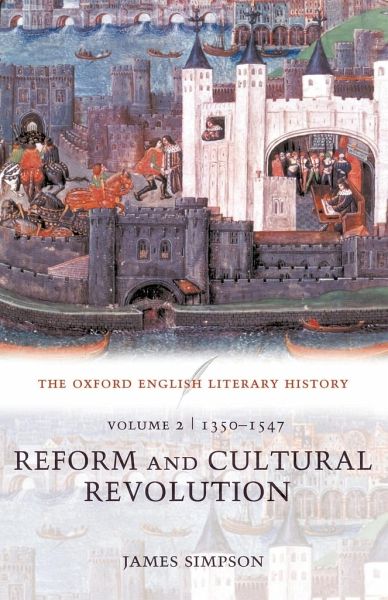
The Oxford English Literary History is the new century's definitive account of a rich and diverse literary heritage that stretches back for a millennium and more. Each of these groundbreaking volumes offers a leading scholar's considered assessment of the authors, works, cultural traditions, events, and ideas that shaped the literary voices of their age. The series will enlighten and inspire not only everyone studying, teaching, and researching in English Literature, but all serious readers. Overstepping traditional period divisions, this volume in the new Oxford English Literary History runs…mehr
The Oxford English Literary History is the new century's definitive account of a rich and diverse literary heritage that stretches back for a millennium and more. Each of these groundbreaking volumes offers a leading scholar's considered assessment of the authors, works, cultural traditions, events, and ideas that shaped the literary voices of their age. The series will enlighten and inspire not only everyone studying, teaching, and researching in English Literature, but all serious readers. Overstepping traditional period divisions, this volume in the new Oxford English Literary History runs from 1350 to the death of Henry VIII. It thus spans the extraordinary burst of English literary writing in the reign of Richard II; powerful phases of fifteenth-century literature; and the cultural revolution provoked by the split with Rome. Although potent traditions praise both the "Reformation" and "Renaissance" as liberating movements, this book argues the reverse. Sixteenth-century centralization instead narrowed possibilities enjoyed by late medieval writers, whose work was energized by generic and stylistic diversity. From roughly 1350 a wide range of literary kinds flourished, in a wide range of dialects. Many of these texts can be described as a mixed commonwealth of styles and genres, such as Langland's Piers Plowman, Gower's Confessio Amantis, Chaucer's Canterbury Tales, the dramatic "mystery" cycles, and Malory's works. In the sixteenth century that stylistic variety gave way to a literary practice that prized coherence and unity above all. Some kinds of writing, especially romance, survived the cultural revolution. Others, such as Langland's attempt to reformthe Church, the broadbased politics of Gower and Hoccleve, and the feminine visionary mode of Julian of Norwich, became untenable. For all its finely tuned classicism or Protestant energy, sixteenth-century writing--by figures such as Wyatt, Surrey, and the dramatist Jo
Growing up in the aftermath of the Video Nasties, during the late eighties and early nineties, James Simpson is from a small town in the North East of England where talking about grisly horror flicks was the norm in his school playground. For the last few years, he has written about cult cinema for several magazines and websites as well as running his own-now-defunct site: Infernal Cinema. He has interviewed horror stars Emily Booth, Barbie Wilde, and the legendary Lloyd Kaufman, amongst others, during this time. He appears in the Jason Impey documentary: VIPCO: The Untold Story. This is his first book. His favourite VIPCO movie is Spookies.
Inhaltsangabe
General Editor's Preface List of Illustrations Note on Presentation of Texts Introduction 1: The Melancholy of John Leland and the Beginnings of English Literary History 2: The Energies of John Lydgate 3: The Tragic 4: The Elegiac 5: The Political 6: The Comic 7: Edifying the Church 8: Moving Images 9: The Biblical 10: The Dramatic Envoi Author Bibliographies Suggestions for Further Reading Works Cited Index
General Editor's Preface List of Illustrations Note on Presentation of Texts Introduction 1: The Melancholy of John Leland and the Beginnings of English Literary History 2: The Energies of John Lydgate 3: The Tragic 4: The Elegiac 5: The Political 6: The Comic 7: Edifying the Church 8: Moving Images 9: The Biblical 10: The Dramatic Envoi Author Bibliographies Suggestions for Further Reading Works Cited Index
Es gelten unsere Allgemeinen Geschäftsbedingungen: www.buecher.de/agb
Impressum
www.buecher.de ist ein Internetauftritt der buecher.de internetstores GmbH
Geschäftsführung: Monica Sawhney | Roland Kölbl | Günter Hilger
Sitz der Gesellschaft: Batheyer Straße 115 - 117, 58099 Hagen
Postanschrift: Bürgermeister-Wegele-Str. 12, 86167 Augsburg
Amtsgericht Hagen HRB 13257
Steuernummer: 321/5800/1497
USt-IdNr: DE450055826