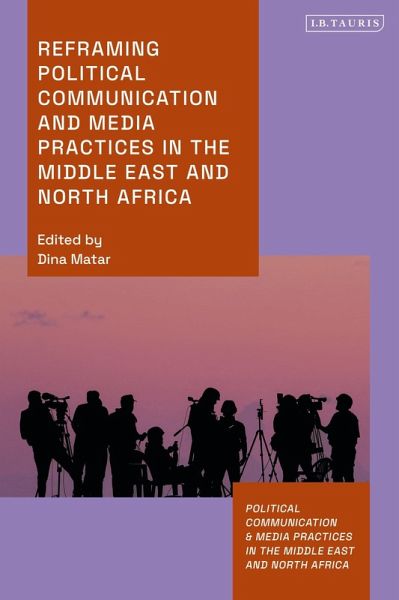
"This book problematizes the relationship between politics and communication in the Middle East and North Africa region, paying attention to the diversity of communicative forms and political practices outside formal institutions and structures while remaining conscious of the power dynamics within institutional practices. Examining political communication in Palestine, Lebanon, Egypt, Morocco, Iraq, Syria, the Gulf, Turkey and Iran, the book's chapters challenge Western-centric theories and methodologies within the broad field of political communication that continue to focus on democracy or…mehr
"This book problematizes the relationship between politics and communication in the Middle East and North Africa region, paying attention to the diversity of communicative forms and political practices outside formal institutions and structures while remaining conscious of the power dynamics within institutional practices. Examining political communication in Palestine, Lebanon, Egypt, Morocco, Iraq, Syria, the Gulf, Turkey and Iran, the book's chapters challenge Western-centric theories and methodologies within the broad field of political communication that continue to focus on democracy or its absence and are primarily concerned with elites, focusing on the marginal or the peripheral, the informal, and the grassroots"-- Provided by publisher.
Dina Matar is a Professor at the School of Oriental and African Studies (SOAS), University of London, UK. She is the Chair of the SOAS Centre of Palestine Studies and the Centre for Global Media and Communication. She is Series Editor of the series Political Communication and Media Practices in the Middle East and North Africa, and SOAS Palestine Studies.
Inhaltsangabe
Introduction: Problematizing political communication theory and praxis in the Middle East and North Africa: Towards de-colonizing the field , Dina Matar: 1-12 Chapter One: Complexity of Political Communication in Iran, Gholam Khiabany Chapter Two: Reframing Political Communication: Palestinian storytelling, witnessing and remembering as politics in the margin, Dina Matar Chapter Three: Cultural self-orientalism and its impact on Turkey's political communication: From Kemalism to Islamism - A theoretical discussion of the country's two '-isms, Dogan Taner Chapter Four: Political Communication in the Arabian Gulf States in Transition- a GCC-Centered Continuity and Change Perspective, Mohamad Ayish Chapter Five: Journalism and State Feminism in Morocco, Dounia Mahlouly Chapter Six: Hate Speech as Political Communication in Lebanon, Zahera Harb Chapter Seven: Rethinking journalism practices beyond Western-centrism, Jummar, an independent Iraqi media initiative, Aida Kaisy Chapter Eight: The Dynamics of Gendered Socio-Political Activism in Pre- and Post-Revolutionary Egypt, Sahar Khamis and Amal Bakry Chapter Nine: The New Tunisian Public Sphere: Navigating the Battlefield of Passions Conclusion: Towards a Third Space/Voice Bibliography
Es gelten unsere Allgemeinen Geschäftsbedingungen: www.buecher.de/agb
Impressum
www.buecher.de ist ein Internetauftritt der buecher.de internetstores GmbH
Geschäftsführung: Monica Sawhney | Roland Kölbl | Günter Hilger
Sitz der Gesellschaft: Batheyer Straße 115 - 117, 58099 Hagen
Postanschrift: Bürgermeister-Wegele-Str. 12, 86167 Augsburg
Amtsgericht Hagen HRB 13257
Steuernummer: 321/5800/1497
USt-IdNr: DE450055826