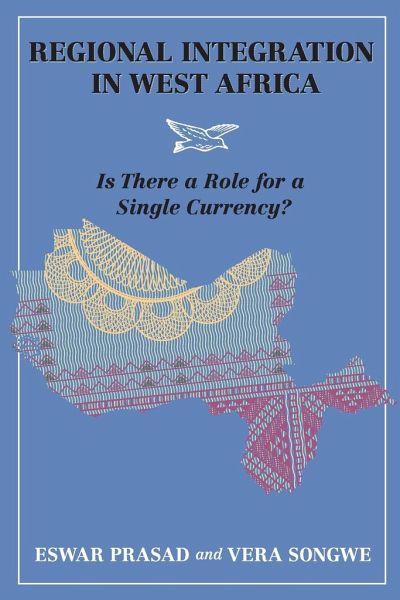
Assessing the potential benefits and risks of a currency union Leaders of the fifteen-member Economic Community of West African States (ECOWAS) have set a goal of achieving a monetary and currency union by late 2020. Although some progress has been made toward achieving this ambitious goal, major challenges remain if the region is to realize the necessary macroeconomic convergence and establish the required institutional framework in a relatively short period of time. This book, by two leading experts on economics and Africa, makes a significant analytical contribution to the debates now under…mehr
Assessing the potential benefits and risks of a currency union Leaders of the fifteen-member Economic Community of West African States (ECOWAS) have set a goal of achieving a monetary and currency union by late 2020. Although some progress has been made toward achieving this ambitious goal, major challenges remain if the region is to realize the necessary macroeconomic convergence and establish the required institutional framework in a relatively short period of time. This book, by two leading experts on economics and Africa, makes a significant analytical contribution to the debates now under way about how ECOWAS could achieve and manage its currency union, and the ramifications for the African continent.
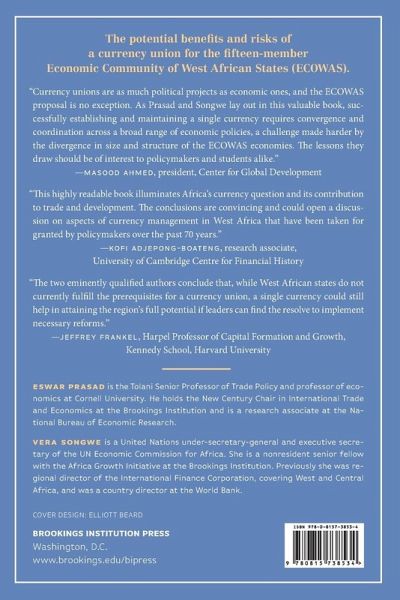
Eswar Prasad is the Tolani Senior Professor of Trade Policy and Professor of Economics at Cornell University. He holds the New Century Chair in International Economics at the Brookings Institution and is a research associate at the National Bureau of Economic Research. Vera Songwe is executive secretary of the UN Economic Commission for Africa. Previously she was regional director of the International Finance Corporation, covering West and Central Africa, and was a country director at the World Bank.
Inhaltsangabe
Contents: Acknowledgments 1. Introduction and Overview 2. Basic Analytical Considerations 3. Integration through Trade 4. Macroeconomic and Structural Convergence 5. Exchange Rate and Monetary Policy Regimes 6. Illustrative Monetary Policy Rules 7. Institutional Framework, Policy Coordination 8. The Path Forward Appendixes: A. Comparing and Contrasting Asia's and Europe's Approaches to Economic Integration B. Macroeconomic Convergence Criteria for Existing Monetary/Currency Unions C. General Equilibrium Analysis of Alternative Exchange Rate and Monetary Policy Regimes D. Details on Construction of Data for Analytical Exercises Notes Bibliography Index
Es gelten unsere Allgemeinen Geschäftsbedingungen: www.buecher.de/agb
Impressum
www.buecher.de ist ein Internetauftritt der buecher.de internetstores GmbH
Geschäftsführung: Monica Sawhney | Roland Kölbl | Günter Hilger
Sitz der Gesellschaft: Batheyer Straße 115 - 117, 58099 Hagen
Postanschrift: Bürgermeister-Wegele-Str. 12, 86167 Augsburg
Amtsgericht Hagen HRB 13257
Steuernummer: 321/5800/1497
USt-IdNr: DE450055826