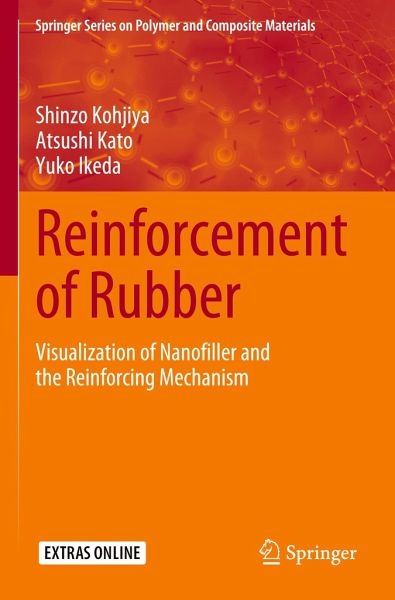
This book presents the most recent description of rubber reinforcement, focusing on the network-like structure formation of nanofiller in the rubber matrix under the presence of bound rubber. The resultant filler network is visualized by electron tomography applied to rubber. In the case of natural rubber, the self-reinforcement effect is uniquely functioning, and new template crystallization is suggested. Here, the crystallites are also believed to arrange themselves in a network-like manner. These results are of great use, particularly for engineers, in designing rubber reinforcement.
This book presents the most recent description of rubber reinforcement, focusing on the network-like structure formation of nanofiller in the rubber matrix under the presence of bound rubber. The resultant filler network is visualized by electron tomography applied to rubber. In the case of natural rubber, the self-reinforcement effect is uniquely functioning, and new template crystallization is suggested. Here, the crystallites are also believed to arrange themselves in a network-like manner. These results are of great use, particularly for engineers, in designing rubber reinforcement.
Produktdetails
Produktdetails
Springer Series on Polymer and Composite Materials
Yuko Ikeda received her bachelor's degree in 1984 and master's degree in 1986 at Kyoto Institute of Technology (KIT). In 1991, she obtained her Doctorate in Engineering at Kyoto University. She was a visiting researcher in University of Bayreuth, Germany in 1993, and was dispatched to Texas Christian University, USA in 1996 as a researcher in the Ministry of Culture and Foreign Affairs of Japan. From 2016 to 2021, she was a director of Center for Rubber Science and Technology in KIT. She is currently an academic advisor at Research Institute for Production Development, a professor emeritus at KIT, and a part-time lecturer at University of Fukui. She has conducted all fundamentals of rubber science, in particular, characterization of natural rubber. Her current research is focused on vulcanization of rubber (JSPS Research Fellowship (B) (Grant No. JP22H02144)). She has published 144 papers, 73 review articles, 48 book chapters and 5 books. In 2014, she was the first female scientistto receive the 29th Oenslager award from The Society of Rubber Science and Technology, Japan. She has 34 years of teaching experience at KIT. Atsushi Kato received his Ph.D. from Tohoku University in 1985. His research interests include synthesis of aliphatic polysulfides by phase-transfer-catalyzed polycondensation of dibromoalkanes with dithiols, unusual stress-strain properties of natural rubber vulcanizates with high primary molecular weight, fatigue characteristics of glass fiber-reinforced polyamide, study on microfracture mechanism of glass fiber-reinforced polycarbonate by using acoustic emission, optical transparency and silica network in cross-linked natural rubber as revealed by spectroscopic and three-dimensional transmission electron microscopy technique, reinforcement mechanism of carbon black in natural rubber vulcanizates, and so on. He is currently working on development of analysis technology of soft materials at the phenomenological analysis department of NISSAN ARC, LTD. He won the Materials Life Society Review Award from the Materials Life Society, Japan, in 2009, and the Rubber-Technical Merit Award from the Society of Rubber Science and Technology, Japan, in 2012. Shinzo Kohiya received his Ph.D. from Kyoto University in 1974. His research interests include kinetic studies on ionic polymerizations, development of soft rubbery materials of high functionality, structural studies on polymeric amorphous materials and their applications, and scientific elucidation of filler dispersion in rubbery matrix. He is currently a professor emeritus, Kyoto University. He is the author of several books, and about 350 papers which appeared in decent international journals. He won the Oenslager award from¿ the Chemical Society of Japan, in 1994. He has 23 years, 13 years, and 3 years of teaching experiences at Kyoto Institute of Technology, Kyoto University, and Mahidol University in Thailand, respectively. Yukio Nakajima received her Ph.D. from the University of Akron in 1985. His research interests include the technological development based on tire mechanics, numerical simulation, and experiments. He is currently the technology consultant for tire mechanics after retiring the Kogakuin University. He is the author of the book "Advanced Tire Mechanics", published 72 articles and contributed to 7 books. He won the best paper awards three times from Tire Society and once from FISITA, the contribution award to rubber industry from the society of rubber industry, the Bekker-Reece-Radforth Award from ISTVS, the patent award twice, the president award three times, and the new technology award three times from Bridgestone Corporation. He has 33 years of tire research at Bridgestone Corp. and 10 years of teaching experience at the Kogakuin University.
Inhaltsangabe
Part I Filler Reinforcement of Rubber.- 1. Rubbery Materials and Soft Nanocomposites.- 2. Filler and Rubber Reinforcement.- Part II Analysis of Nanofiller Dispersion in Rubber Matrix.- 3. Principle and Practice of Three-Dimensional Transmission Electron Microscope (3D-TEM).- 4. Nanofiller Dispersion in Rubber as Revealed by 3D-TEM.- 5. Reinforcing Mechanism of Rubber by Nanofiller.- Part III Non-Carbon Reinforcement of Rubber.- 6. Particulate Silica Reinforcement of Rubber.- 7. Rubber Reinforcement with Lignin.- 8. Self-Reinforcement in Natural Rubber: Template Crystallization.- Part IV Prospective Views on Rubber Reinforcement.- 9. Reinforcement in the Twenty-First Century.
Part I Filler Reinforcement of Rubber.- 1. Rubbery Materials and Soft Nanocomposites.- 2. Filler and Rubber Reinforcement.- Part II Analysis of Nanofiller Dispersion in Rubber Matrix.- 3. Principle and Practice of Three-Dimensional Transmission Electron Microscope (3D-TEM).- 4. Nanofiller Dispersion in Rubber as Revealed by 3D-TEM.- 5. Reinforcing Mechanism of Rubber by Nanofiller.- Part III Non-Carbon Reinforcement of Rubber.- 6. Particulate Silica Reinforcement of Rubber.- 7. Rubber Reinforcement with Lignin.- 8. Self-Reinforcement in Natural Rubber: Template Crystallization.- Part IV Prospective Views on Rubber Reinforcement.- 9. Reinforcement in the Twenty-First Century.
Es gelten unsere Allgemeinen Geschäftsbedingungen: www.buecher.de/agb
Impressum
www.buecher.de ist ein Internetauftritt der buecher.de internetstores GmbH
Geschäftsführung: Monica Sawhney | Roland Kölbl | Günter Hilger
Sitz der Gesellschaft: Batheyer Straße 115 - 117, 58099 Hagen
Postanschrift: Bürgermeister-Wegele-Str. 12, 86167 Augsburg
Amtsgericht Hagen HRB 13257
Steuernummer: 321/5800/1497
USt-IdNr: DE450055826