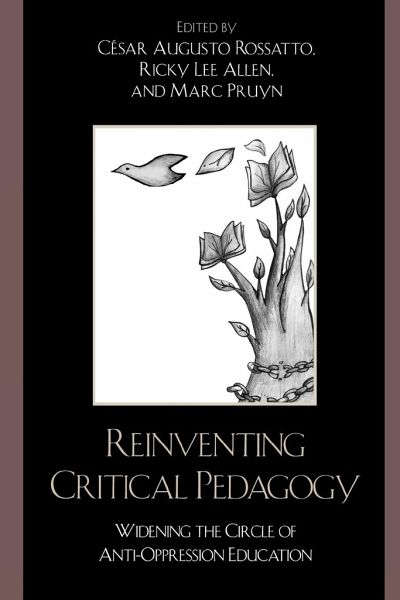
Reinventing Critical Pedagogy is divided into three thematic areas: 'Race, Ethnicity, and Critical Pedagogy,' which exposes the pervasiveness of white supremacy and ethnic conflict; 'Theoretical Concerns,' in which authors rethink the basic premises of capitalism, alienation, experience, religion, and social justice through a critical theory lens, a critical pedagogy staple; finally, 'Applications, Extensions, and Empirical Studies' looks at undertheorized and underrepresented areas in critical pedagogy-gender, math education, pseudo-science, global literacy, and stories of successful resistance.…mehr
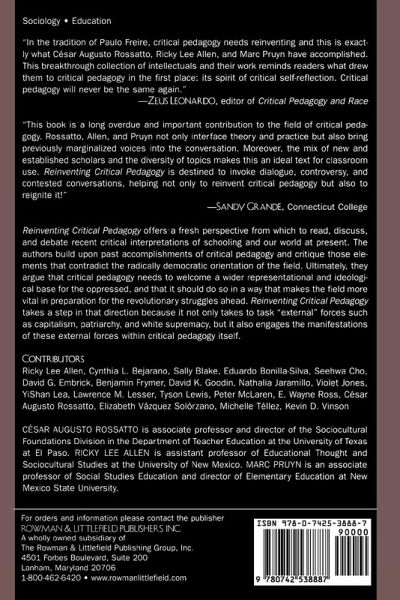
Reinventing Critical Pedagogy is divided into three thematic areas: 'Race, Ethnicity, and Critical Pedagogy,' which exposes the pervasiveness of white supremacy and ethnic conflict; 'Theoretical Concerns,' in which authors rethink the basic premises of capitalism, alienation, experience, religion, and social justice through a critical theory lens, a critical pedagogy staple; finally, 'Applications, Extensions, and Empirical Studies' looks at undertheorized and underrepresented areas in critical pedagogy-gender, math education, pseudo-science, global literacy, and stories of successful resistance.
César Augusto Rossatto is Associate Professor and Director of the Sociocultural Foundations Division in the Department of Teacher Education at the University of Texas at El Paso. He is author of numerous publications including: Engaging Paulo Freire's Pedagogy of Possibility: From Blind to Transformative Optimism (Rowman and Littlefield). He is founder of Paulo Freire SIG (Special Interest Group) at AERA (American Education Research Association). He is founder and chair of the First, Second, and Third International Conference on Education, Labor and Emancipation http://academics.utep.edu/confele. He teaches courses in critical pedagogy, multiculturalism, education for social justice, sociology of education. He is committed to dialectic and dialogical education and praxis for the liberation of disenfranchised groups. He is also well versed on organizational politics, international and urban education in the U.S. and Latin America. His main research interests are: globalization and neoliberalism in the U.S.-Mexican border region; Brazilian identity formation and social relations in United States, and their implications for schooling; the phenomena of fatalism and optimism in relation to social classes' differences; the application of critical pedagogy; and the origins and effects of whiteness in Brazil and in the United States.
Inhaltsangabe
Chapter 1 The Race Problem in the Critical Pedagogy Community Chapter 2 Racism without Racists: 'Killing Me Softly' with Color Blindness Chapter 3 Violence, Discourse and Dixieland: A Critical Reflection of an Incident Involving Violence against Black Youth Chapter 4 Latino Youths at the Crossroads of Sameness and Difference: Engaging Border Theory to Create Critical Epistemologies on Border Identity Chapter 5 Education as a State of Exception: Unraveling the Heart of the School-to-Prison Pipeline Chapter 6 Some Reflections on Critical Pedagogy in an Age of Global Empire Chapter 7 Youth Alienation in Everyday Life: The Promise of Critical Pedagogy Chapter 8 Is Religion Still the Opium of the People? Critical Pedagogy, Liberation Theology and the Commitment to Social Transformation Chapter 9 On Language of Possibility: Revisiting Critical Pedagogy Chapter 10 Social Justice Requires a Revolution of Everyday Life Chapter 11 Mathematical Power: Exploring Critical Pedagogy in Mathematics and Statistics Chapter 12 Teaching Ecocide: Junk Science and the Myth of Premature Extinction in Environmental Science Textbooks Chapter 13 Hooters Pedagogy: Gender in Late Capitalism Chapter 14 The Matrix of Freirean Pedagogy, Time and Cultural Literacies Chapter 15 Generating Hope, Creating Change, Searching for Community: Stories of Resistance against Globalization at the U.S./Mexico Border
Chapter 1 The Race Problem in the Critical Pedagogy Community Chapter 2 Racism without Racists: 'Killing Me Softly' with Color Blindness Chapter 3 Violence, Discourse and Dixieland: A Critical Reflection of an Incident Involving Violence against Black Youth Chapter 4 Latino Youths at the Crossroads of Sameness and Difference: Engaging Border Theory to Create Critical Epistemologies on Border Identity Chapter 5 Education as a State of Exception: Unraveling the Heart of the School-to-Prison Pipeline Chapter 6 Some Reflections on Critical Pedagogy in an Age of Global Empire Chapter 7 Youth Alienation in Everyday Life: The Promise of Critical Pedagogy Chapter 8 Is Religion Still the Opium of the People? Critical Pedagogy, Liberation Theology and the Commitment to Social Transformation Chapter 9 On Language of Possibility: Revisiting Critical Pedagogy Chapter 10 Social Justice Requires a Revolution of Everyday Life Chapter 11 Mathematical Power: Exploring Critical Pedagogy in Mathematics and Statistics Chapter 12 Teaching Ecocide: Junk Science and the Myth of Premature Extinction in Environmental Science Textbooks Chapter 13 Hooters Pedagogy: Gender in Late Capitalism Chapter 14 The Matrix of Freirean Pedagogy, Time and Cultural Literacies Chapter 15 Generating Hope, Creating Change, Searching for Community: Stories of Resistance against Globalization at the U.S./Mexico Border
Es gelten unsere Allgemeinen Geschäftsbedingungen: www.buecher.de/agb
Impressum
www.buecher.de ist ein Internetauftritt der buecher.de internetstores GmbH
Geschäftsführung: Monica Sawhney | Roland Kölbl | Günter Hilger
Sitz der Gesellschaft: Batheyer Straße 115 - 117, 58099 Hagen
Postanschrift: Bürgermeister-Wegele-Str. 12, 86167 Augsburg
Amtsgericht Hagen HRB 13257
Steuernummer: 321/5800/1497
USt-IdNr: DE450055826