
- Broschiertes Buch
- Merkliste
- Auf die Merkliste
- Bewerten Bewerten
- Teilen
- Produkt teilen
- Produkterinnerung
- Produkterinnerung
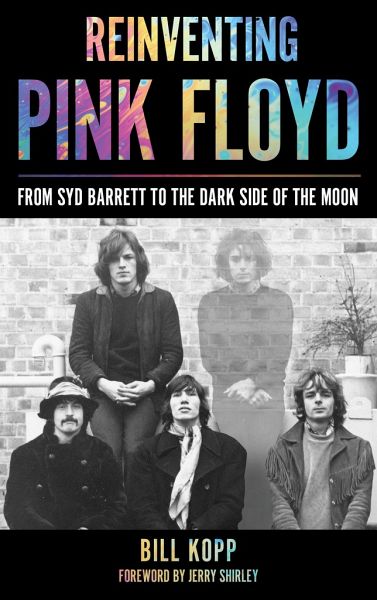
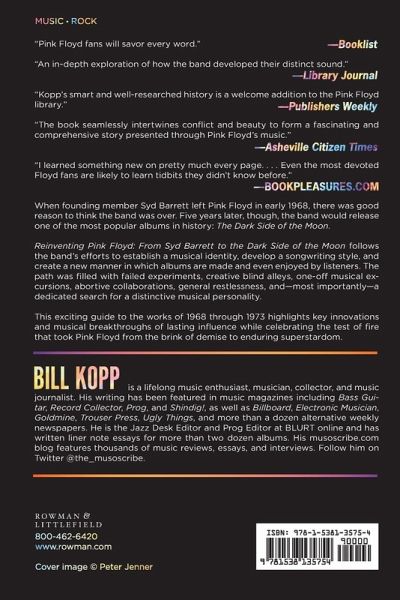
In celebration of the 40th anniversary of The Dark Side of the Moon, Bill Kopp celebrates the ingenuity with which Pink Floyd rebranded themselves following the 1968 departure of Syd Barrett. Not only did the band survive Barrettâ s departure, but it went on to release landmark albums that continue to influence generations of musicians and fans.
Andere Kunden interessierten sich auch für
 Bill KoppReinventing Pink Floyd36,99 €
 Martin PopoffPink Floyd and The Dark Side of the Moon40,99 €
 Duane TudahlPrince and the Purple Rain Era Studio Sessions53,99 €
 Duane TudahlPrince and the Purple Rain Era Studio Sessions24,99 €
 The Routledge Handbook of Pink Floyd47,99 €
 Brian JohnsonThe Lives of Brian16,99 €
 Brian JohnsonThe Lives of Brian17,99 €
-
-
-



In celebration of the 40th anniversary of The Dark Side of the Moon, Bill Kopp celebrates the ingenuity with which Pink Floyd rebranded themselves following the 1968 departure of Syd Barrett. Not only did the band survive Barrettâ s departure, but it went on to release landmark albums that continue to influence generations of musicians and fans.
Produktdetails
- Produktdetails
- Verlag: Rowman & Littlefield
- Seitenzahl: 260
- Erscheinungstermin: 14. Oktober 2019
- Englisch
- Abmessung: 229mm x 152mm x 15mm
- Gewicht: 366g
- ISBN-13: 9781538135754
- ISBN-10: 1538135752
- Artikelnr.: 57018952
- Herstellerkennzeichnung
- Libri GmbH
- Europaallee 1
- 36244 Bad Hersfeld
- gpsr@libri.de
- Verlag: Rowman & Littlefield
- Seitenzahl: 260
- Erscheinungstermin: 14. Oktober 2019
- Englisch
- Abmessung: 229mm x 152mm x 15mm
- Gewicht: 366g
- ISBN-13: 9781538135754
- ISBN-10: 1538135752
- Artikelnr.: 57018952
- Herstellerkennzeichnung
- Libri GmbH
- Europaallee 1
- 36244 Bad Hersfeld
- gpsr@libri.de
Bill Kopp is a lifelong music enthusiast, musician, collector, and music journalist. His writing has been featured in music magazines including Bass Guitar, Record Collector, Prog, and Shindig! (all in Great Britain), as well as Billboard, Electronic Musician, Goldmine, Trouser Press, Ugly Things, and more than a dozen alternative weekly newspapers. He is the Jazz Desk Editor and Prog Editor at BLURT online and has written liner note essays for 20 albums, including titles by Julian "Cannonball" Adderley, Larry Coryell, Edgar Winter, Rick Wakeman, the Ventures, Dave Mason, and Iron Butterfly. He has interviewed several hundred musicians and music industry figures of note, and his musoscribe.com blog features thousands of music reviews, essays, and interviews. Follow him on Twitter @the_musoscribe.
Introduction
Historical and musical contextualization of early Pink Floyd with Syd
Barrett as leader
Discussion of the group's reliance on Barrett
Apples and Oranges: 1967- Defining characteristics in Barrett's songwriting
and musical approach
This early period features a band focused almost solely on the
compositions, vocals and distinctive guitar work of Roger Keith "Syd"
Barrett, the group's original leader. The studio songs of this period are
characterized by a childlike wonder, filtered through the influences of
English classical literature and LSD.
The Piper at the Gates of Dawn and singles - Barrett's studio work as an
exemplar of "Summer of Love" musical ethosReaction in G: Cambridge St/ation
- Pink Floyd's live shows of the era were distinctly different from the
band's studio output, and would provide more of a template for the band's
future direction.BBC One: Continu/ation - Live performances for radio
bridged the gap between the band's live and studio approaches.
Point Me at the Sky: 1968 - Syd leaves; the band begins again in his shadow
Reeling from the loss of both its leader and management, Pink Floyd
struggles to develop new material that continues where Syd Barrett;s music
left off.
Searching for a Sound: A Saucerful of Secrets - Losing its leader halfway
through the making of an album means Pink Floyd has to draw upon its live
set for ideas. The group quickly moves away form pop song
structure.Soundtrack One: Tonite Let's All Make Love in London - Without
even trying, the band makes its first foray into the world of film
soundtrack work.BBC Two: Germin/ation and Continua/tion - The band works
hard for commercial success via multiple television appearances and
additional soundtrack work (The Committee)
The Narrow Way: 1969 - Developing a distinct identity
Guitarist David Gilmour takes on a more active role. The loss of the band's
primary songwriter and creative visionary found the group adrift
artistically, searching for a new and distinctive musical direction.
Nonetheless, some of the group's most enduring work was creative during
this period of exploration and experimentation, setting the tone for the
future.
Soundtrack Two: More - Pink Floyd makes its first serious journey into the
world of composiing music for motion pictures.Live work vs. Studio
Experiments: Ummagumma - Double-album highlights the group beginning to
reconcile the differences between its live performance and studio work; the
lines between the two begin to blur.The Man and the Journey: Dramatis/ation
- An early conceptual work aims to combine scattered individual songs into
a cohesive, semi-narrative extended work, presaging The Dark Side of the
MoonRemergence: 1970 - Increased musical risks yield rewards and setbacks
Pink Floyd explores long-form musical composition in live performance while
pursuing soundtrack opportunities that showcase a different side of the
band and provide clues to the future.
Epic song structure: Atom Heart Mother - Expanding its sound to include a
full orchestra and choir, the group collaborates closely with avant-garde
composer Ron Geesin.Soundtrack Three: Zabriskie Point - The band's
ambient-leaning tendencies are explored in a suite of songs and incidental
music created for film.Soundtrack Four: Music from The Body - Album marks
the first outside venture by a Pink Floyd member (post-Syd Barret) and
develops some musical ideas that will reappear on The Dark Side of the
Moon.BBC Three: Devi/ation - Developed onstage rather than in the studio,
the band's extended set-pieces preview the direction Pink Floyd's music
would take for the rest of its time as a group.
Biding My Time: 1971 - In-depth pursuit of promising musical approaches
Learning from the experience of working with a collaborator, the group
retreats into itself, combining its strengths onto a single album.
Refining the Formula: Meddle - Continuing its approach of developing
long-form musical works onstage, Pink Floyd creates one of its most
enduring work. BBC Four: Reverber/ation - Once again the band reconciles
its studio work (specifically, pop-length songs) with long-form
explorations; BBC performances of this era are the most accurate
representations of the band's growth. Odds and Ends: Relics - Scattered
non-album tracks and previously-unreleased material shows both how the band
has changed and maintained some of its original ideas.
Burning Bridges: 1972 - Leaving Syd's influence behind and looking to the
future
A distinct musical personality emerges, and the group once again attempts
collaboration with outside artists, most notably filmmaker Adrian Maben and
ballet choreographer Roland Petit.
Soundtrack Four: La Valée (Obscured by Clouds) - Pink Floyd embarks on its
final film soundtrack project.Wot's . Uh the Deal: Obfusc/ation - The band
attempts to combine music and ballet, with mixed results.Echoes: Live at
Pompeii - A live performance in ancient coliseum ruins serves as the final
word on Pink Floyd's transitional years, while previewing the future.
The Great Gig in the Sky: 1973 - Creating the perfect album
The synthesis of everything the band has learned in the previous five
years.
Perfecting the Formula: The Dark Side of the Moon
Oh, By the Way: 1974 and Beyond
Conclusion
Historical and musical contextualization of early Pink Floyd with Syd
Barrett as leader
Discussion of the group's reliance on Barrett
Apples and Oranges: 1967- Defining characteristics in Barrett's songwriting
and musical approach
This early period features a band focused almost solely on the
compositions, vocals and distinctive guitar work of Roger Keith "Syd"
Barrett, the group's original leader. The studio songs of this period are
characterized by a childlike wonder, filtered through the influences of
English classical literature and LSD.
The Piper at the Gates of Dawn and singles - Barrett's studio work as an
exemplar of "Summer of Love" musical ethosReaction in G: Cambridge St/ation
- Pink Floyd's live shows of the era were distinctly different from the
band's studio output, and would provide more of a template for the band's
future direction.BBC One: Continu/ation - Live performances for radio
bridged the gap between the band's live and studio approaches.
Point Me at the Sky: 1968 - Syd leaves; the band begins again in his shadow
Reeling from the loss of both its leader and management, Pink Floyd
struggles to develop new material that continues where Syd Barrett;s music
left off.
Searching for a Sound: A Saucerful of Secrets - Losing its leader halfway
through the making of an album means Pink Floyd has to draw upon its live
set for ideas. The group quickly moves away form pop song
structure.Soundtrack One: Tonite Let's All Make Love in London - Without
even trying, the band makes its first foray into the world of film
soundtrack work.BBC Two: Germin/ation and Continua/tion - The band works
hard for commercial success via multiple television appearances and
additional soundtrack work (The Committee)
The Narrow Way: 1969 - Developing a distinct identity
Guitarist David Gilmour takes on a more active role. The loss of the band's
primary songwriter and creative visionary found the group adrift
artistically, searching for a new and distinctive musical direction.
Nonetheless, some of the group's most enduring work was creative during
this period of exploration and experimentation, setting the tone for the
future.
Soundtrack Two: More - Pink Floyd makes its first serious journey into the
world of composiing music for motion pictures.Live work vs. Studio
Experiments: Ummagumma - Double-album highlights the group beginning to
reconcile the differences between its live performance and studio work; the
lines between the two begin to blur.The Man and the Journey: Dramatis/ation
- An early conceptual work aims to combine scattered individual songs into
a cohesive, semi-narrative extended work, presaging The Dark Side of the
MoonRemergence: 1970 - Increased musical risks yield rewards and setbacks
Pink Floyd explores long-form musical composition in live performance while
pursuing soundtrack opportunities that showcase a different side of the
band and provide clues to the future.
Epic song structure: Atom Heart Mother - Expanding its sound to include a
full orchestra and choir, the group collaborates closely with avant-garde
composer Ron Geesin.Soundtrack Three: Zabriskie Point - The band's
ambient-leaning tendencies are explored in a suite of songs and incidental
music created for film.Soundtrack Four: Music from The Body - Album marks
the first outside venture by a Pink Floyd member (post-Syd Barret) and
develops some musical ideas that will reappear on The Dark Side of the
Moon.BBC Three: Devi/ation - Developed onstage rather than in the studio,
the band's extended set-pieces preview the direction Pink Floyd's music
would take for the rest of its time as a group.
Biding My Time: 1971 - In-depth pursuit of promising musical approaches
Learning from the experience of working with a collaborator, the group
retreats into itself, combining its strengths onto a single album.
Refining the Formula: Meddle - Continuing its approach of developing
long-form musical works onstage, Pink Floyd creates one of its most
enduring work. BBC Four: Reverber/ation - Once again the band reconciles
its studio work (specifically, pop-length songs) with long-form
explorations; BBC performances of this era are the most accurate
representations of the band's growth. Odds and Ends: Relics - Scattered
non-album tracks and previously-unreleased material shows both how the band
has changed and maintained some of its original ideas.
Burning Bridges: 1972 - Leaving Syd's influence behind and looking to the
future
A distinct musical personality emerges, and the group once again attempts
collaboration with outside artists, most notably filmmaker Adrian Maben and
ballet choreographer Roland Petit.
Soundtrack Four: La Valée (Obscured by Clouds) - Pink Floyd embarks on its
final film soundtrack project.Wot's . Uh the Deal: Obfusc/ation - The band
attempts to combine music and ballet, with mixed results.Echoes: Live at
Pompeii - A live performance in ancient coliseum ruins serves as the final
word on Pink Floyd's transitional years, while previewing the future.
The Great Gig in the Sky: 1973 - Creating the perfect album
The synthesis of everything the band has learned in the previous five
years.
Perfecting the Formula: The Dark Side of the Moon
Oh, By the Way: 1974 and Beyond
Conclusion
Introduction
Historical and musical contextualization of early Pink Floyd with Syd
Barrett as leader
Discussion of the group's reliance on Barrett
Apples and Oranges: 1967- Defining characteristics in Barrett's songwriting
and musical approach
This early period features a band focused almost solely on the
compositions, vocals and distinctive guitar work of Roger Keith "Syd"
Barrett, the group's original leader. The studio songs of this period are
characterized by a childlike wonder, filtered through the influences of
English classical literature and LSD.
The Piper at the Gates of Dawn and singles - Barrett's studio work as an
exemplar of "Summer of Love" musical ethosReaction in G: Cambridge St/ation
- Pink Floyd's live shows of the era were distinctly different from the
band's studio output, and would provide more of a template for the band's
future direction.BBC One: Continu/ation - Live performances for radio
bridged the gap between the band's live and studio approaches.
Point Me at the Sky: 1968 - Syd leaves; the band begins again in his shadow
Reeling from the loss of both its leader and management, Pink Floyd
struggles to develop new material that continues where Syd Barrett;s music
left off.
Searching for a Sound: A Saucerful of Secrets - Losing its leader halfway
through the making of an album means Pink Floyd has to draw upon its live
set for ideas. The group quickly moves away form pop song
structure.Soundtrack One: Tonite Let's All Make Love in London - Without
even trying, the band makes its first foray into the world of film
soundtrack work.BBC Two: Germin/ation and Continua/tion - The band works
hard for commercial success via multiple television appearances and
additional soundtrack work (The Committee)
The Narrow Way: 1969 - Developing a distinct identity
Guitarist David Gilmour takes on a more active role. The loss of the band's
primary songwriter and creative visionary found the group adrift
artistically, searching for a new and distinctive musical direction.
Nonetheless, some of the group's most enduring work was creative during
this period of exploration and experimentation, setting the tone for the
future.
Soundtrack Two: More - Pink Floyd makes its first serious journey into the
world of composiing music for motion pictures.Live work vs. Studio
Experiments: Ummagumma - Double-album highlights the group beginning to
reconcile the differences between its live performance and studio work; the
lines between the two begin to blur.The Man and the Journey: Dramatis/ation
- An early conceptual work aims to combine scattered individual songs into
a cohesive, semi-narrative extended work, presaging The Dark Side of the
MoonRemergence: 1970 - Increased musical risks yield rewards and setbacks
Pink Floyd explores long-form musical composition in live performance while
pursuing soundtrack opportunities that showcase a different side of the
band and provide clues to the future.
Epic song structure: Atom Heart Mother - Expanding its sound to include a
full orchestra and choir, the group collaborates closely with avant-garde
composer Ron Geesin.Soundtrack Three: Zabriskie Point - The band's
ambient-leaning tendencies are explored in a suite of songs and incidental
music created for film.Soundtrack Four: Music from The Body - Album marks
the first outside venture by a Pink Floyd member (post-Syd Barret) and
develops some musical ideas that will reappear on The Dark Side of the
Moon.BBC Three: Devi/ation - Developed onstage rather than in the studio,
the band's extended set-pieces preview the direction Pink Floyd's music
would take for the rest of its time as a group.
Biding My Time: 1971 - In-depth pursuit of promising musical approaches
Learning from the experience of working with a collaborator, the group
retreats into itself, combining its strengths onto a single album.
Refining the Formula: Meddle - Continuing its approach of developing
long-form musical works onstage, Pink Floyd creates one of its most
enduring work. BBC Four: Reverber/ation - Once again the band reconciles
its studio work (specifically, pop-length songs) with long-form
explorations; BBC performances of this era are the most accurate
representations of the band's growth. Odds and Ends: Relics - Scattered
non-album tracks and previously-unreleased material shows both how the band
has changed and maintained some of its original ideas.
Burning Bridges: 1972 - Leaving Syd's influence behind and looking to the
future
A distinct musical personality emerges, and the group once again attempts
collaboration with outside artists, most notably filmmaker Adrian Maben and
ballet choreographer Roland Petit.
Soundtrack Four: La Valée (Obscured by Clouds) - Pink Floyd embarks on its
final film soundtrack project.Wot's . Uh the Deal: Obfusc/ation - The band
attempts to combine music and ballet, with mixed results.Echoes: Live at
Pompeii - A live performance in ancient coliseum ruins serves as the final
word on Pink Floyd's transitional years, while previewing the future.
The Great Gig in the Sky: 1973 - Creating the perfect album
The synthesis of everything the band has learned in the previous five
years.
Perfecting the Formula: The Dark Side of the Moon
Oh, By the Way: 1974 and Beyond
Conclusion
Historical and musical contextualization of early Pink Floyd with Syd
Barrett as leader
Discussion of the group's reliance on Barrett
Apples and Oranges: 1967- Defining characteristics in Barrett's songwriting
and musical approach
This early period features a band focused almost solely on the
compositions, vocals and distinctive guitar work of Roger Keith "Syd"
Barrett, the group's original leader. The studio songs of this period are
characterized by a childlike wonder, filtered through the influences of
English classical literature and LSD.
The Piper at the Gates of Dawn and singles - Barrett's studio work as an
exemplar of "Summer of Love" musical ethosReaction in G: Cambridge St/ation
- Pink Floyd's live shows of the era were distinctly different from the
band's studio output, and would provide more of a template for the band's
future direction.BBC One: Continu/ation - Live performances for radio
bridged the gap between the band's live and studio approaches.
Point Me at the Sky: 1968 - Syd leaves; the band begins again in his shadow
Reeling from the loss of both its leader and management, Pink Floyd
struggles to develop new material that continues where Syd Barrett;s music
left off.
Searching for a Sound: A Saucerful of Secrets - Losing its leader halfway
through the making of an album means Pink Floyd has to draw upon its live
set for ideas. The group quickly moves away form pop song
structure.Soundtrack One: Tonite Let's All Make Love in London - Without
even trying, the band makes its first foray into the world of film
soundtrack work.BBC Two: Germin/ation and Continua/tion - The band works
hard for commercial success via multiple television appearances and
additional soundtrack work (The Committee)
The Narrow Way: 1969 - Developing a distinct identity
Guitarist David Gilmour takes on a more active role. The loss of the band's
primary songwriter and creative visionary found the group adrift
artistically, searching for a new and distinctive musical direction.
Nonetheless, some of the group's most enduring work was creative during
this period of exploration and experimentation, setting the tone for the
future.
Soundtrack Two: More - Pink Floyd makes its first serious journey into the
world of composiing music for motion pictures.Live work vs. Studio
Experiments: Ummagumma - Double-album highlights the group beginning to
reconcile the differences between its live performance and studio work; the
lines between the two begin to blur.The Man and the Journey: Dramatis/ation
- An early conceptual work aims to combine scattered individual songs into
a cohesive, semi-narrative extended work, presaging The Dark Side of the
MoonRemergence: 1970 - Increased musical risks yield rewards and setbacks
Pink Floyd explores long-form musical composition in live performance while
pursuing soundtrack opportunities that showcase a different side of the
band and provide clues to the future.
Epic song structure: Atom Heart Mother - Expanding its sound to include a
full orchestra and choir, the group collaborates closely with avant-garde
composer Ron Geesin.Soundtrack Three: Zabriskie Point - The band's
ambient-leaning tendencies are explored in a suite of songs and incidental
music created for film.Soundtrack Four: Music from The Body - Album marks
the first outside venture by a Pink Floyd member (post-Syd Barret) and
develops some musical ideas that will reappear on The Dark Side of the
Moon.BBC Three: Devi/ation - Developed onstage rather than in the studio,
the band's extended set-pieces preview the direction Pink Floyd's music
would take for the rest of its time as a group.
Biding My Time: 1971 - In-depth pursuit of promising musical approaches
Learning from the experience of working with a collaborator, the group
retreats into itself, combining its strengths onto a single album.
Refining the Formula: Meddle - Continuing its approach of developing
long-form musical works onstage, Pink Floyd creates one of its most
enduring work. BBC Four: Reverber/ation - Once again the band reconciles
its studio work (specifically, pop-length songs) with long-form
explorations; BBC performances of this era are the most accurate
representations of the band's growth. Odds and Ends: Relics - Scattered
non-album tracks and previously-unreleased material shows both how the band
has changed and maintained some of its original ideas.
Burning Bridges: 1972 - Leaving Syd's influence behind and looking to the
future
A distinct musical personality emerges, and the group once again attempts
collaboration with outside artists, most notably filmmaker Adrian Maben and
ballet choreographer Roland Petit.
Soundtrack Four: La Valée (Obscured by Clouds) - Pink Floyd embarks on its
final film soundtrack project.Wot's . Uh the Deal: Obfusc/ation - The band
attempts to combine music and ballet, with mixed results.Echoes: Live at
Pompeii - A live performance in ancient coliseum ruins serves as the final
word on Pink Floyd's transitional years, while previewing the future.
The Great Gig in the Sky: 1973 - Creating the perfect album
The synthesis of everything the band has learned in the previous five
years.
Perfecting the Formula: The Dark Side of the Moon
Oh, By the Way: 1974 and Beyond
Conclusion